Visit to China, Tibet and Japan
Part 1
Sep/Oct 2016
Our visit to China, Tibet and Japan concluding with a tour of Hong Kong lasted exactly one month! People asked me how we were ever going to live out of suitcases and move from place to place for that long! We ourselves were wondering about this. But the visit went off almost seamlessly and we enjoyed every moment! The “almost” will be reserved for the adventure we had prior to landing in Tibet which will be shared later. But thanks to the superb arrangements by Lakshmi Travels, we had a wonderful time.
Normally I like to give a somewhat detailed description of all that we saw, but to do so this time would almost result in a book! So in the interest of holding the reader’s interest, I have to reluctantly keep it brief, highlighting only the anecdotes that will make it more personal for my fellow travelers and readers. Suffice here to say that China was amazing in many ways. I had been turning a cold shoulder toward this magnificent country, thinking that all it had was a wall and a great square. But I was soooo wrong! The places, the people, the discipline, all impressed our whole group deeply. As we made our way through the country seeing destinations that were not always visited by the average tourist, our amazement grew and looking back at the pictures we took, we can only conclude that it is definitely a “bucket list” country to see. And guess what? We did not have to reset our watches, the time difference was exactly 12 hours from EST.


As has been commonly done before, our wonderful group converged from various parts of the US and met at our final starting point of Beijing. Our smaller group from Newark travelled via Hong Kong. Made sense as we returned home after visiting Hong Kong. The journey was long, but Cathay Pacific was a wonderful airline to travel on. As it was not peak rush either, we could spread out a little and did not feel packed in like sheep! Eventually we arrived in Beijing and were met by a local English speaking Chinese guide as well as our super efficient Tour Guide, Amita Suvarna from Thomas Cook. She stayed with us all the way including our Tibet tour and returned with us to Shanghai. Our Chinese guide, (usually local guides met us in each town, they were all friendly and well informed) gave us a glimpse of what young people have to deal with in China. Housing affordability in cities was very difficult, to own a car license plate one had to enter a lottery and even with marriage, it was a matter of “no money, no honey!” We had dinner at the local Taj Indian restaurant and were pleasantly surprised to find some South Indian items like sambar and rasam, no doubt ordered for our group!

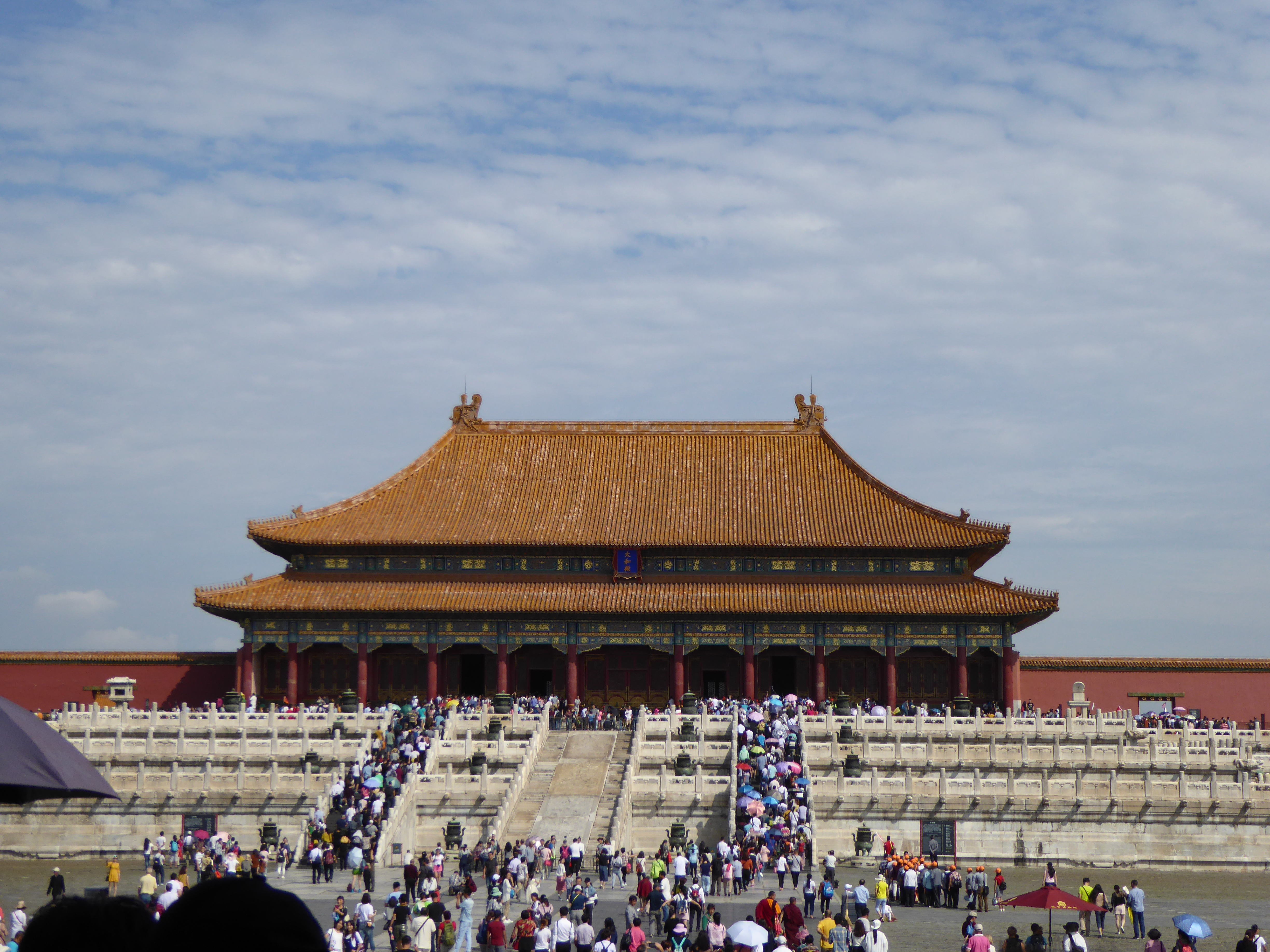
After a nice breakfast at the beautiful hotel we stayed at (definitely these luxury hotels, four stars and above, eased the pinpricks of travel!) we were ready for our first big day of sightseeing. It was Beijing’s best. The weather co-operated, providing us with sunshine and warmth, though it was fall. The Forbidden City was the first stop. In the olden days circa 1406-1420 when it was built, only the royals were allowed to reside here and the city was forbidden to commoners, other than those who served. It is one of the largest wooden structures to be built anywhere in the world. In the reign of the Ming dynasty, it was the seat of power for 24 emperors over the course of 491 years. Official business was carried out in its huge courtyards and buildings. The yellow and red colors, meticulously maintained, had eye appeal while the courtyards beyond endless courtyards provided as with good exercise and the sights kept us wonderstruck and entertained. The inner courts included former residences of royalty and commoners serving the Emperors. As each one was allowed to have up to 3,000 wives or concubines, the population housed within was high. However no one lives here now and parts have been converted to a museum containing beautiful artifacts, but we did not have the time to see this. We did catch views of thrones in cordoned off rooms and could have an idea of the opulence of that era. Among the impressive sights were the Gate of the Heavenly Purity and layer after layer of buildings, gates and squares. The entire area was spotless, not a single store or vendor in sight. Just walking through all the gates, climbing each higher level and ultimately being rewarded with a grand view of the surrounding mountains was exercise as well as entertainment for the morning!
Tian’an Men Square
 Next the iconic Tian’an Men Square (this is the official spelling!). Probably the largest in the world, it has a central commemorative monument. We were told about a 100,000 people can fit here. This was the historical place where protest was voiced but immediately silenced in the distant past. We walked around, admiring the symmetry of the gardens with splashes of color, the buildings around and appreciating the statues of the common men and women of the people’s republic at one end. The Gate of Heavenly Peace of the Forbidden City was at the other end. The next day as we headed for the Great Wall, all traffic came to a halt near the Tian’an Men Square — there was the ceremonial changing of guards and groups of working people and children in school uniform, had taken time out to pay homage.


The Great Wall of China
The Great Wall of China! This is what most people go to China to see and experience and I have heard this is visible even from outer space. Snaking over the hilly terrain for over five thousand miles, even a small section is a stupendous sight. The first section was built as far back as 221 BC and many dynasties continued to build it for protection. Around Beijing there are many locations to view and climb the wall and we were taken to a spot that was not the easiest, it appeared. Perhaps the tour gave us credit for our fitness level! It was known as the Juyongguan pass section. Many of us were able to do the steep climb for part of the way and a few, notably those from Canada, went much further up and only returned in the interest of time! Our tour leader rewarded each of us with a medal souvenir with date and name inscribed. Being a world icon, maintenance work is constantly done on the wall.


The same day we took in the Summer Palace gardens. The palace itself was not open to the public but we had a pleasant walk around part of the huge lake near it. On the way back to our hotel, a detour was made to give a view of the “Bird’s nest” structure that became the focus of the Olympics that China had hosted in the not so distant past. We also had the opportunity to have great seats and witness the lush and beautiful Golden Mask Dynasty show during our brief stay in Beijing.
Bullet Train, Shaolin Monastery
Having heard a lot about bullet trains, we were excited to board one for Zhengzhou the next morning. But no one had told us that people bring minimum luggage! With our full sized suitcase and one bulging carry on, it was quite a miracle that we made it on and off that speedy train. Our men (husbands) were amazing in packing in all the luggage in the small area provided and in the overhead shelf. Further the conductor created more space by having seats face each other and sliding smaller bags between the rows. The train was so sleek and its (other) passengers so disciplined. Our group of course created the initial excitement of loud comments, exchange of snacks and general commotion (this is what Indians do that makes us so unique!) Once we settled down to some degree of order, we noticed how quiet the train was, how imperceptible the super speeds upwards of 300 km per hour and how quiet and orderly the local Chinese were! It was a great experience and we also heard that a bullet train will soon be part of the travel routine in India!


The Shaolin temple in a beautiful mountain setting of the Shaohi mountains was a lovely rural escape after the city sojourn in Beijing. This was the birthplace of Kung Fu and even today thousands of young boys, dressed in various colored uniforms get trained in the martial art. Some even reside there for the course. The complex was so huge, it was divided into several parts that we had to use their transport system to get from one area to another. The monks also cooked us a fabulous Chinese vegetarian meal. Incidentally, most Buddhist monks are vegetarians. One small branch of monks, due to non availability of food had to turn to meat and that tradition has continued. The lunch was delicious, course upon course of fresh and lightly cooked vegetables and rice. The eggplant was so good, almost like our own South Indian curry, that we had to place a repeat order! We consumed every delectable bite.
The temple itself was in several levels and individual halls set on the mountain slopes. Originally built in 1928, it was burnt in a fire and rebuilt in the 1980s. Many original parts remained, including the topmost hall where Kung Fu was born. The original floors, still with dimples and pits caused by the hours of practice remains as a silent witness over the decades. Here we heard so many beautiful Buddhist legends. The Shakya Muni (Buddha is often referred to in this way in China) who was born in India could walk and talk as a baby and when he took little steps, a lotus appeared for each step! We too walked on the seven stone lotus flowers on the ground for good luck. We put our hand into the mouth of the turtle with a dragon head to get rich! We heard there are usually three depicted Buddhas, including a Medicine Buddha and we found this in many temples. We saw a room which was an age old library. But the most beautiful legend was that of the Standing In Snow, Prevailing, pavilion. This involved an a monk named Damu of Indian origin. He had many students but he did not share his deepest secrets with all. He had one devoted student who wished to learn everything from him. After serving for nine years, he approached his guru, but was turned back. He was told something like he would be taught only when the snow turned red! So one day, the student stood out in the snow and cut off his left arm till he bled on the white snow. The master was so touched that he immediately taught him everything and and to this day only the right hand is used to salute the seniors. His name was Kui Koh.
We then watched with wonder and a little amusement a Kung Fu demonstration when one of our own group, Dr. Ram, volunteered to participate and was declared the most sporting volunteer. Congrats Ram! Our comfortable couch then took us to Louyang for our overnight stay. How lucky we were to get a glimpse of rural China and the old world monastery where young minds and bodies are still being shaped to combat the effects of the fast pace of the modern world where children are mostly glued to their electronic “screens”. Tradition that is handed over to the next generation for safe keeping!

Fabulous Longman Caves, Gifts from Across the Globe
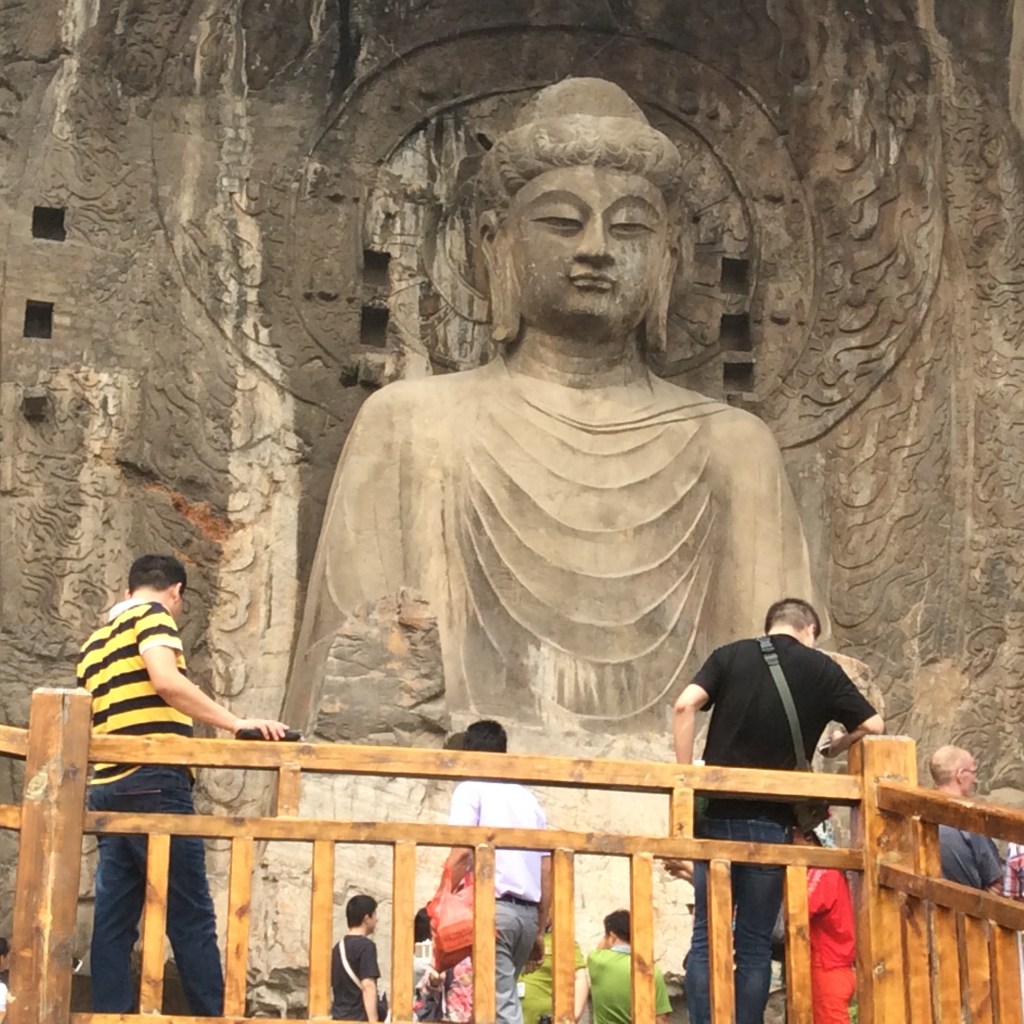
Our next day of sightseeing unfolded many more wondrous sights and legends. All along we were also blessed with gorgeous sunny, warm weather. The gods smiled on us! This day we visited the world heritage Longmen Caves and then the White Horse temple. The grottos left us speechless. There are estimated to be over a thousand caves, small and big. Most of us have never seen such beautiful, extensive or huge carvings of Buddha and his disciples right on the mountainside, one cave after another. Carved right out of the limestone cliffs, the heritage of many dynasties, they are surprisingly well preserved. We had to climb steps to get to some of the carvings but many could be viewed from ground level as well. Only photos can somewhat give a clue as to the magnitude of the edifices, but certainly we were all wonderstruck. The Buddhas had peaceful and beautiful expressions, some we were told, deliberately made to look feminine. Very reminiscent of Ajanta and Ellora caves which also feature Buddha a lot. Later we crossed a bridge and enjoyed the panoramic view from the other side.
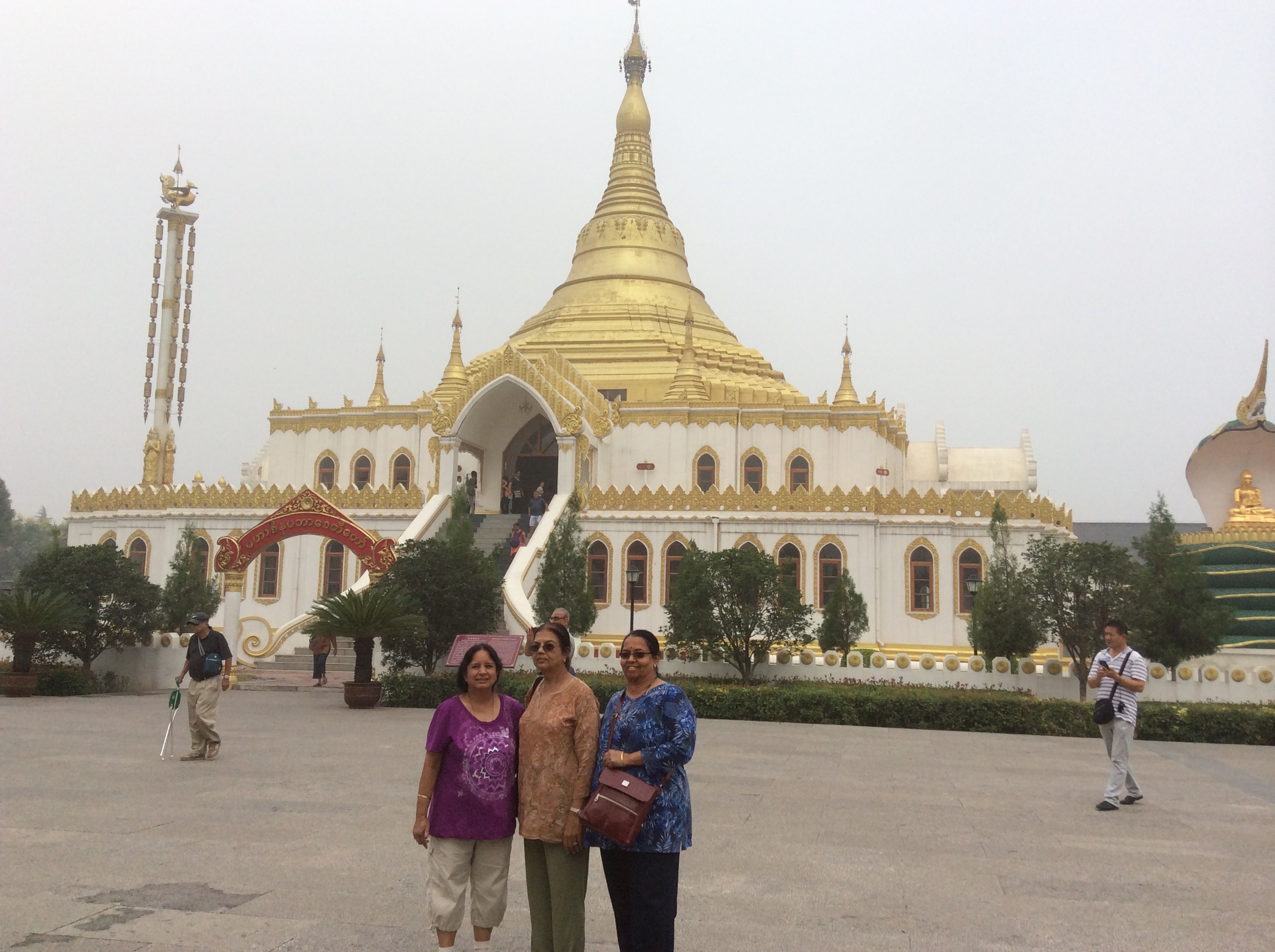
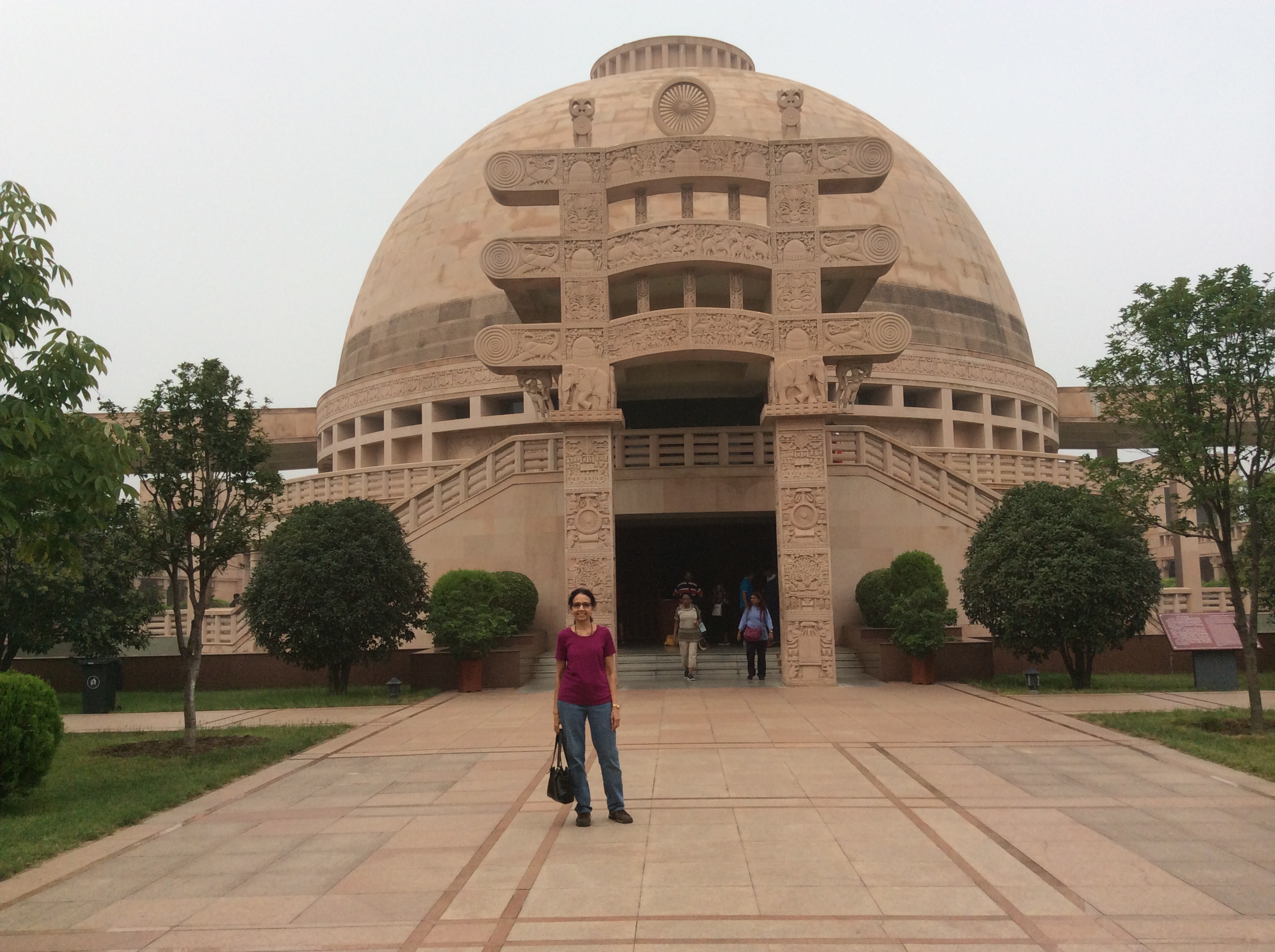
The White Horse temple, also from ancient times, started with a dream by an emperor. When he attempted to fulfill this, he met two Indian monks from Afghanistan who were invited to China and they travelled on two white horses. The temple was then built depicting Shakya Muni, (another name for Buddha) his disciples, Bodhisattvas and Arahants. The Laughing or Smiling Buddha which is the Buddha of the future, is also included at most monasteries and Buddhist temples. The art work of hollow clay statues is also a special technique of this area. Impressed as we were by the artistry of bygone days, we were in for another pleasant surprise from modern days – the huge complex had many temples gifted by different countries, including India. The Buddhist temple from Thailand, resplendent in gold and enamel was gorgeous as were some of the other temples. From India was an elegant Stupa style architecture, similar to ones found in Sanchi, Madhya Pradesh that some of us had seen. Each had its own courtyard and garden complex, one could spend an entire day there soaking in the peace and quiet ambiance.
Terracotta Warriors, Yangtze River Cruise
Our next big destination was the yet again famous Terracotta warriors of Xian and our fabulous Yangtze River Cruise. But let”s take a breather here and continue in our next installment. There is only so much that can sink in within one write-up! Throughout China we loved the simple scenery be it agricultural fields or mountains shrouded in clouds. However the rustic homes that had been the mainstay for centuries have now been replaced with multitudes of very high apartment buildings looking quite incongruous in the pastoral scenery! Some are used for relocations and others simply to generate rent, which we were told were very high, especially in towns. Many looked unoccupied. The land is always owned by the government and a 75 year lease is on even ownership abodes. After the given period expires, no one is sure what may happen.
Vegetarian Food in China
We must comment on the food! First of all, the Indian restaurants are doing amazing jobs, springing up in the remotest little towns! The food is delicious! Perhaps the group tourist stream keeps them in business. As for Chinese food, that was good too. But it took some practice to get used to the serving method! We each got plates a little bigger than a saucer with a soup bowl. The vegetables, deliciously sautéed, arrived in batches. The soup was usually watery! The rice came at the end! We had to beg for extra salt and chilly powder, given our Indian palates. The chutney and puliogare powders we had taken were also greatly utilized. Soon we learned the tricks and our tour manager arranged for the condiments and rice to be provided in the first round! We survived and to our great delight and surprise, none of the eateries had any lingering smell of seafood and all was very neat and good. Thanks to our travel agents for taking us to such good places, for providing us with superb tour managers like Amita in China and Aditi in Japan. Also for providing us with bottles of water. The hotels did too, so we were always plentifully supplied and never had to buy any.
 travelswithshamla
One thought on “China — A Visit to Remember”