Visit to China, Tibet and Japan
Sep/Oct 2016


Saying goodbye to the memorable Longmen Caves, we turned our attention to the next destination, Xian, or rather focused on getting on and off another fast train! Upon reaching our destination our first visit was to the Wild Goose pavilion. Do you recall that there are some Buddhists that are not vegetarian? Well, the legend here corroborates that. There was a time when a Hinayana Buddhist sect was starving and desperate for food. A group of geese was flying overhead and one goose fell down dead near the monks. They took it as a sign that it was all right to eat meat and the tradition was thus started.
Our local guide told us that the Wild Goose pavilion with its old style beauty was also a very popular tourist attraction in Xian after the Terracotta warriors. The tall pagoda which we viewed lighted up at night as well as during the day, was quite imposing. Nearby a garden featuring two camels sculpted out of the plants and some kite sellers also attracted us. The town itself was of great historical significance with its 14 dynasties, Qing to Qin we were told. China had been very fragmented before the intelligent emperors unified it, starting with the first one who was Qin Shi Huang. Among the great practices initiated were that of currency, measurement, script and seals and the Great Wall was also started during this time. His tomb took 37 years to build. In ancient China, the afterlife was equally important. It was camouflaged as a hillock. Later jeweler, jade, concubines and guards were all found buried with him! Terra Cotta warriors stood guard near his tomb. I had ventured a guess in my mind that the soldiers were to fool invaders, but no! For his afterlife, he wished to have an army that was indestructible, maybe not real men, but created warriors.
Terracotta Warriors
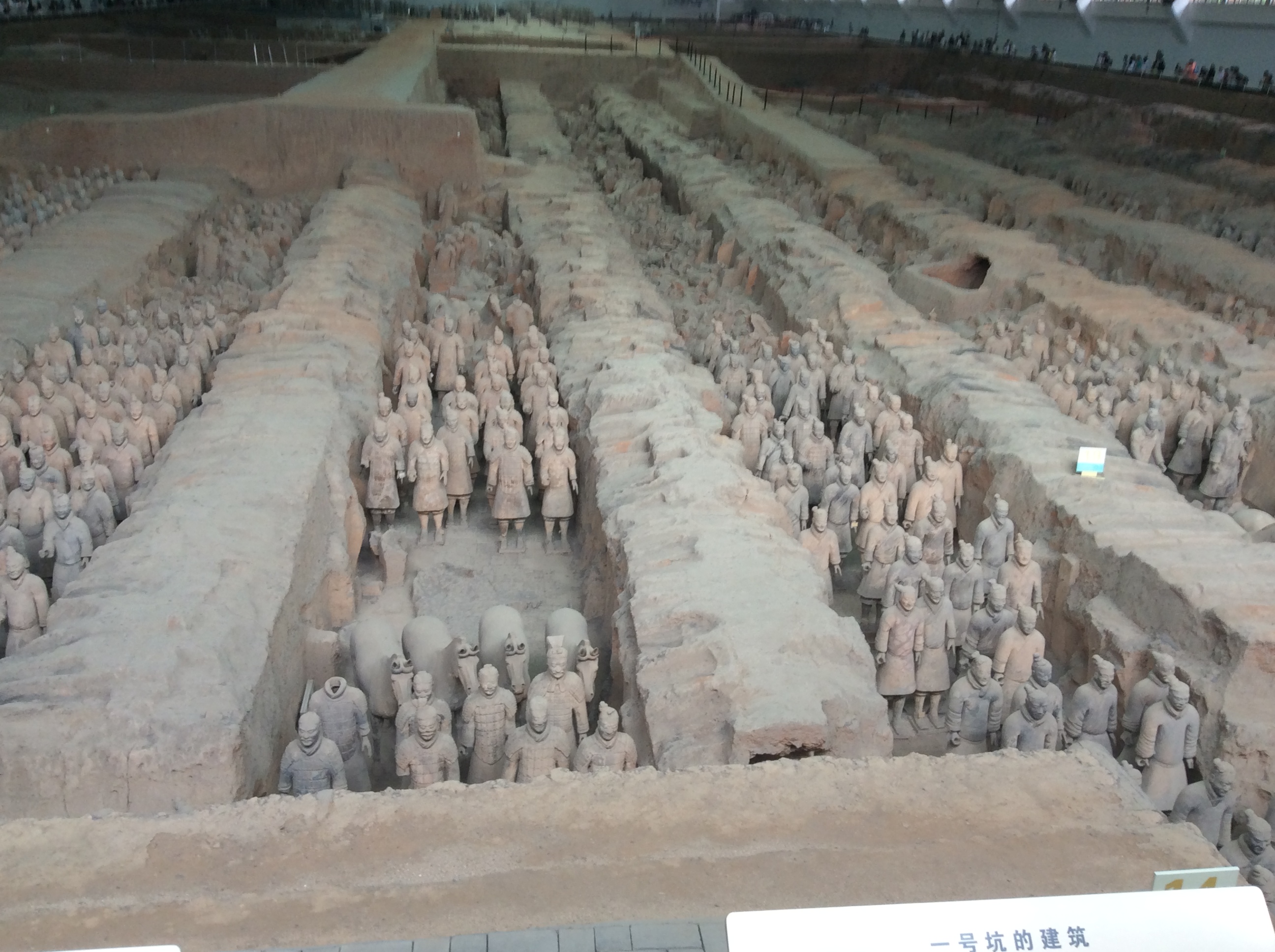
The visit to the site of the Terra Cotta warriors was unforgettable. None of us (except maybe those who googled ahead) were prepared for the magnitude of the excavations nor its preserved forms. Due to the Cultural Revolution, this secret lay buried although a few soldiers had been discovered and many knew that a huge cache was waiting to be unearthed. Thanks to some well diggers and curious journalists it was found as late as the mid 1970s and finally the government took over and oversaw the excavations and preservations. Today there are several pits, the first two worth spending time at. Here, from an elevated platform that goes all around the huge dug out enclosed area, one can see larger than life sized warriors, depicting soldiers from all over China. In authentic costumes and hair style of the period, they were of clay, with some wood or metal weapons, several ranks of officers. Thousands of them, the very first pit with 6,000. They were not randomly dumped, but re-arranged in battle formations, rows upon rows.
It was an eerie feeling to see so many soldiers that were not real. What’s more, there were horses and chariots as well. Although three pits were open, the first was the most impressive. We later saw a movie on the discovery and visited a museum. Over 2,000 years old, this discovery is one of the greatest archeological finds of huge proportions. It was figured out that the warrior parts like head and torso, tunic, arms and legs were made of clay separately, then assembled and fired in a kiln. Then they were painted, but unfortunately the paint has faded, prompting the authorities to have their storage indoors as the sunlight was causing more damage. As in many other attractions all over China, the government has done an equally magnificent job of building up the entire tourist attraction in a pleasing and convenient manner.
Yangtze River Cruise
That done, we caught a short flight to Chongqing. This city is stated to have the third highest population in the world! It was fondly known as the “hot pot” with its foggy and humid weather. We were scheduled to make our way to the Yangtze River Cruise. After the hectic travels, this was to be our few days of rest and relaxation, lazily floating down the famed Yangtze river and enjoying the food, ambiance and entertainment of the cruise ship. Getting there was another story as we had to drag our full luggage down alleys and even steps to get to the dock. Granted the ship was small in comparison to the mega cruise ships of the world and the arrival and room allocation period was a bit of a squeeze, but we finally settled in our rooms. Though the ship was old, the hospitality was good and they did their best to provide us with palatable vegetarian food, even one or two Indian dishes. Of course some amount of jealousy existed when a group from India had brought their own chef and ate daal and roti and exotic dishes every day! But our tour manager strictly warned us not to hob nob with them in the dining room and hope for a taste!
The river itself with its famous history was interesting to us. The valley is referred to as the “great granary” of China with its waters coming from the snow melt of high peaks, lesser only than the Himalayan ranges. Boat traffic on the river which flows nearly 400 miles to Shanghai is high and we got to see the varied interesting vessels. Actually the river is known in different sections by other names, only the last section known as Yangtze. Among the rivers of the world, it ranks as the third longest after the Nile and the Amazon, traversing about 396 miles. The building of the dam had dislocated many families, but the Government took care of the relocation and provided them with jobs and housing. Most of them were illiterate farmers and had few complaints on being moved. It took 17 years from 1990 to 2009 to complete. Twenty more dams have been planned on other rivers. By the way, Chinese currency notes have drawings of famous tourist spots, including the dam.
Among the many absorbing sights in the seven gorges, we found it fascinating that there were vertical and horizontal coffins hanging from the cliffs. How they stayed there is a mystery, some wedged in the rocks. But it was a practice for important people to be “ buried “ on the cliffs so they could be closer to heaven. When the dam was built, some coffins had to be moved, as were living people! The passing scenery was very pastoral and pleasant, but again no children, animals, farmers or people were in sight. Saw the Goddess Peak. Some of the gorges, there were 6 or 7 altogether, were deemed dangerous as the current was swift and rocks were covered by a volume of water.
We thoroughly enjoyed the lazy time socializing as well as having the privacy of our balconies, catching up on reading, browsing. Every evening we were entertained by the young staff on board, including our own waiter, who proved to be so talented in the local arts. They had plays, operas and fashion shows, even passengers were invited to participate. The staff also presented some experts on Tai Chi, Acupuncture and intricate snuff bottle painting. They gave us interesting and enlightening talks and demonstrations, some even found the treatment beneficial. The ship’s photographer followed us everywhere eliciting smiles from us and was well rewarded when we all chose to buy several laminated candid camera pictures. Some day trips had been lined up when the ship docked occasionally. Before that, a word of warning to travelers. In China, several of us lost fair amount of cash , including this writer! Our educated guess was that it was stolen by the airlines as we were innocent enough to believe that it would be safe in our suitcases! But between the X-rays that reveal everything and the TSA locks made to be opened, the money flew away! Three other people lost cash, they believe either in the hotel, flight or even the cruise ship. But the blame lay only with us for not being more careful and keeping cash and valuables within hands reach at all times.

We went on two of the trips planned by our cruise. One was a short bus ride and the other a medium trek. Both were enjoyable as the weather was so pleasant. The first was in the ancient town of Fengjie on the north bank of the river above the Qutang Gorge. We travelled by coach to the White Emperor city, an ancient temple complex, dating back to 25 AD. It is steeped in the legend of a Han Dynasty official who turned rebel and called himself the “white emperor”. The beautiful gateways with ornate painted carvings and legendary lions guarding the gates, it was surely a taste of the ancient history as we ambled through the narrow hallways and admired the statues within, recreating scenes of yore. I think the second outing was to the Fengdu ghost city with its exciting trek through the market place, traversing the shaky wooden bridge and finally coming up to the tower pagoda. It was well populated for a ghost city! The legends are all part of the Chinese folklore. Now the names are a bit fuzzy, but our pictures make us recall the places! The view from the great height was spectacular, a photographer’s paradise! We got a good view of the river with our cruise ship moored. Along the way we viewed carved gateways, some of which had been actually moved for the dam project but restored authentically. There was opportunity for shopping as well.
The Three Gorges Dam, Guilin
Finally, the Three Gorges Dam located near Sandouping, Yiling . Before we alighted to view it by bus, we were actually a part of the exciting dam “locks” . Smoothly and slowly the level of the water was adjusted to carry our ship and a few others to the other side. This was done overnight but we could see from our balconies how the action took place in the narrow area. The dam was built with the view to producing electricity, increase the shipping capacity of the river, reduce the potential for floods downstream with its flood water storage capabilities. It is the largest project of its kind in the world and China has well demonstrated its capabilities. The dam is at a height of 185 meters and capable of producing 22,500 MW of power. China is planning several more dams on its many rivers often prone to flooding. We had a pleasant time in the area, of course ending up in the gift shop and picking up some more souvenirs.

After a short plane hop our next destination was Guilin, a river boat ride had been scheduled to view the beautiful limestone formations. Bill Clinton had visited this town was one of its claims to fame! It is also a village which gives longevity due to its humidity and relief from arthritis. The scene was very reminiscent of the Ha Long Bay in northern Viet Nam that our group had previously visited on another tour. The hills were covered with short foliage that did not obstruct the shape of the formations. Our time permitted us only a brief cruise down the Li River (our slight flight delay contributed to the shortage of time). There are hundreds of miles of lakes connected by rivers and unique natural formations, we were told. It was indeed a beautiful and peaceful sight. The boat was small, it was all ours, the weather a bit cloudy and we enjoyed the offering of nature in a mellow mood. A small boat pulled up with an old fisherman who had a horizontal pole with two cormorant birds tied on each end. They were his aids for fishing we were told, he took any big catch from the birds but allowed them to eat the small ones. Poor birds! They did make good photo ops for the men to pose with!


Later everyone got a bit playful and we went to the upper deck of the boat and took nice group pictures and joked around with each other, creating good memories. On the horizon were towering mountains but here near the river there were small, pointy formations, green and pleasant to the view. The other attraction of the area was the marketplace of Yangshuo with marble streets, over a thousand years old. We did some souvenir shopping here.
Shanghai, a modern town
On to Shanghai! What a contrast, from the rural hills of Guilin! Here was a city to be admired and savored! We got great accommodation right downtown, with superb views of the iconic buildings. Shanghai, once a small fishing village has now rightfully earned nicknames such as Paris of the East, Paradise of Adventure and the Magic City! We really could not take our eyes away from the brightly lit up buildings the night we arrived, especially the Oriental Pearl tower, I believe it is used for tele-communications, with its gorgeous pink and pearl-like jewelled lights. The Shanghai tower was a combination of Chinese architecture with the genius of the designer of the Burj Khalifa of Dubai. The next day in glorious sunshine we went to view and go up the iconic Jin Mao tower. With its glass skywalk (not too scary!), height of 1,380 feet and a grand view from the top, it was very impressive. Each building had its shape, an egg beater, a bottle opener and the Shanghai tower really looked like a roll of newspaper! The number 8 which is high good luck for the Chinese, played heavily here with Jinmao tower having 88 floors and 8 steel columns. Among other offices, the tower houses a Grand Hyatt hotel. In the day time Shanghai had much greenery, was deemed a safe city with space for sports like volleyball and badminton. In the vicinity of the city there were 15 metro lines with AC.


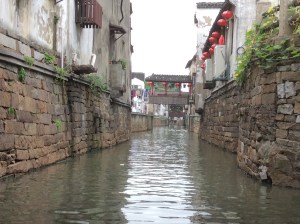
We had seen a lot in China, our day culminated with a fabulous acrobatic show which did not disappoint. The performers were highly talented and coordinated expertly using props like bicycles and ropes and great juggling. All that remained to be seen was Suchow, a 2,500 year old garden city that even Marco Polo had visited in the 13th C. It was a very long drive to get there and the weather was gloomy and the gardens bare. It was one small disappointment in the itinerary. The man made narrow canal was quite interesting with wedding pictures being taken on the shores. We went for a short ride and returned to our bus.

Chengdu, The Panda Reserve
At this point on our return to Shanghai, we had to part ways with a few of our fellow travelers. Some were travelling to Tibet, others back home and a few to another mountain resort. We did have one other stop in China before heading for Japan. That was after Tibet – the panda town of Chengdu! It would be appropriate to cover that here as well. Our group was so very lucky. At the panda reserve, unlike a zoo, the adorable big bears were allowed to wander around large enclosures and we could freely view them. The best part was when it was feeding time and about six or seven pandas came out all at once and sat amidst the food, some on the bamboo shoots and thoroughly enjoyed their lunch and friendly banter with each other. That five minute video of these gentle giants lounging around at lunchtime was the best of the whole tour! We also got to view red pandas, more like foxes with bushy striped tails and saw a movie. Baby pandas were also there, so it was a complete package as far as we were concerned. Excellent work is being done here for preserving the species. The walk amidst the beautiful bamboo gardens with small scenic bridges added to the feeling that yes, we were indeed in China! Not to mention the satisfying shopping at AP Market which had the imitation of every handbag, well made and at amazing prices! It was a shoppers paradise and we all indulged!
 travelswithshamla
One thought on “China Part 2”