

(Friends, this is just a light hearted account of our group’s experiences while touring Egypt. Please excuse any mis-facts or mistakes and feel free to send your special pictures for posting to my email. (This blog is a work in progress, more pictures being uploaded)
Since the advent of the recent pandemic and the postponement of our trip to Egypt and Jordan we had been hoping to revive our cherished trip. Earlier this year an unexpected opportunity came our way when one of our friends cancelled their trip and another friend facilitated us receiving their spots. We were able to see Egypt thoroughly through a well- arranged tour and learn its secrets from a knowledgeable Egyptologist, travel with friends and relax on the Nile cruise. Very satisfying!
We chose to combine it with a visit to India and Muscat prior to the tour and though challenging to pack varieties of clothes and essential items, we were able to pull it off . In fact we arrived in Egypt with minimal time difference and jet lag. We also decided to leave behind a suitcase of unneeded clothes and other items as we were coming back to the same hotel after our Nile cruise. The pick-up by Gita Travels from the airport was smooth. A bus had been arranged as many from our group arrived at around the same time. We hit the evening commuter traffic and it took us about 45 minutes to arrive at Hilton Ramses, downtown. We were met by Gita and Kris in the lobby. This lovely couple has been running this travel company for a long while now, based in Troy, Michigan. The couple had made a trip to Cairo just to get us started on our tour and accompanied us to Luxor and settled us in the cruise boat. This was the largest group we had travelled in , two full busloads of about 35 people each. We travelled everywhere together but stayed with our group. In fact on the Nile river cruise ship, we had the entire place to ourselves which made it super exclusive. It was smooth operations all the way, no glitches kudos to the organizers, Gita and Kris! Everyone was very satisfied with all the arrangements.
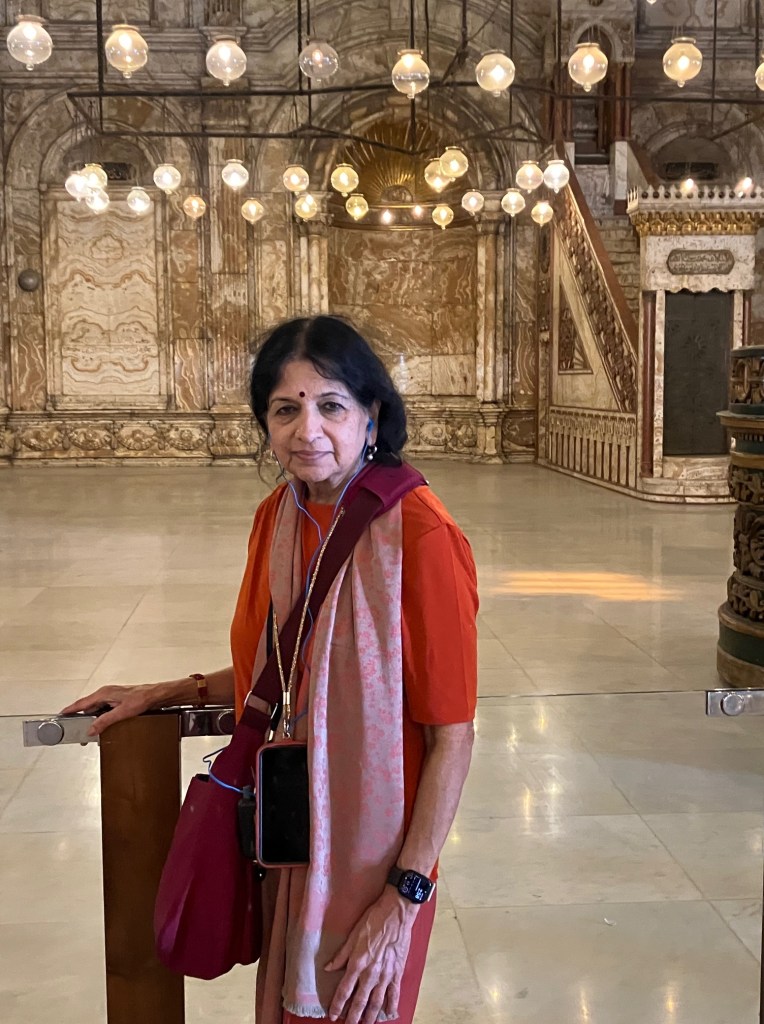

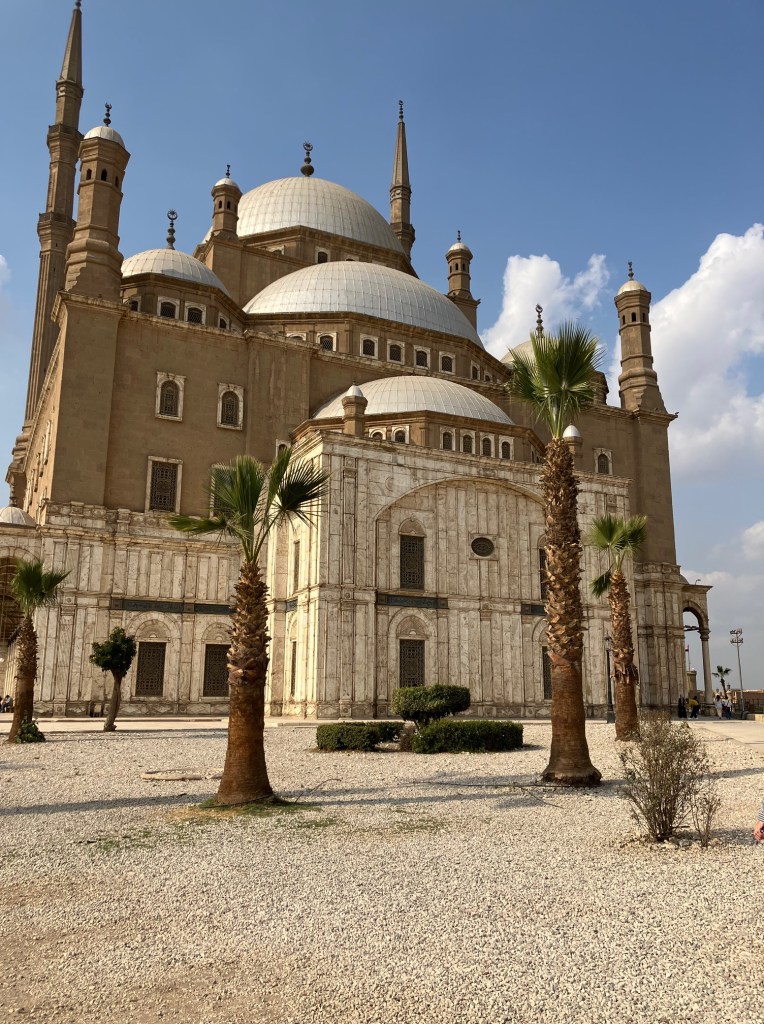
Raji, Rajini and myself at the Citadel and mosoleum
The next morning, our first day of sight seeing, we visited a museum and a mosoleum. Our group had a dynamic, friendly and very knowledgeable Egyptologist as our guide. He was with us throughout the trip. In fact Mohammad Taha, as everyone on the bus agreed, was a rare gem and we were so lucky to have him. He shared so many details with us, practically the inside info on ancient Egypt. At the same time he was easy to approach, friendly and forgiving if we were a bit late. He was open to answering all questions, including the social life of the locals. Right from the first moment, he won our hearts by calling each of us “Habibi”, a term of endearment! His “Meshe Meshe” with which he ended every other sentence is still ringing in our ears! Similar to “do you get it?” or “okie dokie”. We knew we were in good hands!
The Tahir Egyptian Museum showed us things which we would not be able to see at the actual sites. For example, down the road (or the Nile river!) we visited the Valley of the Kings containing the tombs and sarcophaguses of past Egyptian kings. But these were all empty for most part. They only exception being the tomb of “King Tut han kha mun.” In the museum we saw an actual mummy as well as many of the treasures recovered from the sites. In fact there are daily digs happening in Egypt and treasures discovered. The museum was super educational with amazing artifacts. There were stone tablets that the Egyptologists could talk about for hours, interpreting the hieroglyphics. The throne of King Tutankhamun, wood coated with gold, the usual articles found buried in tombs and a section dedicated to the famous King Tutankhamun. This room where photography was prohibited, displayed his golden face mask and several sarcophaguses with gold coating that went one inside the other. The mummy itself was left behind in the original tomb in the Valley of the Kings which we visited later. The upper level also featured long showcases of gemstones and other valuable items recovered from various sites.


The gilded chair and some beautiful artifacts at the Tahir Museum
After a local buffet lunch at a riverside restaurant our next stop was the Salah El-Din Citadel. This was a mosque as well as a mosoleum combined since it contained the remains of the emperor, Muhammad Ali Pasha. It also has a wall fortification to defend the city. We were given foot covering to put over our shoes. Inside, the main attraction for us was the beautiful high ceiling and the unique artwork on the walls. We also took pictures in front of the area that was used for prayer, facing Mecca. For dinner we proceeded to another restaurant on the Nile which had beautiful night views of the famous river. We could also view this from some rooms at our hotel. Cairo by night was a vibrant and colorful city. Hilton Ramses was a top notch hotel to stay in.

The beautiful Nile river by night at Cairo
The next morning we had an early flight to Luxor. Not only were there many luxury river cruise ships leaving from there but it saved us time going by road. The idea of spending four nights on a ship was ingenious because we did not have to move from day to day, packing and unpacking. The lovely ship, the M/s Miriam, moved us serenely along the placid river (though we went against the current flow) to our next destination to see sights. We had a warm welcome on the ship with coffee and baked delicacies and were given an orientation speech. The rooms were lovely and the bathroom modern. A picture window afforded a view of the river at all times, even from our bed. There were three levels with the spacious dining hall on the lowest. There were no elevators. More about the ship later, but to describe it in one word – Fantastic! We loved the space, the food the service and the people working on it. They made us feel like it was our home. Just a mention about the unique way they “ parked” or docked. There were three to four ships parallel to each other and to reach ours, we had to step into the lobby of each of those and walk to our own! Just docks were in a state of disrepair in many ports and one had to watch one’s step.
Before we set sail, at Luxor we saw two wonderful “temples” as the ruins were called. As it was our first exposure to outdoor Egyptian architecture, we were bowled over. The statues were very large as were the pillars. But the colorful inscriptions carved on every inch of stone was what was quintessentially Egyptian. For those who could decipher, many stories were silently told. Our guide Mohammad did not miss an opportunity to delve into each and every one of them. Sometimes we were so much into the intricacies that we almost missed the big picture. But I am sure many of us understood a lot more than just visiting on our own. We got familiar with the “Ankh” symbol which was a mirror-like holy object on top of a cross (no relationship to the Christian cross) and also signified sound and philosophy of life, the oval “Cartouche” which contains the name of the king or queen in hieroglyphs. We saw much of this at every location we visited. Some were even damaged or erased by subsequent pharaohs who did not want to give credit to the original leader.
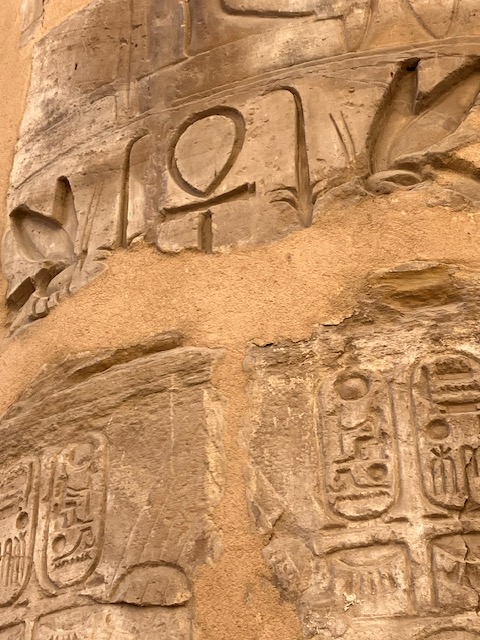


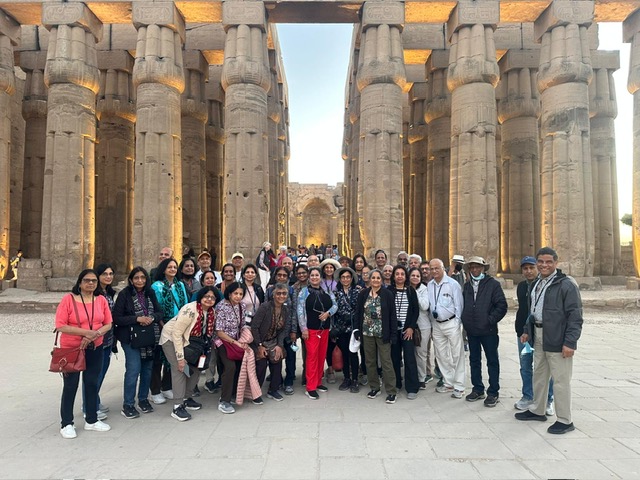
We viewed the Avenue of the Sphinx (some damaged or destroyed) which was a long open air passage leading to the Karnak temple. At the temple end, we could wander into the passage to see them up close. Here before the entrance was a very large paved area where apparently the commoners gathered in ancient times. Only priests and royalty were allowed inside the actual temples. Mohammad entertained us with many legends and stories including a quaint one of men going off to war and the only male being left behind was a small lad named Sim. He eventually grew to manhood and the women all had children so the clan could survive. This did not please the men who eventually returned from war. They first cut off an arm and a leg but later killed him and cut him into 14 pieces. These are represented by 14 pillars at the temple.His true love resurrected him and she had a child by immaculate conception as his manhood could never be found. This story of was continued at other sites too.. Snakes had significance also. Some pharaohs wore a snake on their headgear representing one of the wives who could keep track of all the wicked plots brewing in the harem!
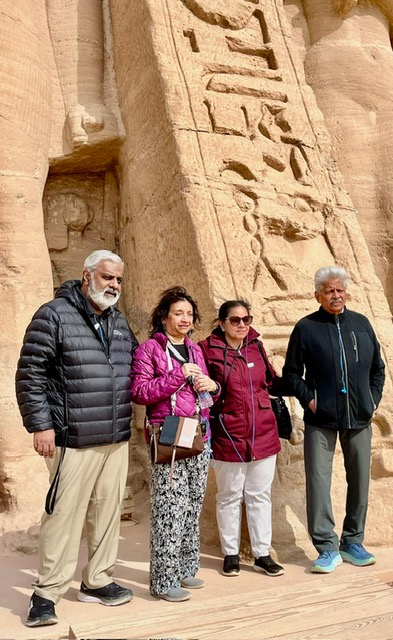
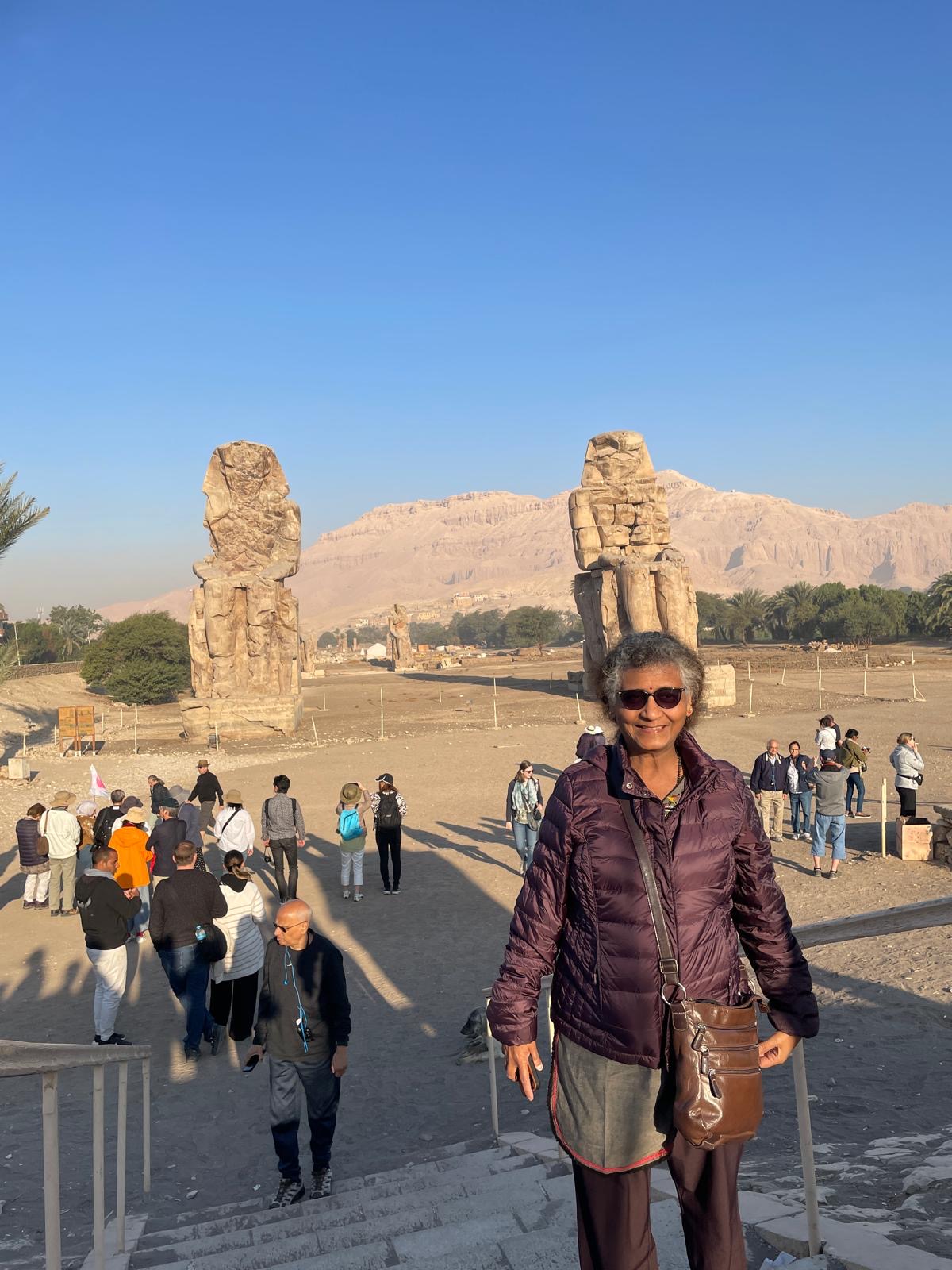

Other group members enjoying the sights; Luxor temple on the right
The second temple was simply called Luxor temple. Most temples we visited had a two wall structure with an entrance in the middle, getting narrower as we walked into the innermost sanctum which was nothing special, just a space, sometimes with a large stone block in the middle. Obelisks or needles were common as their purpose was the connection between man and God. Luxor temple was unique because it also had a mosque on one side of it, the Abu El Hagag mosque, separated by only a wall and visible. Apparently the temple was underwater for a long time till it was restored. Imposing huge statues were located outside. Floors had originally been made of alabaster which represented water, being translucent and smooth. Often organs of kings, before being mummified were stored in alabaster jars Mohammad told us. These organs were removed from the body before the mummification process to prevent decay of the body and being of attraction to animals when tombs were made in the mountainsides. Mostly only royalty received mummification and burial in decorated tombs especially in specific areas like the Valley of the Kings.
Luxor was a bustling, friendly small town, here you could see modern cars, there a cart being pulled by a donkey. Cats that looked well fed wandered around in the city and ruins. People everywhere in Egypt were friendly. We were strictly told to stay away from hawkers who followed tourists everywhere, except inside the monument area. Of course the enterprising Indian shoppers from our group managed to strike bargains in the few moments it took to walk to the bus! Real talent!!
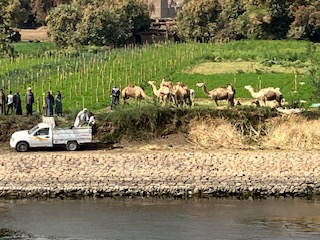
After our lunch the next day, our ship set sail and it felt wonderful. The Nile cruise part was as beautiful as the Egypt monuments. In the daytime we could see the ever- changing scenery, both sides of the shore being visible though the river felt quite wide. On the first day we passed through some locks that adjusted the ship to the level of the water as sometimes the river level rose or was lowered. It was an unusual experience with both sides of the lock very close to the ship. Soon we were out on the river and there was much greenery, other sailing boats and sometimes animals like camels along the shore. We could view all this from the top level of the ship which also had ample reclining chairs and space to walk and get some exercise and fresh air. We loved the tea/coffee service on the top deck on most days in the afternoon too. These were the cherished moments of relaxation that will stay with us forever.
The trip arranged by Gita Travels really fit in so much. One of the highlights after breakfast the next day was the visit to the Valley of the Kings, including the tomb of King Tut. Some of the more adventurous ones had decided to take a hot air balloon ride and we picked them up at a spot which also had some collosal statues. This was a 45 minute ride.

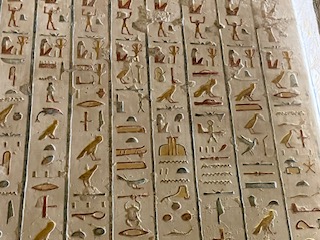

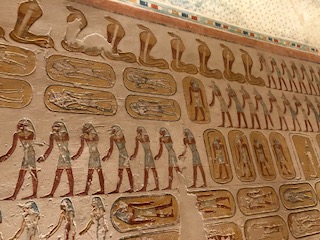

The high mountain of the Valley of Kings, inside a tomb and outside the tomb of King Tut
At some point in time, instead of building pyramids for kings, they decided to bury them in tombs on the mountainside. One exclusive area was this valley where the soft mud was conducive to digging. We went into two caves as recommended by our guide, including that of Ramses 4 and 9. The walls of the cave were well built with amazing carvings and colored hieroglyphics on the wall. The tombs themselves had been raided many times, the riches stolen in spite of guards posted. But they were still worth a visit. Mummies had been removed to other locations. Apparently, King Tutankhamun’s tomb was discovered untouched by British explorer Howard Carter in 1922. It was not seen earlier as it was right under another King’s tomb and discovered accidentally. When the young King’s golden mask was pried loose, his mummy suffered damage as did the rest of his body. So it was treated and left back in the tomb, bereft of the priceless fineries, thought to be over 5,000 in number. The 18 year old king, worshipper of the Sun god, Amun, who was estimated to have died in 1327 BC had been found in a triple sargophagus, one inside the other, all gold painted. Many fascinating facts about King Tut as he is popularly known now, can be found on the internet. There was a separate charge for entry to his tomb. Some of us opted not to go. However, those that went not only “saw” his mummy (his face could not be discerned by the pictures) but found the artwork in the cave to be fabulous. Fortunately they brought back some pictures for us to see:


Beautiful wall paintings in King Tut’s tomb. The sarcophagus and his mummified body. Note that he was identified by the cartouche(s) on the walls. Photos by kind courtesy of Jayanthi Raghunath
We had to reluctantly leave the the Valley of the Kings because there was another location awaiting us, the temple of Queen Hatshepsut. As it was a long walk to the actual tombs, we were transported in an open buggy that saved time and effort.


The Temple of Queen Hatshepsut, her statues outside depicted with a beard
This was undergoing mega renovations and re building thanks to a Polish group we were told. The outside façade was very impressive and it had several levels. The beautiful Queen born in 1508 BC and was depicted in several statues. She ruled with her own power after marrying a stepbrother who inherited the throne. After his demise her stepson who was a toddler ascended the throne. Hatshepsut was appointed regeant. She became a self appointed Pharoah. She ruled for over two decades, wearing a false beard and manly attire as was required. Though married, she is said to have an affair with her architect who is reported to be buried on the land occupied by her temple. Her story is certainly impressive among the queens of Egypt.


So much more was yet to be seen as we sailed along the Nile. Meanwhile we had some entertainment too from hawkers who pulled along the ship in small boats and tossed their fabric wares three stories high with perfect dexterity and their customers examined them and paid them or tossed them back. It was fun and the hawkers made their money with a little help from some of the friendly customers who facilitated their sales, like our friend Rekha. She proved her dexterity by understanding their system and throwing them money wrapped in their goods with perfect precision! In the end the fair minded hawkers gave her a hefty discount!
You can see Jayanthi, Shamla, Chandra, Rekha and Raji

In the interest of not cramming too much into Part 1, I will conclude here. Please enjoy the pictures that tell half the story. The best is yet to come — our visit to the pyramids which was saved for the end. If you wish, you may leave a comment on this blog. Thanks for reading.


































 travelswithshamla