Visit to Vietnam, Laos, Cambodia and Bali
November 2013


If so far our travels had been adventurous, Cambodia brought us to the doorstep of awe inspiring. One hears a lot about ancient wonders and even sees pictures, but being there is very different. It always turns out to be eye popping, grand, larger than life and imprints on the memory like nothing else. So it was with Cambodia, it was not just Angkor Wat, there were so many unique and amazing temples within short distances.


To me the strange aspect was the lineage of the rulers; did they came from India, quite far geographically or were they just influenced by the Chola kings? No one knows as the meagre information was gathered from inscriptions or travelers who wrote notes. We can be justly proud of these rulers who managed to perpetuate dynasties for centuries and more remarkable, left distinctly Hindu architectural marks that the world can continue to appreciate for centuries to come. As with many migrations, trade via the Malay peninsula could have been the catalyst that motivated the dynasty to be so much under Indian influence.
To go back in history for a moment, the building activity was at work from the 9th to the 14th centuries. It hit the peak in the 12th century during the reign of Suryavarman II. His ancestors, notably Jayavarman II and earlier emperors, ruling from the 6th century had consolidated several areas of the Mekong and moved the capital to the present area of Angkor. However, by the 15th C, the thriving Angkor had become a Forgotten City, cleaned up and revived by benefactors, notably the French and now surprisingly, India which is participating in a restoration project for one of the temples. Angkor Wat had been used as a Buddhist monastery in the later years, but now it is basically a tourist attraction only.
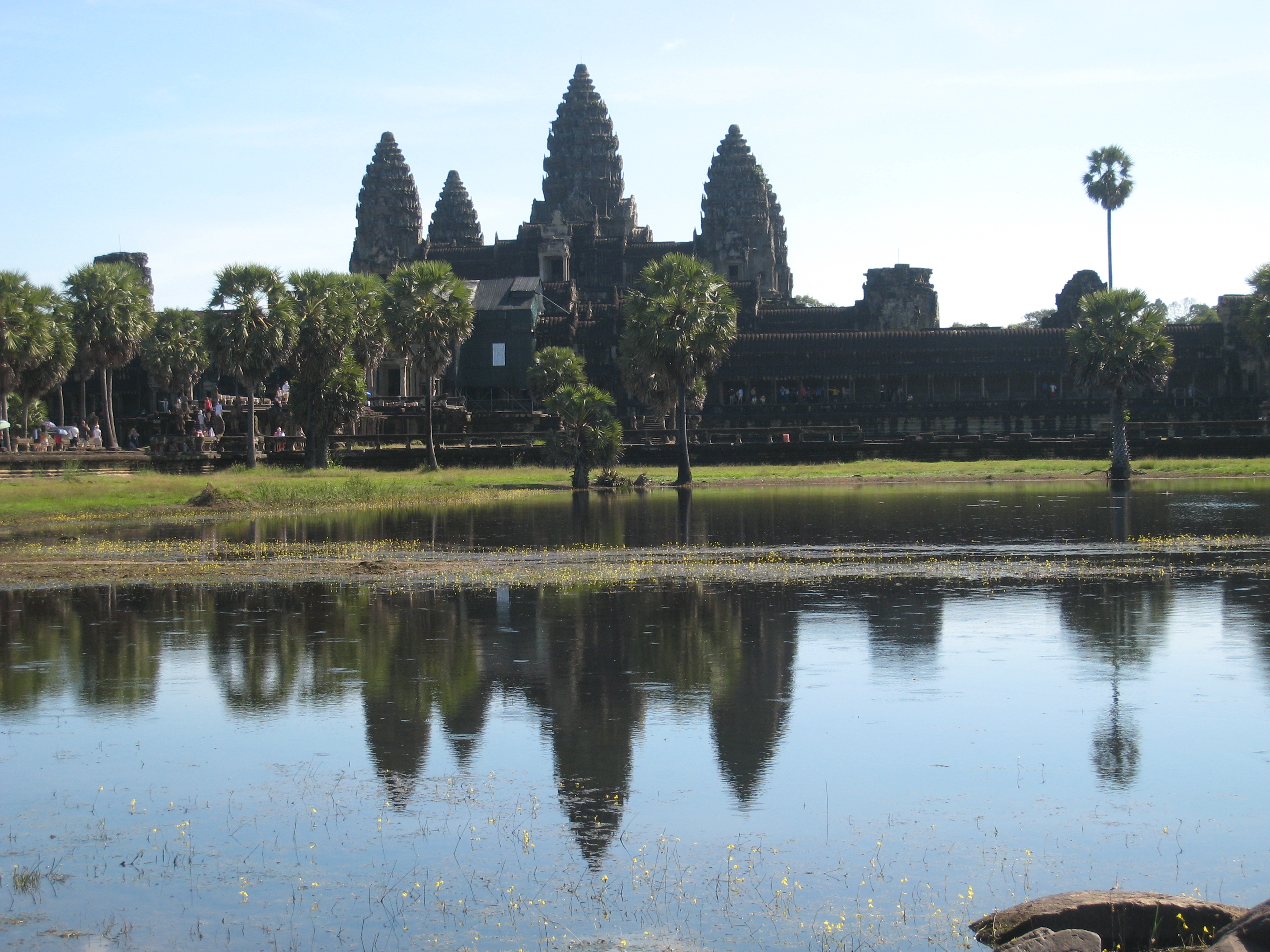
Amazing Angkor Wot
To list a few unique qualities of Angkor Wat (the second word means temple), it is considered one of the largest standing Hindu monuments of the world. The complex occupies 250 acres, fully surrounded by a moat still filled with water. It has several entrances, each designated to permit passage according to the seniority or rank of the people. Built at three levels with interconnecting stairs outdoors, it aspired to imitate Mt. Meru, the abode of the Gods. Its levels, angles and construction is perceived to be perfect in respect to the sun, planets etc. as is often the case with edifices built in India. It is considered based on Dravidian architecture. But this was built at a time when manual labor, metal tools and simple mechanical devices was all that was available to the builders. Everyone in the country was put to work, it appears, as stones were hauled from distances. Without cement, the guide pointed out to us, the blocks were placed so close together and so aligned that even rain water could barely get through. There has been conjecture as to why it faced West and one explanation or guess has been that the emperor’s remains were buried within, East being the auspicious direction.


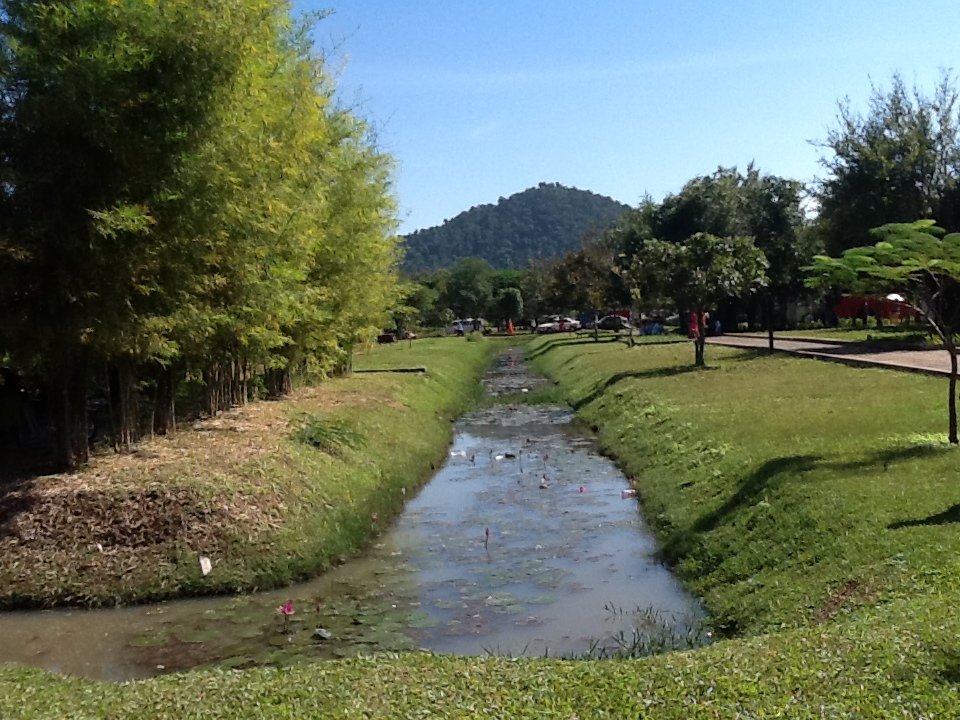
We did not see the famous Angkor till the morning after we arrived and had a relaxing night of sleep in the luxurious Grand Soluxe Angkor hotel at Siem Reap. The hotel was beautiful with a huge lobby, a lovely girl playing a soothing instrument to set the mood. The grounds with the lotus lake were charming for a morning walk. The day of arrival from Thailand was used to take us around to a handicraft center, a wax museum depicting various scenes and people like the Emperor and his consort sitting on their thrones. Next was the inevitable viewing of the atrocities of the civil wars and the skulls and bones were stored in a glass case at an exhibit garden known as Wat Thmey or the Killing Field. On the way out we saw some young monks enjoying activities in the noonday sun. Our next stop was some beautifully maintained gardens inclusive of miniatures of the city. We were duly impressed with the huge wall fresco of Buddha in a reclining pose. The same garden provided us with our evening entertainment. By the time we slowly sauntered over, the good seats were all gone and some of us had to plop down on the hard floor. But the slow dancing and the play acting spread over two huts with pretty damsels in ethnic clothing climbing up and down, chased by local youth, was quite entertaining. We ended the day returning to the hotel after a nice dinner. The distances in Siem Reap were much less compared to Bangkok and afforded us some relaxing time. However, though we passed by dozens of foot massage parlors, it was almost the last day before we had time to actually try one! We did enjoy some meals at the Currywalla restaurant, items that were almost homemade in taste and topped off with rich and creamy yogurt. The other Indian restaurants were mediocre.

The next day was dedicated to Angkor Wat and other temples. We spent the whole morning at Angkor and continued to be surprised by its size and grandeur and amazed by its carvings. As we walked over the Rainbow bridge, we admired the super long naga (snake) balustrades and the lion guardians of stone. Inside, a small man made pond reflected the ancient structures and enticed the photographers to pay an early morning sunrise visit the next day. Inside we found a bare statue here or there of a large sized Vishnu draped with decorative cloth. Other statues had been pilfered over the centuries, but not necessarily destroyed. In any case only us diehard Hindus from India want to cram every available inch with our variety of gods. The building itself inspired wonder, not necessarily reverence. It felt more like one of our Indian forts. The smooth and detailed bas relief carvings on two extra long walls evoked amazement for their detail and beauty, still very well preserved. One was dedicated to the Mahabharata and other to the Ramayana with Vishnu incarnation stories woven in. Notable among all this was the churning of the seas with the snake with Shiva and Vishnu in attendance. Devas, asuras, the Kurma avatara, the battle scenes, chariot with Krishna and Arjuna and also the pleasures of heaven and travails of hell, the valors of Hanuman, all this and much more could all be found. One would need several days just to examine and admire these carvings, especially by us Hindus who are familiar with the epics. At several points in the complex, the view from the elevation was serene and beautiful. Commercialization had been kept out completely inside the complex and the restoration was tastefully done. We explored several galleries, both inside and outside in the courtyard.
Angkor Thom, Bayon and the Tribhuvana
Reluctantly we said goodbye to this world heritage sight as there was much more to see around Siem Reap. As Shankar aptly commented, the Brihadeeswarar temple in south India was built a bit earlier in the 11th century or so, but because it continued to serve the local people as an active temple, it never went to ruin. We visited next a temple with huge faces in four directions, the Angkor Thom, built with blocks of stone with an impressive avenue of asuras and a yali (lion) guarding the outside. At Bayon, similar with large stone heads, the expression on the faces was amazing and we could climb to the upper levels to see at close quarters. The temple indoors had a linga from bye gone days, now just an architectural memento. This temple was more in disrepair with huge piles of fallen stones outside. On the outer walls were more beautiful frescos detailing daily life events, including a mother giving birth, , armies on elephants. Then there was the Bante Srey built by King Rajendravarman in the 10th century, before Angkor. It was the only one with pink sandstone with good detail to the carvings. Here the “tribhuvana” or three gods, Brahma, Vishnu and Shiva were celebrated in olden days. Beautiful archways with intricate carvings, a three headed elephant and even Shiva riding a Nandi, was depicted.


In order not to let the temples befuddle our brains, our guide next took us to a landmine museum. It was a one man project founded by Aki Ra. Besides the pictures telling stories of unfortunate victims there were remnants of the landmine pieces displayed. Volunteers are still removing these dangerous hidden missiles that maim rather than kill and innocent children playing around are often victims. Our group was quite fascinated by the details and chipped in donations toward the work. We also visited the Bantey Samrai temple where lovely carvings of Vishnu and Gajalakshmi on the door and many “prakarams” impressed us.


On the return trip, as dusk was fast approaching, we were led into Bapuon complex which we totally mistook from the outside to be something small. It was actually humongous, a huge fortress, layer upon layer of stones. Now the jungle is fast taking over. We did not even attempt to climb the upper levels in the fading light, but wandered around the periphery. An adventurous few attempted to climb a steep and open stairway (to the heavens?) while the rest of us stood down and prayed for their safe return!
Ta Prohm, Amazing nature and Architecture
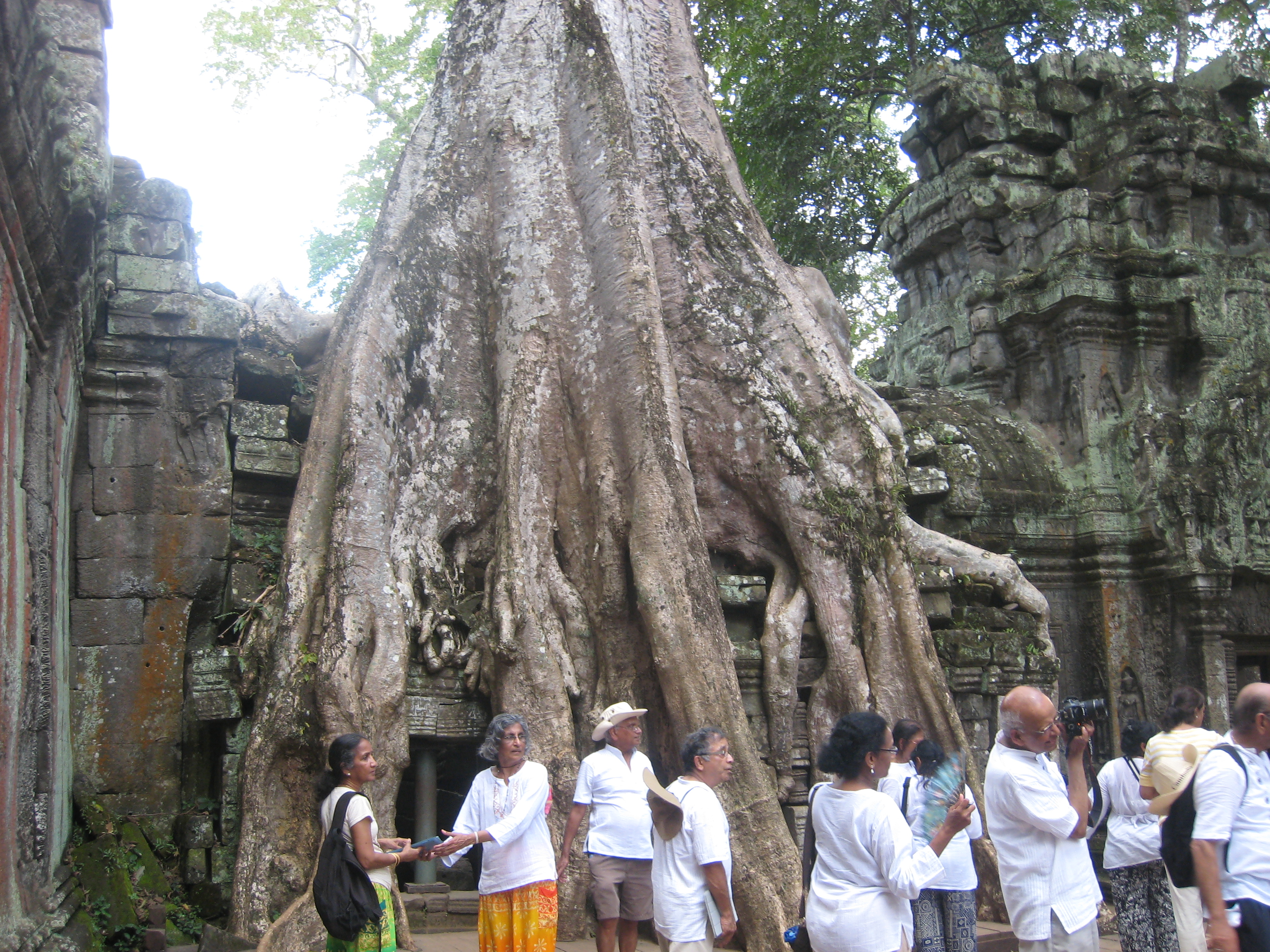
Last but not the least, the following day, we visited the temple of Ta Prohm where nature and man have unwittingly co-operated to produce a fantastic effect. Here literally the huge and curvy trunks of trees have squeezed themselves into the stones without knocking them over, leaving the tourist to gape in wonder. The trees were also huge, the trunk of one like a cave carved out, a good photo opportunity to stand within. We could see many Indian sign boards announcing in Hindi and English, the co-operation by the two countries to restore parts of the temple that were more in ruins. We enjoyed wandering around, spotting heads of Buddha or Hindu deities within the roots of trees.

One project that had enticed many of us was the visit to Kbal Spean where carvings were to be seen in the river bed and waterfalls and this was supposedly a difficult but adventurous trek through some jungles. For better or worse, we will never know, our tour operator decided to take us to a different place on the same mountain eliminating the trek, which many in our group could not have taken. The viewing here, though different, was nevertheless very exciting. With the weather being warm and sunny, it turned out to be a very pleasant excursion. We took the long drive to the Phnom Kulen mountain. The area is known as Srah Damrei at the peak, the bus went all the way to the top. We were told that the kings often visited the spot and had coronations and important ceremonies there due to the lingas in the river sanctifying the place. Water from the river is used in worship and it is also said to produce good crops as it flows over the sacred carvings.
Lingas in the river at Srah Damrei
We were quite surprised by the amount of the very small lingas enclosed by stone squares that had been carved in the river bed at various spots, literally thousands. Depending on the light, the visibility varied. A girl helped us by drawing a picture on the sand of the reclining Vishnu and Lakshmi carving on the river bed. It is more visible in the drier seasons when water flow is low, we were told. At a different spot that we could reach by bus, we were able to actually step into the water and walk around a rope cordoned area in the river bed to clearly view another reclining Vishnu with a lotus stalk coming off his navel, Brahma seated on top of the lotus and Lakshmi at his foot. It was exciting to walk around in the flowing current, ankle deep in water. Some of our group also found a waterfall and viewed that as well. Kbal Spean was located on another tributary of the river, we were told, with its origins from the same mountain.


The trip had gone so well, but one incident that made us very sad was the fact that our dear friend and tour organizer, Lakshmi, fell at the hotel in Siem Reap and broke her ankle. Others had taken falls too, but with no broken bones. She had to leave the next day for India, missing the entire Bali trip. We were just happy that she was well cared for by the docs and others in our group and received good treatment in Mumbai as well. We missed you in Bali, Lakshmi. On the last night, in Cambodia we made a second visit to the night market in Siem Reap, nearby and also got our foot massages which were wonderful and dirt cheap, so soothing after all the walking we had done. We were all quite satisfied with the shopping as well; all the men got white shirts with button necks and the women got printed pants and white gauzy shirts, a typical reminder of all the countries of the Far East. Our trip concluded with a long boat ride on a fresh water lake 140 km long, the Tonle Sap, which connected to the Mekong river. The sunset cruise was relaxing and scenic.


Reaching Bali
That leaves just Bali! Well getting there was not a fun experience. We left Cambodia in the morning and after many hours of delay reached Bali only at 9 pm thanks to the disorganized airline, Air Asia. Then to find out that our luggage was only arriving on the next flight! Fortunately the organizers made sure that the staff at the Indian restaurant waited till 11 pm to serve us dinner. Throughout the Bali trip, we got very good food from a chain restaurant Queens Taste of India, and the south Indian chef gave us personal attention and lovely treats like masala dosa, pani puri and the all time favorite, yogurt rice with pickles!
The resort in Bali was located at the south end of the island and reached by a 12 km bridge each time we went in or out. This did prove to be very time consuming and we missed out by not being closer to the main areas. However, the Nusa Dua resort and beach was gorgeous. Every morning we could walk on the pristine beach.


We were served free cappuccino made right there! We just wished we had more time to enjoy the resort, but it was the same story every day, get up early, eat and out for the whole day! The foggy and rainy weather also prevented us from viewing the volcano and lake; though we made a two hour drive each way, we could not see a thing in the Kintamani area. We did end up at a coffee “plantation” where we learnt about something really strange. The Lawasa peabury coffee bean is used to feed a mongoose (Civet per internet) comes out undigested, is cleaned and roasted, ground and made into a delicious (???) cup of coffee, we were told! Who came up with this unbelievable process was not revealed! Was it even true?? We tasted other flavored coffees.
Kecek musicians and dancers
Memorable among the visits in Bali was the one to the Uluwatu temple on the mountain where the Kecak dancers and about 50 musicians entertained us with depiction of parts of the Ramayana and their sole instrument was their mouth, they made a constant chak chak sound with it with both hands raised.


Some of us opted out of the long drive to view another temple on the beach at Tanah Lot and instead enjoyed the beach and resort and local shopping. In Bali our disappointment was that the drives were long distances through heavy traffic and for one reason or another we missed the good views. The town seems to be over commercialized as well and we drove by rows of stores making batiks, wood furniture and carvings all for export. The temples themselves had no idols, the people were just very well informed about the Hindu gods and incarnations. We saw several beautiful temples which drew in the local people to a silent retreat in serene and lovely gardens with high, empty pedestals. They seem to shun idol worship, although we saw many gardens in private properties decorated with Ganeshas and other Indian gods.
Our shopping was a disappointment too, we made a time consuming outing for silver jewelry to come back almost empty handed. Seems like we missed the main ethnic shopping in the Ubud village. Other curio items available seemed to be of a much inferior quality compared to workmanship of Laos or Cambodia or even Thailand.

Soon the long and adventurous trip of almost three weeks came to an end with everyone catching different flights to different destinations, but the memories will stay with us.


 travelswithshamla