Japan Part 2, Scenic Beauty All Around

October 2016

 Visit to China, Tibet and Japan  

Ohio!!   That is how you say hello in the Japanese language!   Japan surprised us in many ways.    Our drive through the densely wooded areas, the crowded suburbs where homes were very neat but nevertheless close together, sometimes with small patches of rice fields in between.   The cities were impressive too with their high rise towers, but none too pretentious.
IMG_3203 (2)

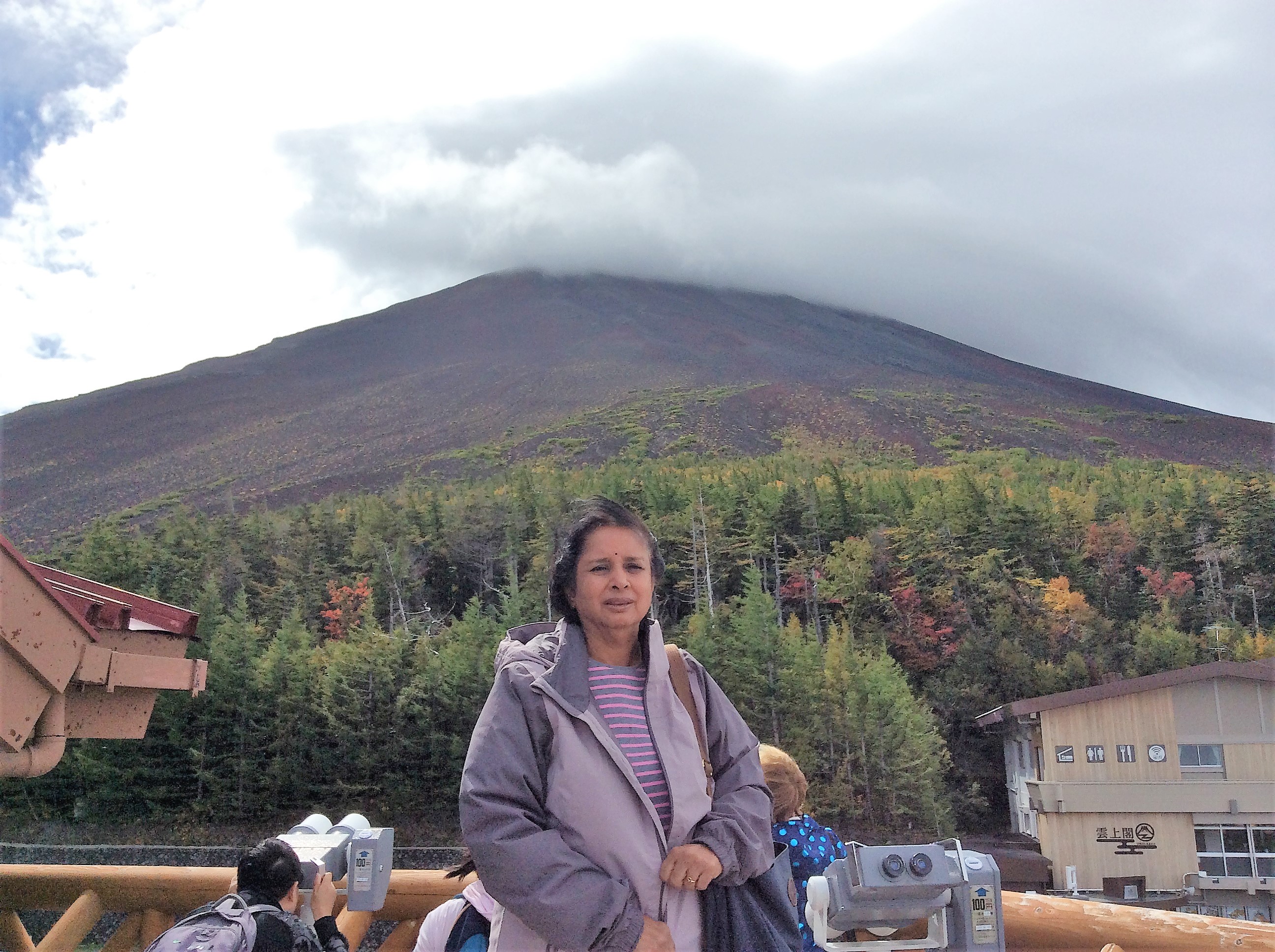
Mount Fuji Viewing Station

Mt. Fuji had been a sight that everyone had looked forward to and we drove by coach there as we also did to many other locations.   With the frequent stops and the good company we had, it did not seem too much.  It sure beat waiting at airports and catching flights.   The symmetry of the mountain itself was undisputable,  most people have seen pictures or paintings of Mt. Fuji with a snow cap.  The snow melts by July.   With these dreams in our head, we drove to the 5th station viewing point.  The last eruption had taken place in 1707, so fear was not on the cards for us!   Ashes, it is reported reached Tokyo a hundred kilometers away.   It was said that the volcano erupted 13 times with a 300-400 year gaps!   The locals considered it very sacred.     At the 5th station the highway came to an end.  Those wishing to go further had to come prepared for the hike which could be a good 5-6 hours.

In the four seasons, Mt. Fuji is said to have  different looks.   Unfortunately we hit the cloudy season and could not see the top two thirds where it narrows.   We were told that a clear view was possible only about a 100 days in the year!  It is a solitary mountain that stands at a height of 12,388 feet.  There are eight small “peaks” (more like bumps) circling the rim of the crater.  The 5th station was a mere 8,000 feet.  As we drove, our driver and guide alerted us to a hum coming from the road, almost musical.   This was due to ground vibrations in that stretch. Once we reached, we did have fun going up to the built up viewing gallery and taking pictures of what we would have to claim was Mt. Fuji.   Our proof was the picture by the 5th station sign!   The crater had a lake  and several underground water channels.   Later though, on another day, as we travelled in the vicinity to a different destination, we did see the sunset around Mt. Fuji with the entire elusive mount visible in the skyline!  We scrambled to take pics from the moving bus and get a good glimpse.

06-IMG_3357

Lake Ashi, Black Eggs at Owakudani Boiling Valley

Our luggage had been sent ahead to Tokyo, so we were happy to manage just our small cabin bags.   This is because the fast trains do not have the facility to accommodate big bags for big groups.  The next destination on the bus was Lake Ashi  but the rainy, cloudy weather did not make the visit conducive and our boat trip was cancelled.   The scenery did look like a lovely Japanese  painting though, the lake surrounded by mountains shrouded in clouds.  More interesting that day was the visit to the  Owakudani Boiling Valley where eggs are literally boiled in the hot  springs and turn totally black in their outer shells.   The locals make the pilgrimage here, eat the eggs which, as legend has it, gives a 7 year extension to their lives!   We also learn that Japanese ladies prefer to hand wash dishes and dry clothes outside in the sun!

Sky Tree Observatory

Upon reaching Tokyo, after a night’s rest, we were ready for the city tour.    As in numerous other cities, we had the opportunity to go to the top of a tall tower – the Sky Tree Observatory.   This tower had been visible to us close at hand from our hotel itself and was a pretty sight lighted up blue and white  at night.  Inside, at the base, we had a chance to get a group photo with a mural of a simulated skyline which also included Mt. Fuji!   The town and surrounding views from the top was nice too. We then took in some of the famous sights of Buddhist temples and Shinto shrines in the area.   The Asakusa Kannon temple was on the itinerary.   This was quite a famous one.     The difference was that it was located in a very busy shopping center leading up to it and being a holiday, the crowds were milling around.  The street was decked with large red Japanese lanterns, making it festive.  We passed through the shopping area, nothing unique to buy,  just the usual Knick knacks.  In the edible department, the small nut balls in sugar were crunchy, light and tasty.  Outside this famous temple in a small garden we found statues of Buddha’s followers.   One of them looked like Adi Shankara!   Coincidence, or a fact that holy men bear resemblance to each other!

Shogun Shrine, Turtles in a Lake

We saw another shrine (frankly, the names have become a confusion in my mind in spite of the itinerary, which we may not have always followed in sequence.  My memory fixed it as the Shogun shrine with the three monkeys, colorfully carved on a doorway!  Many visitors had left wish notes, including one that mentioned Trump!  It also had many gifts from other countries like a huge bell.  The ancient architecture was remarkable too.  Perhaps, this was the Toshogu Shogun shrine.  It had some wall carvings of imaginary elephants never seen by the artist, Kano Tanyu.  On the following day,  we visited another lovely shrine .  It had extensive gardens around it including a pleasing Japanese bridge over a stream.   We spent quite a bit of time here, main reason being turtles!!   If I am not mistaken, it was at this place where at the other end of the garden was a lovely lily pond with a man there feeding what looked like baby turtles.  He was kind enough to let each of us use a spoon to feed the turtles as they came out of the water and up the rocks for a bite.   Quite a few large hungry fish also populated the pond and it was a pleasant change for us from being in and out of Buddha and Shinto shrines

The Majestic Kamakura Buddha

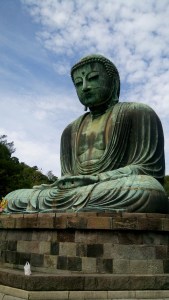
  The next big destination was the visit to the Kamakura open air Buddha, housed in the same complex as the turtle pond.   This Buddha had an aura and a history.   This was one that was memorable for us.   It was huge and made of bronze and copper that had attained green hues like the Statue of Liberty.   Though built over seven and a half centuries ago , it had used great technology.   Those who went inside the hollow statue for a glimpse could attest to this.   There was also a good description sign.  It had been cast in 30 stages with special welding being done from base upwards.   Even the techniques had been explained in sketches.  It had been renovated in 1963 after some damage.   But it was not the technicality, but the serenity that won us over.
DSC_0036_9

We could not stop taking pictures.  As with many outdoor Buddhas, the size was magnificent, 44 feet high, weighing in at 274,000 lbs. and a simple altar had an offering of flowers and fruits, no fuss, no mess!

Glitzy Ginza and the Illuminated Sky Tree

             Not going in any specific order, let me mention here some other sights we saw in and around Tokyo.   Some of us went on a small walk across manicured gardens with impressive trees to see the outside of the Imperial Palace which was quite secluded, we just got to see the moat and wall.  Then there was the two part “mad rush” to do shopping in the Ginza.  This is a beautiful street in Tokyo with bright lights and fancy shops.   Best for window shopping, unless you want to lighten your bank balance!   Some in our group did go for the famous Mikimoto pearls (these have been well known for so long, I remember my father bringing a string home for my mother in the 1960s!).   This set off the second spree the following day for those who missed out and had opted to go to the hotel for a rest. Luggage stores attracted some also (our group tradition has been known to ditch old suitcases in favor of new ones on any given trip!).   Uni Qlo which occupies seven stories, was a favorite for the clothes shoppers.


Toyota showroom and mega hub mall was another visit.   Most of us did not find much there.   The car area did have some newer models (photo op!) and a movie/show did interest us.   I think we ate at an Indian restaurant in the mall.  Next,  went over the famous rainbow bridge and Nantai mountains.  On another long drive, we saw Lake Chuzenji with a touch of fall colors in the trees, again it was cloudy and pretty.  A part of the Nikko national park, we also saw  the Kegon, a  tall waterfall.  In visiting these nature sights, we also drove along a very hilly road with maximum of 48 hairpin bends, the Iroha Zaka.   In short, we did it all!  Again our travel group leaders spent their own money in giving us a taste of local fare like the persimmon fruit and matcha tea flavored ice cream, not to mention a non stop supply of packets of salty snacks from India!   One more place, Yokohama, which is a sister city to Mumbai.   It had a nice memorial plaque and benches by a beautiful lake.  We all sat down and finally found time to be relaxed, if only for a moment!!  And so we bid sayonara to a beautiful country and  the next day as some of us headed for Hong Kong.    Very memorable three country  tour of China, Tibet and Japan for some of us.

Group pic Japan from Aditi Bose


Hong Kong:

Riding a Sampan,  the golden lotus at Macau

This was our  bonus, three days to see this bustling city.   Many from our group had to return home due to time limitations.   Anyway our final flight back home was from here so it made sense.   But on the very first day, after an early start and many hours of travel, we ended up waiting for a very crowded tram to go up a hill to Victoria Peak to see Hong Kong by night.  They wanted us to have the “experience” but it was more than we bargained as it was worse than India getting on and off that crowded tram.  But the night view was worth it from that height.   There was an extensive wax museum included but  we did not have the time nor patience to truly appreciate it.   Just took a quick run through.   Luckily the bus came to the top to pick us up!

Earlier we visited some pleasant parts of town and some of the co-travelers took  a ride on a local sampan in Aberdeen Bay.   We saw thousands of container ships, ready with their “made in China” goods to be delivered world wide!    Repulse Bay was nice too.  But the highlight of the day was dinner at a dosa place.  Finally, south Indian food!   We found two nice places close to our hotel and made the most of it during our stay as we were on our own for food.

         The next day we had  gorgeous weather and went up to another high peak but this time the experience was very pleasant.  Known as Lantau Island, it afforded spectacular views as we went up for a good amount of time on a steep cable car.   It was not scary, just very relaxing.   The view of the bay below with blue waters under sunny skies was indeed a pleasant sight.   Later we passed through the wooded hillside with small pathways and steps for those who wished to hike.   We saw an open air Buddha (no, we were not tired of seeing Buddhas!) and this one had been put up as recently as 1990.  Known as the Nong Ping 360.   We could climb all the way unto the lotus base and get a close up view.   In a slightly lower platform all around, there were statues of what I would like to call “apsaras” (beautiful celestial women).  The view of the surrounding hills was spectacular too.   There was also a lovely monastery, nearby, which we almost missed.   In it were golden statues that evoked our wonder and amazement.


That just leaves our trip to Macau Island by boat.   Almost everyone who visits Hong Kong goes here.   Of course most of our group had already been to at least one casino in the US or elsewhere.   So that was not the attraction.   Although, I must admit the slot machines were so cute with dancing panda bears going “Yoshie Yoshie” whenever there was a small win!   They also said other things in the local language.  The indoor casino with a Venetian  flavor was quite exquisite with artificial skies, clouds and a waterway with bridges and gondolas which authentically dressed youth were rowing!  Nice to walk around.   Macau island itself was good to drive around, it is a special administrative region of China and reportedly the casinos pull  in more revenue than Las Vegas.   In the Lotus Square we saw a lovely large golden lotus which made for a photo op.  We visited the ruins of an old church and the Kwan Yam temple.

The next day saw a familiar scene at the airport, checking in our luggage.   A monumental trip had come to an end with many many unforgettable memories thanks to Aditi and the staff of Thomas Cook.  Farewell to the East and back to the West,  to home sweet home!

Japan — Epitome of Culture Part 1

Visit to China, Tibet and Japan

    October 2016

P1010755

On to our last lap – Japan.   Quite a contrast from the rustic travels we had so far.   Not that we did not stay in lovely hotels and had  top notch travel arrangements, but Japan is in a class by itself.   Its culture speaks volumes, centuries of developing a persona of politeness, friendliness and orderliness as well as beauty and symmetry.   Just take the example of restrooms.   Boy, were we glad we went to other countries –first and then to Japan!   It was sheer luxury.  In many parts of China, we were asked to throw any used tissue in garbage cans provided so as not to clog drains.   In Japan, the toilets had special instructions NOT to throw paper anywhere but to flush it!   It made us smile!   Also, there were so many Indian style  toilets in China (who knew they could even be found outside of India) but it was all modernity and cleanliness in Japan, would even say luxurious, with bidets even in public washrooms.

Apologies for starting on a lowly subject about such a great country!    Well,  we got there to Osaka from Chengdu via Shanghai.   Again some of us were bumped off the flight and thanks to the resources of our our tour manager,  we were upgraded and on board.   We arrived at the Kansai international airport hotel where we could just walk out and cross a walkway and push our luggage into our hotel.   That night was the first local dinner and because it was cosmopolitan we were able to get pizza, spaghetti and other items, it was a good change.   More about Japanese food soon!  We had a happy reunion with some fellow travelers who did not join us in China and met some new charming ones, all living in the US and of Indian origin.

Great Guides, Beautiful Gardens and Kimona Show, Tea Ceremony

We had wonderful guides  in Japan, as usual a local one and our new tour manager.   Aditi Bose had received us at the airport and as soon as she started talking we knew we had hit gold!   She was amazingly knowledgeable, very friendly, helpful, always smiling and participated whole heartedly in all our activities on or off the coach.   She knew Japan inside out!   It was so soothing to hear her roll off the names of places and shrines as if she had grown up in Japan.  The local Japanese guide was a gem too, his name was Ito.   When one visits so many countries you tend to forget the guide, but not Ito San.  He went the extra mile to accommodate all our needs and what’s more stayed with us for our entire tour of Japan so we had great continuity.   Ito gave us a glimpse of Japanese culture.  He said Japan is somewhat the size of California, and at the time we visited, a 1,000 yen was about $10.  But Japanese items being so well made, even a magnet would cost us $5.  He said the local residents did not have an easy life as taxes were high and jobs were lost easily.  He deemed it the safest country in the world!  People had not developed very good conversational English, perhaps they did not feel the need for it.  One reason why it was so clean everywhere was the fact that there was a rule for everyone to bring their own garbage home, we did this too to our hotels!   There was no homelessness or beggars or slums, but the men were either workaholics or alcoholics (this was his little joke!)  Sake, the rice wine was widely used, even in the Shinto shrines it was an offering along with chicken sometimes, similar to cooked prasad we offer in our temples.  The Shinto religion came out tops in Japan although Buddhism also prevailed.  In Shinto-ism there was worship of nature and ancestors, not so much of statues or images.

P1010723

Mild quakes hit Japan often due to movement of tectonic plates in the Pacific ocean.   At the outset must mention that we really wished we could have visited Japan in the cherry blossom season.  Something seemed to be missing in the scenery.   I guess we have always seen  pictures of beautiful trees blossoming and Mt. Fuji with its snow capped top.   Well we missed both of that.   Nevertheless the gardens, shrines, palaces and  parks were so meticulously maintained, in fact every branch and leaf trimmed to perfection.   Our first full day after arrival was chock full of lovely sights.  We first visited the Todaiji temple which was housing one of the largest Buddhas and built in the Nara period of the 8th Century. The wooden structure is also remarkable for being the largest one made of wood in the world, although it is 33 per cent smaller than what it was originally.  As we often heard, it had burnt down and was re-built.   The golden hued Buddha, a picture of peace and calm was the Vairocana Buddha (Buddha that shines throughout the world like a sun).  It is resplendent in cast bronze, coated with gold.   Outside the temple was a red medicine Buddha and a throng of people around it.   Apparently, if any part of the body ails one, one needs to touch it and then the medicine Buddha who would take care of the problem!   But the main bonus at the park surrounding the temple were the deer.   Todaiji is also a deer park and the animal is venerated in Japan.   They were so tame, trained to accept allowed treats from the public.  They came over to sniff and be petted but left when they knew we had no treats to offer!   It was fun taking pictures with them.

Kinkakuji Golden Pavilion, Deer Park

After a delicious lunch at an Indian restaurant, we next set out to see the fabulous  golden pavilion in the middle  of a lake known as Kinkakuji (Rokuonji) temple..  Built by emperor Ashikaga originally, it was rebuilt in 1955 when it burned down;  the gold leaf portion is upto 20 kgs, quite believable given the size of the pavilion!  A sect of Zen followers come here to meditate, the public can only view it from outside.   We walked around the supremely serene lake and saw ancient trees and well maintained wooded areas.  Only a picture can describe its beauty, especially with its golden reflection in the water.    Our next destination was a small Zen meditation center which we had a hard time finding, but got our exercise anyway walking up and down steep streets!   Finally when we did, we were a bit regretful!   The master who had told us to raise our hands if we felt sleepy, actually used a stick to sharply tap us awake and many of us were not used to the fairly long duration of sitting on a cushion on the floor.   The Nishigin Kimona Show was the next destination and proved to be a pleasant respite.   Although we had to walk through a showroom selling kimonos and other expensive souvenirs, the show itself was great.   There were ladies as well as men doing the modelling, we could take pictures and the short duration and beautiful music made it all worthwhile.   Finally we attended a Japanese tea ceremony which was formal.   We took off our shoes at a different location, went up some narrow steps to a small room covered with beautiful tatami mats.   (Wish they would sell these in the US, sure beats carpeting!) At one end  of the floor, a square panel was removed to reveal a warming stove on which matcha tea was ceremoniously made.   The serving and drinking too was per instruction and each of us had to bow down and say a word in Japanese to the person next to us before drinking.  Japanese tea of course is always without milk or sugar.

We were all glad to realize that our stamina was really up there with the younger tourists, but once dinner was over we were very happy to hit the hay in our lovely hotel.  The next day involved a bullet train ride and some serious sightseeing.   When I say serious, I mean a visit to Hiroshima.   This was totally worth it.   It was like re-living a piece of history after all the hurly-burly is done.  The world’s first atom bomb exploded on Aug. 6, 1945 at 8.15 a.m., levelling Hiroshima, a bustling town of higher education and army facilities.   All was now quiet but the devastation has been preserved for the generations to see.  However, before we visited the site, we had been scheduled a more pleasant outing by short ferry ride to the island of Miyajima to see the Itsukushima Jinja shrine.   Although it was a dark day with a slight drizzle, we were greeted by the bright orange red torii (tori-ee) arch welcoming us right there in the water near the island.   The shrine itself was extensive, built of vermilion colored camphor wood which is also water resistant.   As we slowly wandered the covered and pillared corridors reminiscent of our South Indian temple outside prakaras, we could also peek into a Shinto wedding in progress and then take pictures. It was a small place with many attractions, we had time only to see some of them.

The rain sort of cleared up by the time we were touring Hiroshima.   Our guide explained that a T-Bridge in the vicinity had been the target of the A-bomb, but missed by a slight distance and hit the structure of the large dome-shaped government  building.   This half devastated building still stands as is as a reminder, unrenovated.   We walked on the T-bridge also. 

Magnitude of Tragedy at Hiroshima

Though it was a solemn sight, it was nothing compared to the museum a short distance away.   This has been visited by past US president, Barack Obama who also made origami paper cranes.  Blackened and charred school uniforms, a burnt but intact tricycle and other photos and items from the day of the devastation are well displayed, lest we forget.  A lunch box displayed the black contents of food once lovingly prepared, never eaten.  Especially poignant was the story of Sadako Sasaki, a two year old girl who was seemingly normal after the blast, but down the years when she was ten,  developed leukemia, a serious illness.   She valiantly fought with with an optimistic spirit and made a thousand origami cranes in the hope of recovering, but  the end was tragic.  She is the symbol of the optimistic spirit of Japan that slogged on despite the unthinkable tragedy.   The radiation fallout claimed victims as far as few miles away.  Outside the museum,  in the large yard too there was a children’s shrine as well as an eternal flame to which we paid homage.   Last but not least, we saw an olive tree that had been charred, but rejuvenated over the years and is back to normalcy, depicting nature’s  indomitable spirit and teaching us humans that life must go on.  Through this museum, similar to the Yad Vashem in Israel which we have seen, Japan wants to keep memories alive so that a tragedy of such magnitude is never imposed on mankind again.

Japanese Food — Art on the Table        

Just a word about the Indian restaurants in this part of Japan .   The food was fabulous!  Who knew that tucked away in a remote corner of the world,  such  places could serve our whole group of 30 plus people and make us so content!   As for Japanese cuisine, our guide, Ito had  arranged a beautiful Japanese individual table setting  meal with each tourist having his or her own burner in which soup was simmering and we could add other items to it.   It was a work of art with tiny ceramic dishes and a lacquered wood hexagon box!  The concept was great but one had to be a mushroom lover as almost all of it was just that, or olives or tofu.   Some of us, sorry to say, had to take recourse to puliogare powder again with the rice provided and waste this exotic fare.   Others who love tasting local fare in every country, I am sure enjoyed it!  For the rest of us, it was just pleasing to see this art form.

Serene Kenrokuen Gardens

We spent the night in Kyoto and the next day took a fast train, the Thunder Bird express to Kanazawa.   We were here to see one of the three most beautiful strolling gardens in Japan, the Kenrokuen.   It was meticulously maintained and pleasingly arranged with a lake in its center.  However the season did not allow for any flowers or blossoms to add to its beauty.   Here we also had a more than usual delay when three of our coach passengers were “missing”,  happily this problem was soon solved as our main person from the travel agency, had  hurt his leg and needed to rest it before walking to the bus.   It was a pleasure to have him on our tour, in addition to Aditi.   Not only was their presence uplifting, but they frequently treated us to snack packs (from India), sweets and local ice cream.   By the way, a well kept secret that never made it out of Japan is their ice cream enclosed in a waffle rectangle instead of a cone.  Easy to eat and yummy!

A World Heritage Model Village

The next part of Japan did surprise us.   We drove toward Shirakawago, a world heritage site.   We went through densely wooded jungles and mountains, not to mention long tunnels, driving for many hours, later  too as we headed to Takayama.   Who knew there is so much by way of woods with dense foliage, steep mountainous regions with tall trees and long tunnels in Japan?  The model village was old, yet beautiful with A-frame homes.   The thatched roofs made with reeds were meticulous and really thick.   An old farmhouse which we could see inside stood the test of time though it was held together for decades with just ropes and no nails!  In it was durable wood floors and equipment for weaving.  The furnishing was sparse with a shrine in the lower floor.   Outside, trout were growing in the small created streams, ready to be caught and freshly cooked!   Ingenious!!

After a good rest and breakfast the next morning, we visited Takayama and started the day by seeing a local vegetable market and an old heritage tax collector’s office (Takayama Jinya)  that even included simple punishment restraints.   Matsumoto castle was another picturesque sight with photo ops located as it was on water.  Although built of grey and black stone, it was beautiful in shape. The displays of the Samurais and Shoguns was interesting.  We climbed the tower that  was primarily used for defense against invaders centuries ago.  We were told that the Nagano Olympics were also held in this area of Japan.