The Islands of Greece — Part 2

After enjoying a good tour of mainland Greece, we were now ready for the famed islands.  Isn’t this where people go for honeymoons or get-aways?  I was not disappointed except maybe with one aspect.  The beach.  Most places like Bahamas, Aruba or even Tampa Bay beach we have always associated with miles of sand, gentle oceans waves and hotels nearby.  Not the case with either of the islands we stayed on.  We had a long drive away from where our ferry docked and even the next day when we walked along the touristy beach strip, it was not impressive.

Getting there was a fun experience.  The ferry we were booked on was not waiting for us but arrived after a wait at the dock.  Of course, everyone seemed to be heading for the islands and it was a rush to board.  We had to pull our luggage around too.  At the entry level the vehicles were allowed to board first and parked in designated areas.  Then we could “park” our suitcases on the same level.  We had to corral them with the first row in each direction facing a different direction so all the boxes would not roll away with the motion of the ocean!  Then we had to climb a few levels to find our seat.

The seats were comfortable and we had an upgraded section and our breakfast boxes to stave our hunger.  The food sold on board was very average and the coffee tepid.  The ferry ride that day was smooth with good weather and sunny skies.  Though there was not much to view outside, we had an interesting ride which was a couple of hours, not too long.  We could even go out to the open end of the ferry to experience the rush of the wind and the churning of the water behind the boat.  Once we reached, we got out quickly as the ferry was continuing on to other islands, then we made our way to the waiting bus.
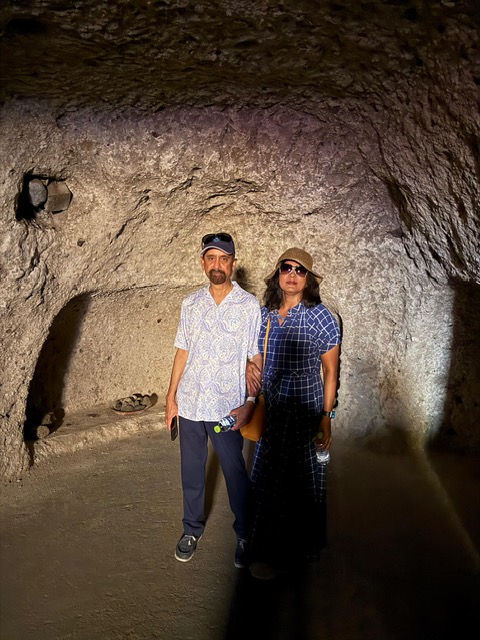
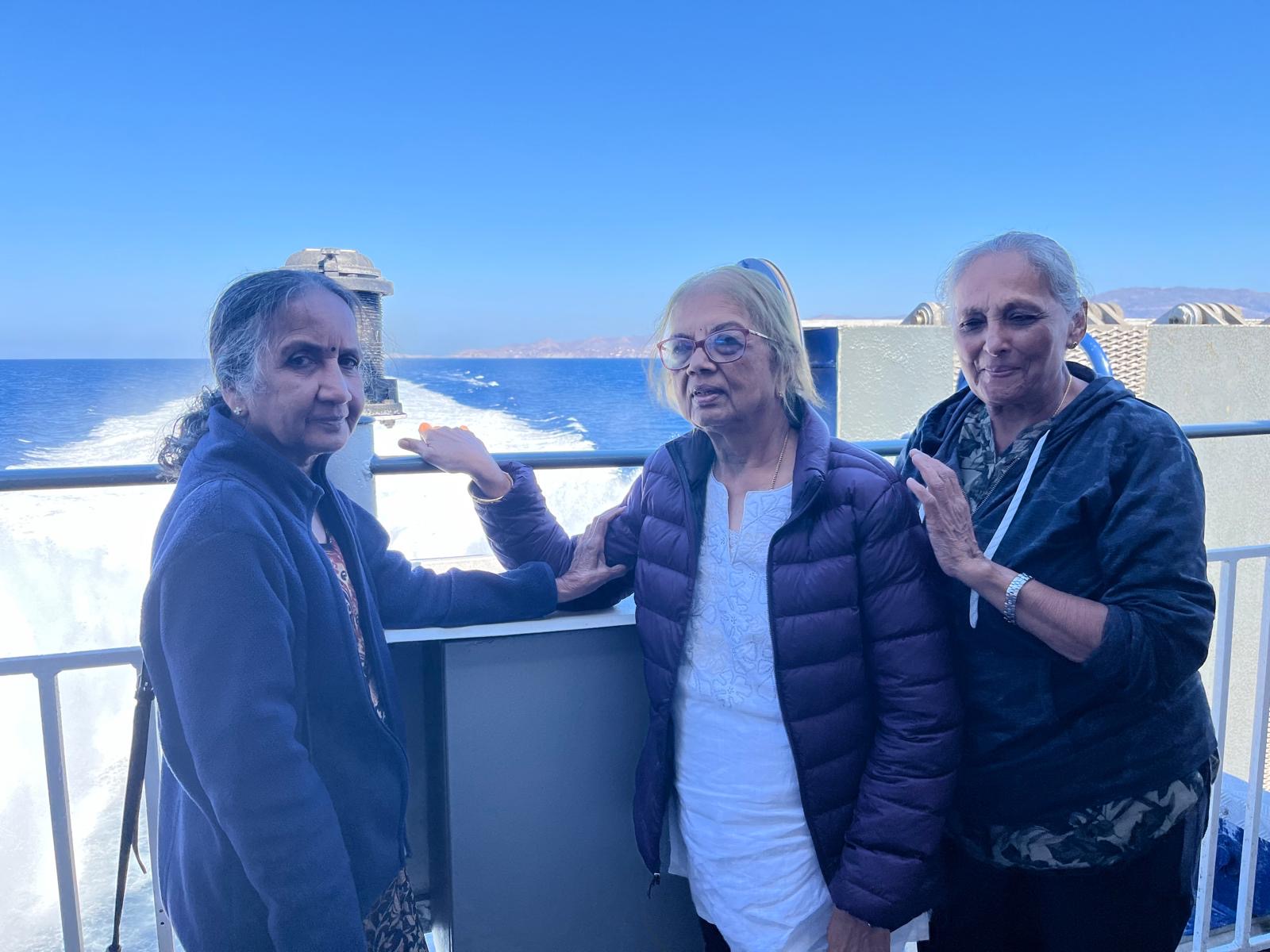
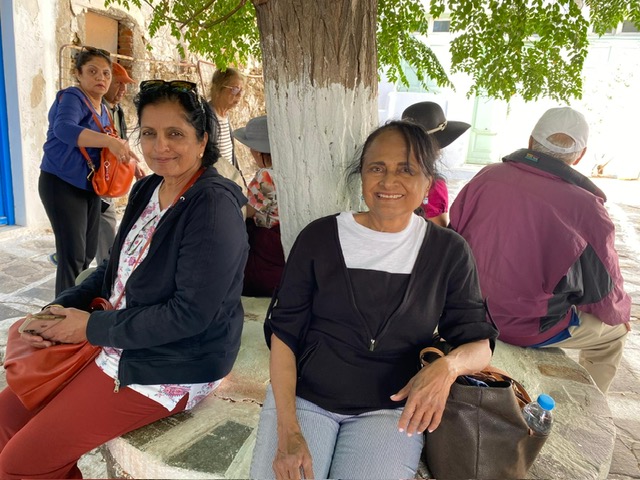
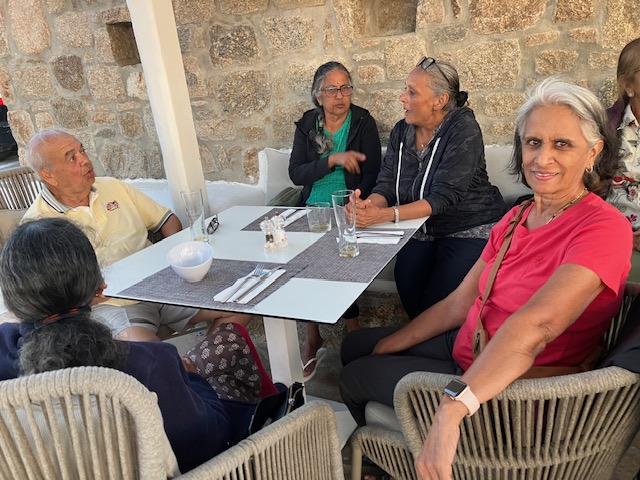
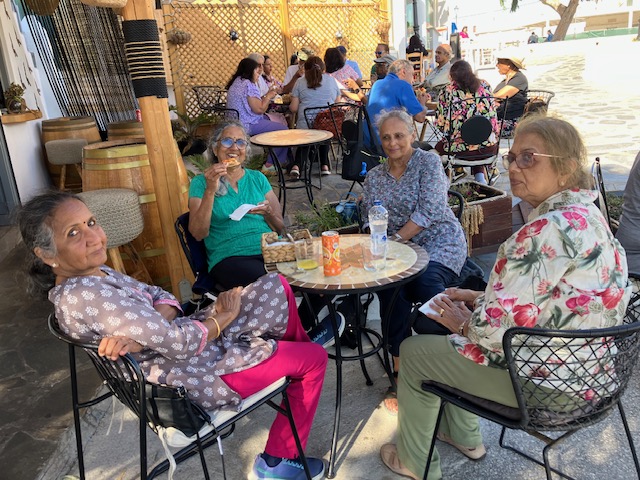
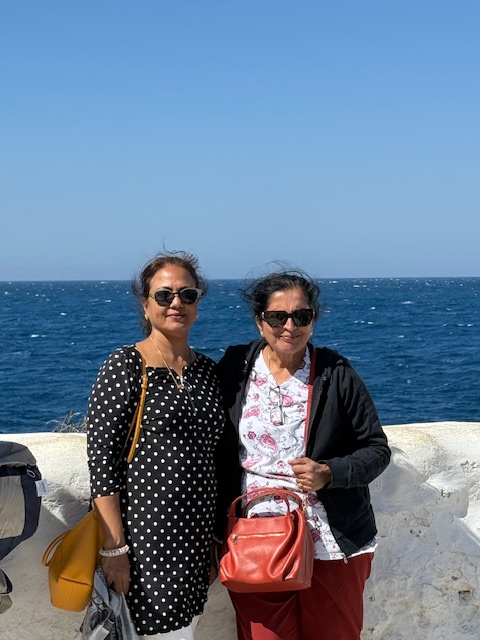
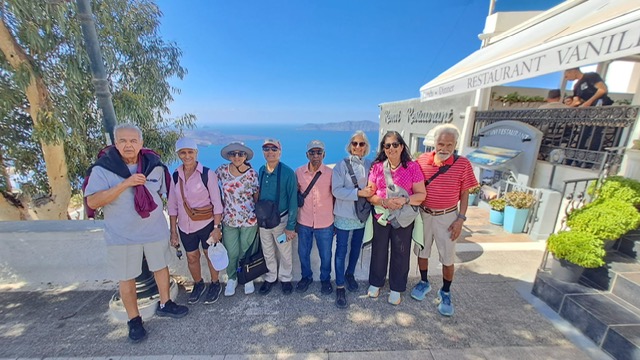
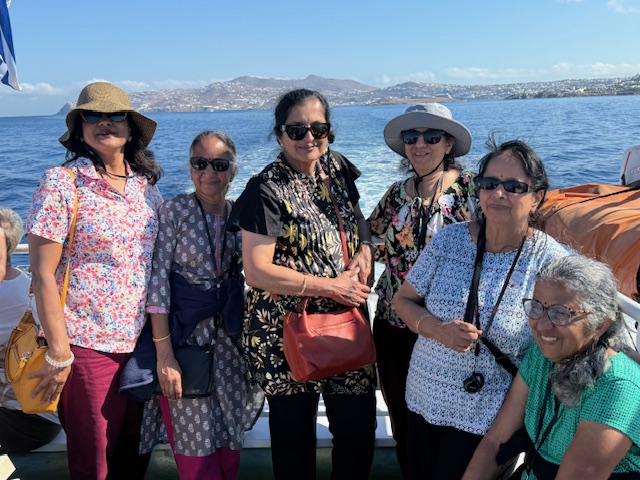
KK and Chitra in an old cave dwelling in Santorini, Radha, Lakshmi and Saroja and others on ferry, Rekha and Sashi taking a break during city tour

The inner parts of the island of Mykonos was not particularly remarkable, some dry vegetation and grape “bushes” growing here and there.  Straight on we were taken on a walking tour of the small city.  There were some quaint windmills, different looking than usual, a large built up area near the ocean where people could lounge around.  Then we went to lunch.  Our guide on the island was a young girl who, though sweet and friendly, appeared to be a trainee with not much knowledge.  Her English was ok.  Though we thought we were having a local lunch we ended up at an Indian restaurant after a long mountainous drive.  The climb up from the parking lot to the restaurant itself was also a put-off for some of the weary travelers who did not do well on slopes!  But we all made it and the tables did have a spectacular ocean view.  After a simple lunch we headed to our hotels for check in.  Dinner at the same restaurant proved to be a much more  fun experience. More on that later.
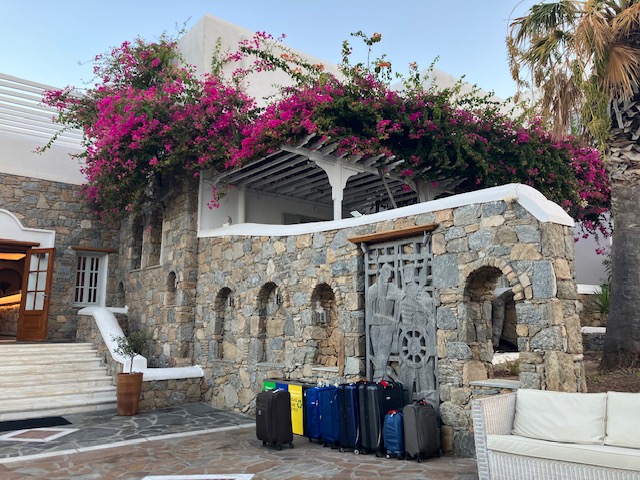
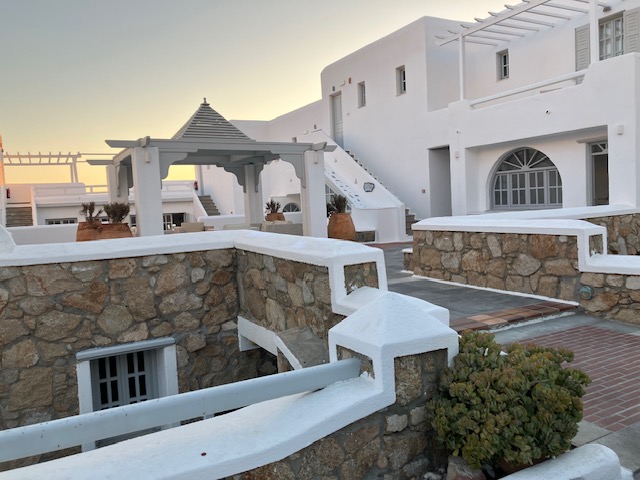
The beautiful San Marco hotel, relaxing poolside, the unique architecture of the area

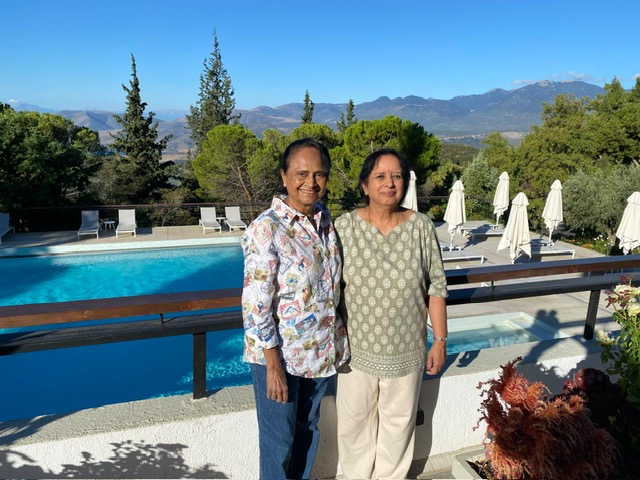
The San Marco hotel  was a pleasant surprise.  Rooms were mostly at ground level on the slopy road with each room having an outside porch with luxurious views of white washed charming one-story buildings and overflowing magenta bouganville bushes.  Built on a somewhat isolated part of the island  we could see the blue sea in the distance and a short walk took us to the coastline.  Some of us did venture out one day but found it isolated and rocky.  We rather enjoyed our time sitting by the gorgeous swimming pool and chatting and taking pictures.  The morning breakfast too extended out to a sunny porch overlooking the pool.  If it had been a month earlier we could have enjoyed a dip as well.

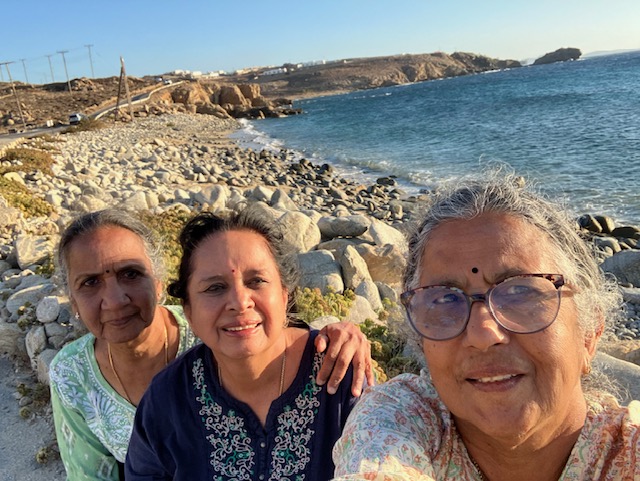
San Marco beautiful location and the pebbly beach nearby           

We stayed two overnights at the same hotel which made it very pleasant.  But by no means were we done with the archaelogical sites!  The next morning we took a ferry to the island of Delos which had an interesting history and was a wonder of bygone days.  But before that a note about the walking we had to do in Mykonos! Each time we got off the bus we were taken on a long, long walk close to the ocean till we reached our viewing points.  These were great but the long walk back did dampen some spirits especially towards the end of the day.  We had some  amazing sights of the ocean from this viewing point.  Normally these walks would have been enjoyable but we were asked to do it too many times!

            So, to get to the boarding dock for Delos we had to do our usual walk from the bus depot to the other end of the beach.  This time it was a smaller boat but we were out in the sun for a while and those who opted the upper open deck soaked in more sun.  I think we made up for a whole year of indoor living in US!  The ride was short and pleasant.  When we landed we found there seemed to be a scarcity of restrooms and our guide said “join me now or forget it!”  So we joined the group and proceeded on the tour.   This island is dear to the Greeks as Apollo and Artemis, the children of Zeus were reported to be born here.  A unique fact is that no one is allowed to stay here overnight although in its hey days around 167 BC, it was well populated.  Our guide took us on a detailed tour, pointing out closely- built living quarters, some boasting of mosaic ceramic work, flooring that has apparently survived centuries.  Even the remnants of  a sewer system was discovered here.  Among the other attractions were the remains of the temple of Apollo, his name carved on the low wall and the terrace of the Lions that included many stone lions, some intact, others damaged.  Again the Romans were blamed for the destruction of parts of the island and its abandonment.

At the interesting island of Delos, preserved mosaic and stone lions             

We were to have a local lunch but the restaurant got the dates mixed up and there was no way they could accommodate us.  It was sheer luck that right next door was a pizza place with many outdoor tables.  Perfect!  We were ready for pizza and it was great.    With a relaxed afternoon, we felt refreshed and that night we got dressed up for a special dinner at the Indian Palace restaurant.  When we got there, what we thought was a party related to a wedding turned out to be just other tourists dancing to loud Bollywood music.  Our turn came too and after eating we had fun doing some moves in the space between the tables.
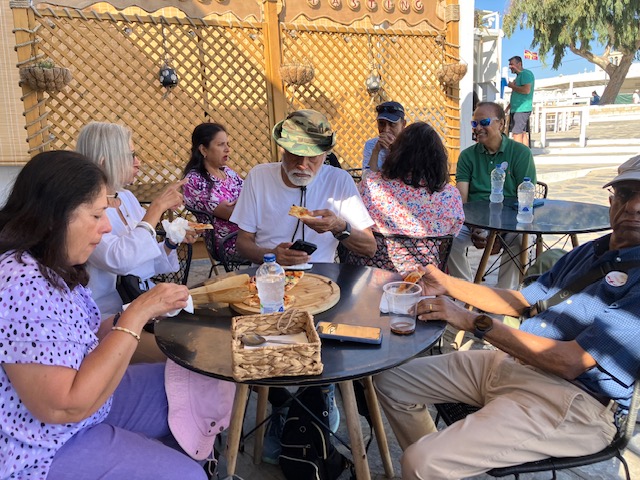
Delicious impromptu Pizza Party lunch in Mykonos!           

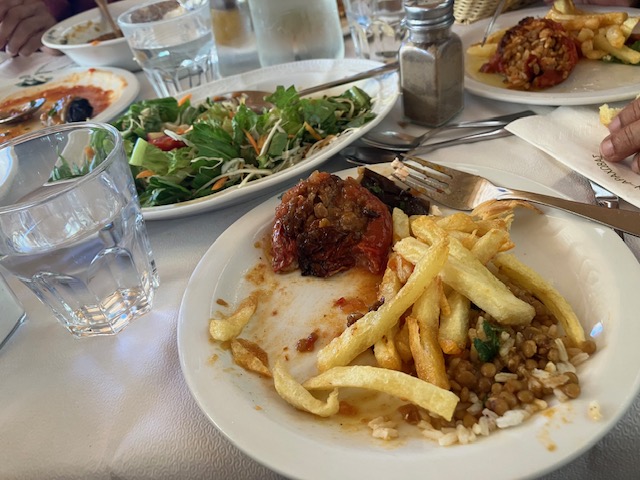
All too soon it was time to say goodbye to Mykonos and move ahead to the island of Santorini.  The next morning found us on the dock again ready to load our suitcases on the same ferry.  This time we knew the drill and the ride was also shorter.  Soon we were at Santorini.  Now if any of you have seen pictures of Greece, they feature the lovely blue and white domes and buildings, set close together on the cliff with the lovely blue ocean just beyond.  In fact, a Bollywood movie song was picturized here when the hero and heroine had to get off the plane that happened to land there for repairs! How convenient.  However, believe it or not, they keep this area well hidden and we did not see it till the last day.  We kept asking about it but the guide told us to be patient.  Santorini and its surrounding smaller islands were unique. One of them had the largest dormant volcanic caldera in the world.  Santorini is said to be one of the most-visited islands of the world after Bali.  The bus ride was pretty steep to reach the habitable parts of the island.  Our first stop was a local lunch and visit to the beach.  We were treated to salads, tomatoes and peppers stuffed with cooked flavored rice (a speciality of Greek vegetarian food as we got it everywhere) and delicious chocolate mousse and were allowed on our own to check out the nearby beach and shopping area. 

KK and Shankar, Local Greek stuffed veggies Chitra and Rekha

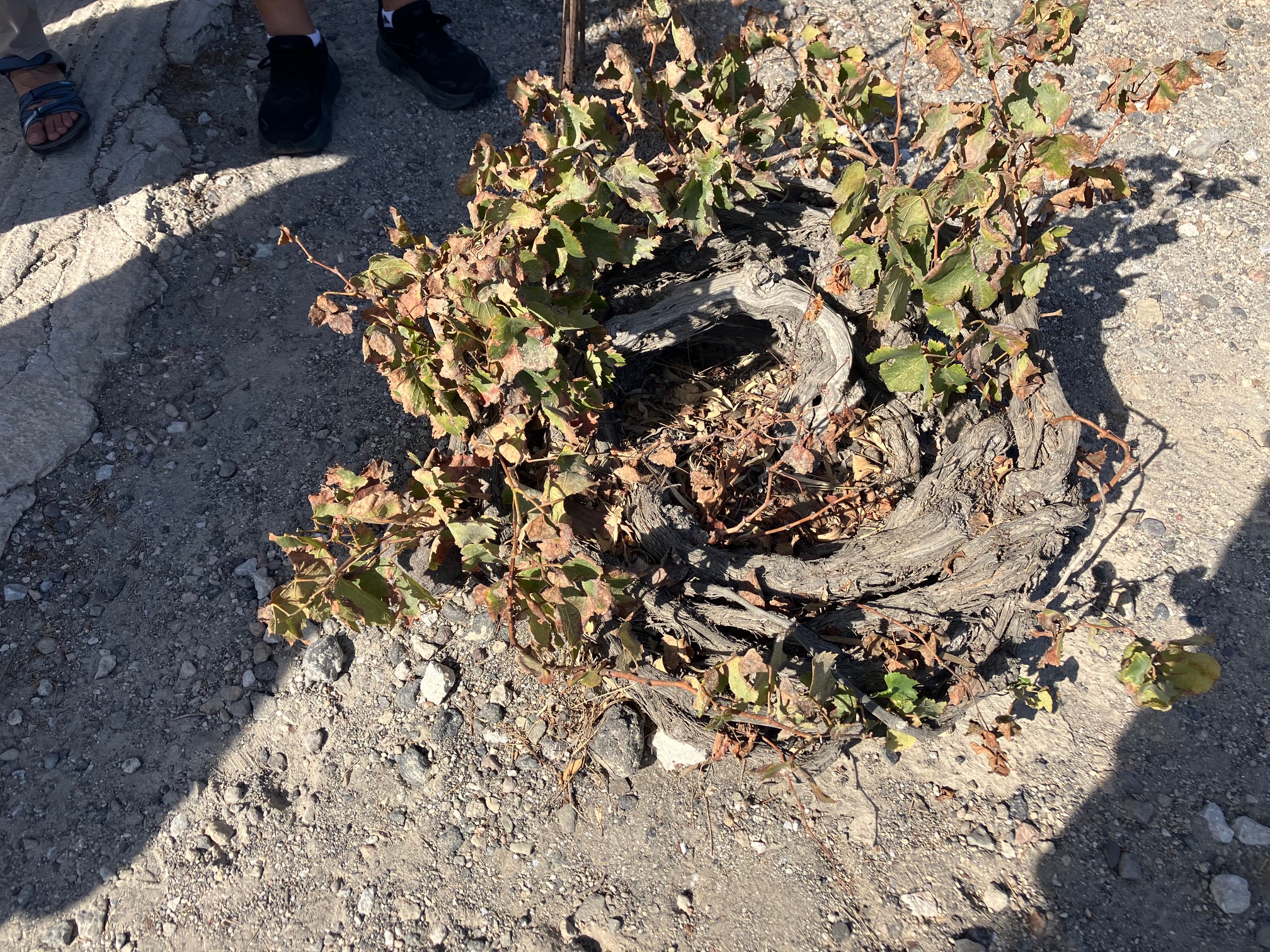
This beach was full of pebbles being volcanic, but people were having a good time lounging on the small strip of sand.   I think this is where we got our first gelato.  No comparison to the Italian ones though!  We had a lovely walking tour of Fira with its old pebbled roads and beautiful churches. We even went into a cave house from olden days.  Also had some wine tasting for those interested and a visit to an olive oil showroom where everyone bought samples.  A note here on the grape bushes.  Both on mainland and the islands grapes are cultivated on individual bushes that are just twisted into a round shape.  The wind on the islands aids in this also.  They were unique to look at.

            Our hotel named Splendor, definitely lived up to its name.  Five star once again!  It was fabulous!  Rooms were big and overlooking small pools and the ocean.  There were in fact pools everywhere making us regret the fact that it was just a bit too cool to jump in.  The hotel was in so many levels, some of the people needed a golf cart ride to avoid the steps.  The sunrise the next morning was spectacular and at night the stars were at their brightest, enabling us to view many formations including the big dipper.  Of course, the breakfast was an exotic spread including tiramisu and baklava.   As was the practice we had an Indian dinner arranged for us.  The first night the restaurant was a bit chintzy.  The eating area was small, they had no cutories  and the food average.  However, on the second day we visited Jaipur Palace and had an amazing dinner with hot crispy bajjis, delicious panneer dishes and rajma to mention a few items. 

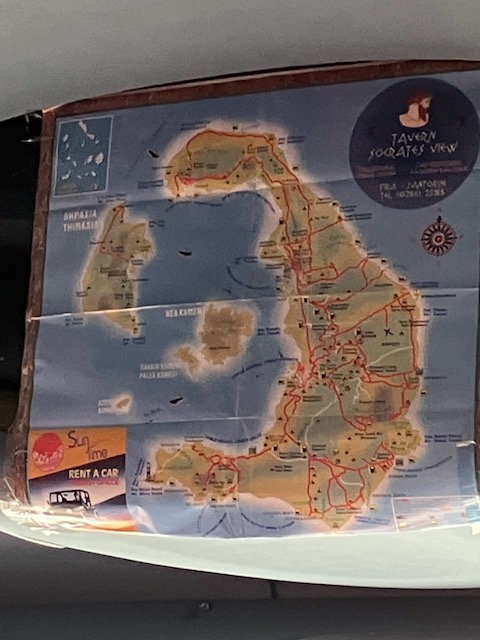
The rocky climb from the port, inviting swimming pools, a map of Santorini island           

Finally on the last day of the visit, we were ready for Oia to view the sunset.  The bus ride was long as we had to reach the very top of the island. On the way the expert driver took us to a view point and I think it was a cathedral though we did not go close to it due to time bind.  We could take nice group pics although the bus reversing close to the edge gave us some heart stopping moments!  At Oia, it had to stop at the base of the hill and we had to hike it up.  We all made it.  At first we met at a very large church square which itself was beautiful.  Then we were on our own to make our way slowly to the sunset viewing portion.
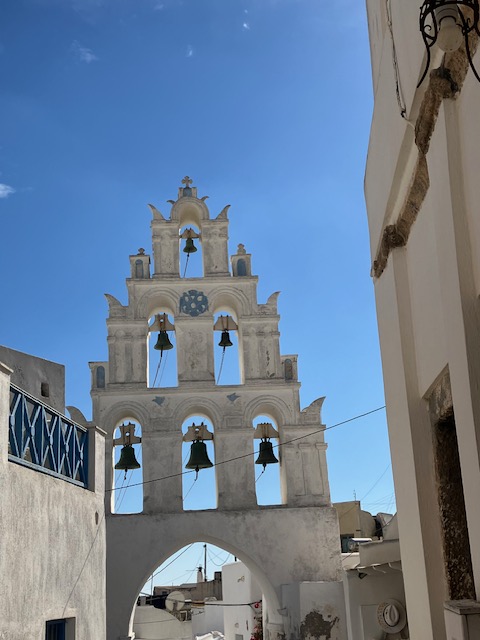
The beautiful Fira walking tour, taking a break and a mother-daughter moment!    

      At long last we were able to see the Santorini of the tourist brochures!  From the church square the blue ocean lay glimmering in the sun. Once everyone had assembled pictures were taken. Don’t miss the fact that we all wore at least one item in the blue color! The guide then hustled us along to catch a spot to view the sunset.  With shops on either side and some alleyes to view the blue domes at close quarters, we were excited.  But no, all that had to be saved for our free time after the sunset!  It appeared like everyone on the island was in Oia!  We hurried along the crowded narrow alley till we negotiated many small flight of stone steps built into the cliffs.  Eventually the ocean came in sight and we all perched here and there on the small wall awaiting the sunset.  Some sat on the wider steps facing the ocean.  It was good catch- up time as we reminisced about our experiences.  In front of us the ocean was dotted with evening cruisers in small boats, probably enjoying a wine and sunset experience with clear unblocked views!  Some others had already booked tables in tiny restaurant balconies for the sunset hour.  Slowly the sky grew pink and we could see the sun shaping into an orange ball that did not have a glare anymore.  Slowly it dipped into the ocean, much to the delight of those gathered there.  Yes some beautiful pictures were taken of the sunset and it was one more memorable moment for us to look back on.  On our return some of us found areas that offered closer views of the blue domes.  However one has to be on the ocean to get the full effect.  Others preferred the exotic shopping and secured nice gifts.
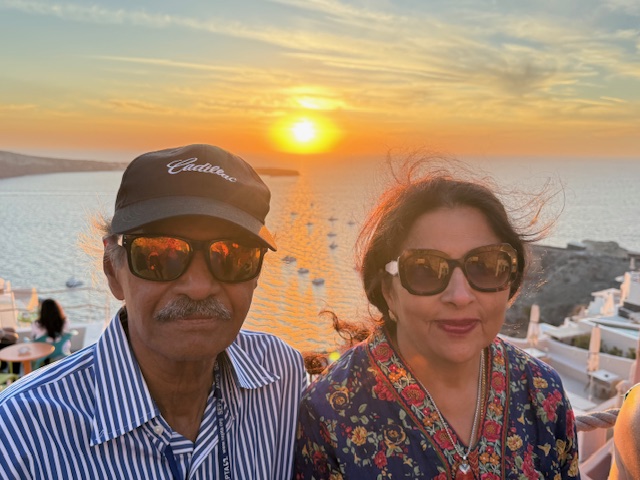
Oia sunset!! The group wearing blue to honor Santorini, the beautiful marbled church square. Above a Bollywood couple — wait, no, thats our Indu and Gopal 🙂           

Departure back to the mainland from Santorini was a staggered affair.  Most of the group were proceeding the next day to the island of Crete.  Four of us were to travel back by ferry to Athens, then take our designated car to the airport.  We felt we had all day to do this.  However, the ferry made stops at four islands! The timings had changed and we made it back really late after some rough waters as well.  By a miracle (and direct intervention from our tour leaders) we caught the flight after the booking counters had closed.  Our thanks to Emirates and our tour organizers.  Never have we reached an airport 40 minutes before the departure of an international flight!!

            We reached our destinations safely and now as we think back, it all seems like a whirlwind dream, we just have to reminisce those golden moments when time stood still in a beautiful country across the oceans from us.   I will post some pictures here of Crete as well that I found in our group chat.

Below the happy group in Crete!

Greece — Sunshine and Blue Oceans Part 1

{This is an informal write up about our travels and chronicles our day to day activities. Please excuse any omissions or errors. I am indebted to all my travel companions for their memorable company. I have freely used pictures from our group chat posted by many of you. If you wish to send any more please do so}

Our Lakshmi group had missed visiting Greece over the years and 2025 was the year it happened!  We were a group of 20 plus from the US, all except the tour guide, Shruti who was requested to be our guide and made her way from Dubai to join us.

This time Lakshmi too travelled with us which made the deal sweeter! Having meticulously planned this trip to the last T in conjunction with Bhavesh who is amazingly knowledgeable as to what we need, she totally deserved to enjoy it. So did the rest of us! Another VIP was my anthropologist daughter Shalini, who enjoyed being the knowledgeable one as well as the youngest in the group!

After an on-time arrival at Athens, we retrieved our luggage.  Many ignorant ones like me kept calling the city A-thens whereas the correct pronunciation we were told was Ath-ens!  Oh well, we might master it by our next visit!  Being US citizens, the immigration process was very simple and we were not charged any fee.  We finally made our way to the large bus after some delay as the driver did not hold up a sign to locate us!  Meanwhile we stood around near the exit, admiring the bakeries and other delicious looking eateries.

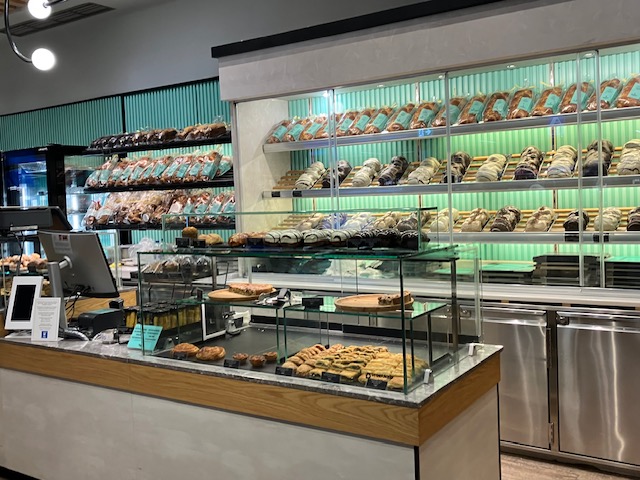
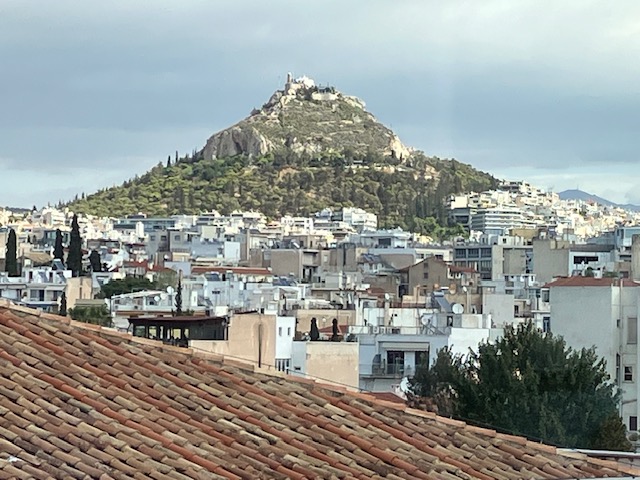
Bakery delicacies …… Flats similar to Bombay …….. Views around Athens

We found the city to be somewhat similar to Mumbai of by-gone days when we lived in India.  There were many apartment buildings that were only 4-5 stories high.  Later on a guide told us that the city of Athens tried to follow the rule of not allowing sky scrapers in order to keep visible the day and night view of the Acropolis, which was on a hill and a spectacular sight!  The night time lighting made it really worthwhile to view and we were able to do this the next day.  One more thing that’s quite funny!  We all finally understood the expression “its all Greek to me!”  The signs were in the local language long and mind boggling.  What looked like letters in English suddenly turned in every direction and made no sense at all!  Of course this is a bit of exaggeration as all important tourist areas had English signs as well.

We all met at the Radison Blu in Athens, some in our group had already arrived on earlier flights.  After the long and mostly sleepless flight, we were happy to be quickly allotted our rooms where we freshened up and met again in the lobby to proceed for dinner.   Our tour manager, Shruti, was a very pleasant no nonsense type of person who made it clear that being on time was our first priority.  I think every person in our group kept up this condition.  The penalty for being late was steep – buying gelato for the whole group!   We proceeded to the Indian Chef restaurant for a quick buffet dinner.  The items were the usual, but the Greek yogurt here and at many other restaurants was delicious and available in generous portions.

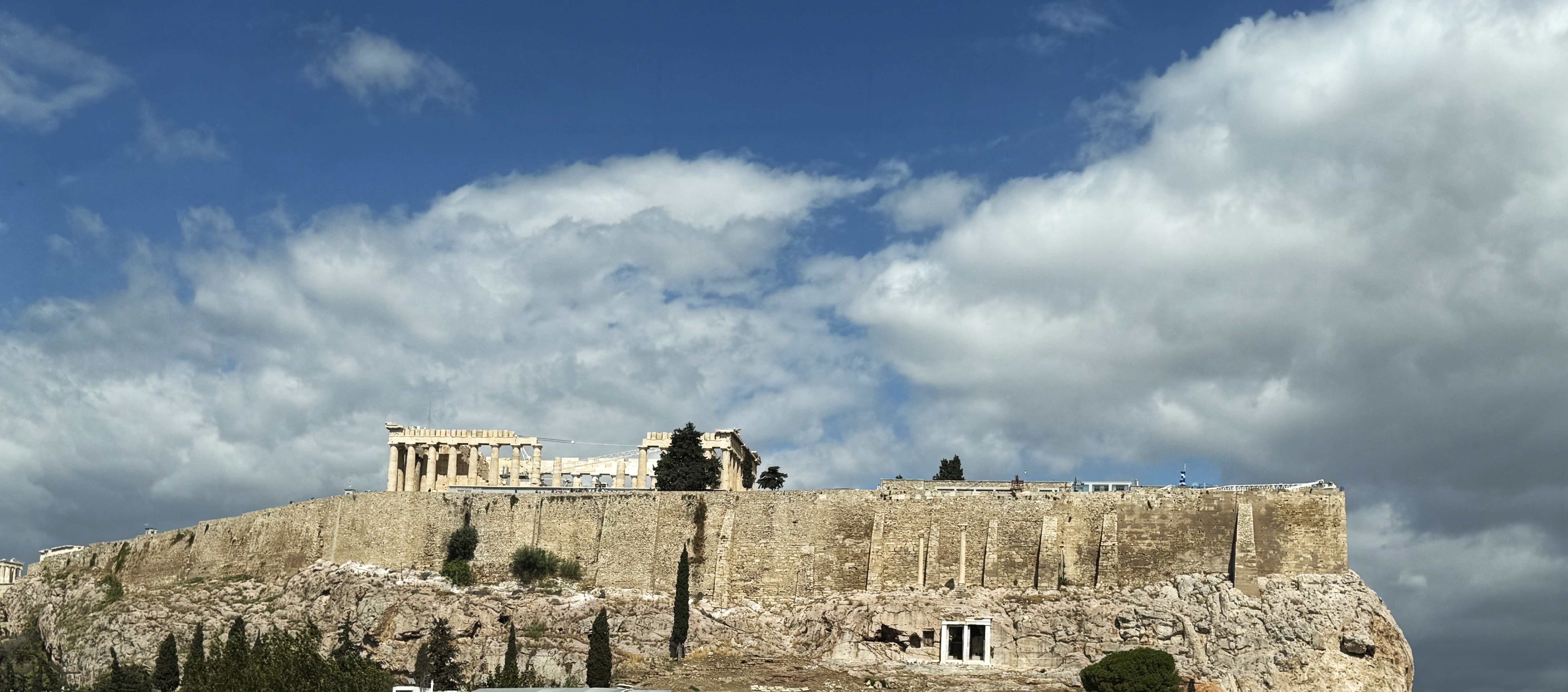
The Parthenon on the Acropolis

The next day was a very big day for us and the sun was shining with high intensity throughout our trip.  Not a single day of rain!  September is the perfect month to visit! We started with a drive- thru bus tour of Athens and many important buildings and sights were shown to us.  Along the drive we passed archways and statues. Notable was the Hadrian’s arch.  Corinthian and Ionic styles of pillars were mentioned.  The naked male depicted in some statues was always a god or a hero and he held his shield till death, a matter of honor, we learnt.  One place caught our attention, an official building where a ceremonial change of guards takes place every hour.   We were told this is in front of the Hellenic Parliament building on Syntagma Square.  A crowd had collected to witness this but we had no time to stop.  Our city guide who had boarded the bus earlier on informed us that the guards wore kilts and special shoes that weighed something like 6 kilos each with a metal bottom so they could make the impressive clicking sounds on the stone floor. Among other general information our guide told us that the present- day graduates found it difficult to find employment in Greece and English was being taught in schools and  universities so the youth could move to other countries and find jobs.  Indeed the only activity apparently seemed to be growing of olive trees and resultant olive oil industry , some wine production and of course, tourism.

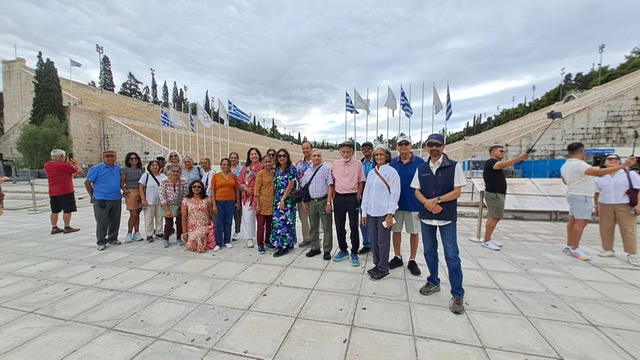
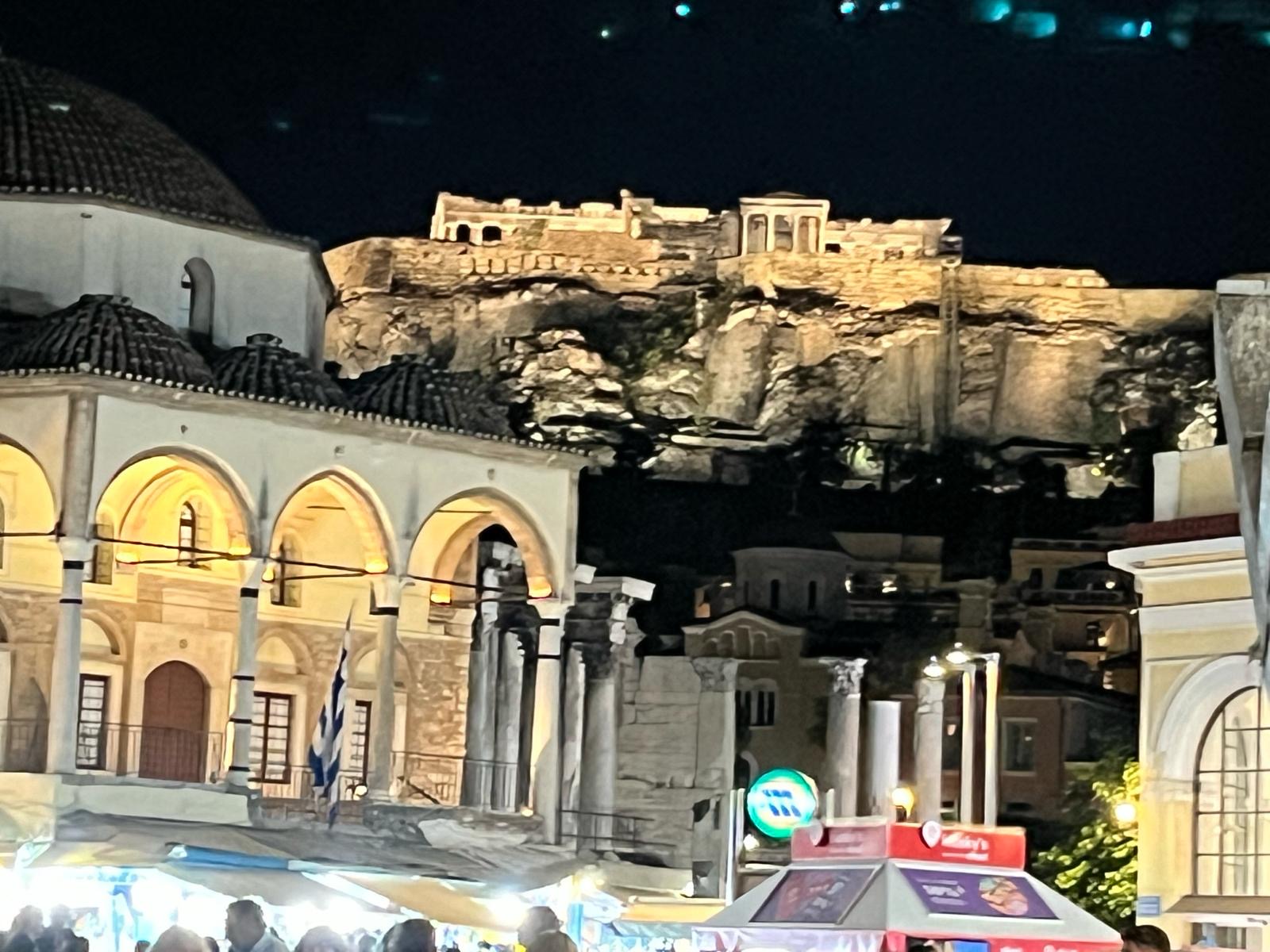
At the Olympic stadium ……….. and a beautiful night view of Acropolis  from the market square         

The first stop where we got down was the  Olympic stadium.  We were told that the Olympic flame, contrary to popular belief, does not burn continuously.  It is specially lit some months before the games are due and transported to the host country.  Currently the stadium which is built mostly of marble is used as a venue for sporting events, cultural shows and socialization.  Referred to as the Panathenaic Stadium, it was rebuilt around 1890 on the ruins of the original arena from the time of Zeus. It has a massive capacity of about 80,000.  We learnt more about “the Games” when we visited Olympia and were totally absorbed in the thrill of the origin of the historic event that has lasted till this day.  This stadium as well as the Spyros Louis stadium built in 2004 served well when Greece hosted the Olympics and Paralympics.

The Acropolis at dusk and from a different view        

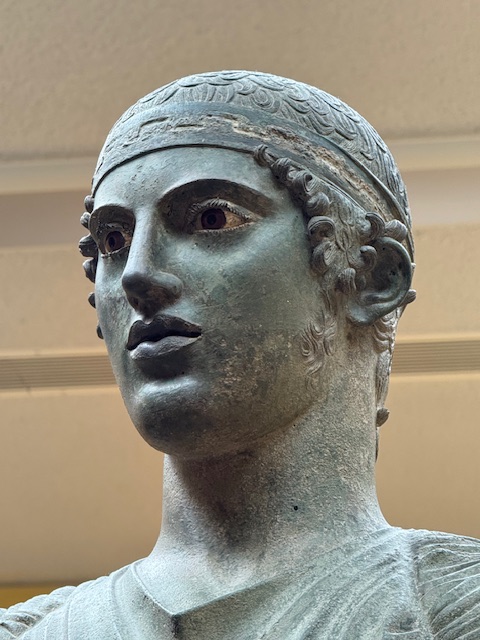
The highlight of our day’s tour was a visit to the Acropolis which included the museum.   Though full of ancient artifacts and beautiful displays, for us it was a bit tiring to view as the guide took us from piece to piece, some headless statues, and gave us very detailed information.  As a result most of us were drained out even before the strenuous climb up the hill.  Initially we were quite intrigued by glass floors in some areas built over ancient edifices. We could walk over these.   A  “man cave” was pointed out to us.  We also saw four or five different models of how the Acropolis might have looked in different time periods.  Among the artifacts were miniatures of household articles from ancient times that were likely included in the wedding trousseau.  Perhaps the pictures of the artifacts will speak more than words.  But a fact to be admired was that many individual statues were beautiful from top to bottom with each leg detailed and separate.  This we were told was unlike Egyptian statues that were carved into the rock wall mostly with much less detail.  Indeed many had stunningly beautiful forms.  Particularly fascinating was the winged statue of Nike, since the name is so familiar to us!  One unique and fascinating display, though from modern times, was a huge Lego block model of a Greek stadium and its environs, gifted by Australia from Sydney’s Nicholson museum.

Beautiful artifacts at the museum …….  Lego wonderland

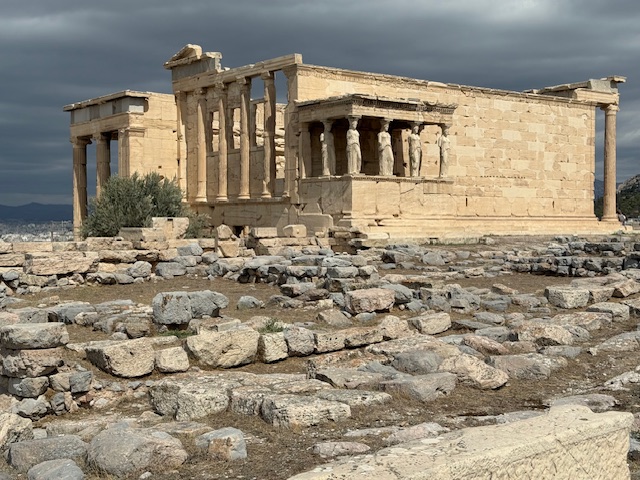
We were ready for the outdoor part of the visit to Acropolis (literally meaning the city on the hill) and within it the famous Parthenon, 490 feet above sea level.  It did not disappoint!  The climb, though a bit tough was not too high or time consuming.  The steps were wide but loose rocks were to be avoided; we were careful and managed well.  The top covered an area of approximately 7+ acres.  The main buildings that still solidly stood their ground were beautiful in white marble and much photographed.  The present remains date back to approximately 429 BC although it appears that several were rebuilt on the site. Sometime later a temple dedicated to Athena in the Doric style of architecture was also added, hence the name of the city.  We spent some time soaking in the vibrations of the past and then carefully made our way down.  That evening we got  beautiful glimpses of the Acropolis from a market square where we were dropped off for shopping or browsing.  As the dusk fell, the night view was even more breathtaking.  The lighting was subtle, yet so effective.  While the daylight was still there, we made a quick visit up the hill to view from a distance the Chapel of St. George. From that high point we got an amazing view of Athens city.

Group near the Chapel of St. George

The market was quite nice, rows and rows of shops selling artifacts, geared mainly to the tourists.  Notable among the purchases for gifts were the shawls, T-shirts, ceramic items and miniatures of Greek architecture.  We were taken for dinner to an Indian restaurant and enjoyed dosas, vadas and other South Indian fare.

Beautiful statues ………. Beautiful ladies           

Side view of the massive structure ……. Lakshmi, Radha and Shamla …….. Temple of Athena        

          Day three dawned and bright and early we had to leave on our road trip.  Actually we had to check out of our hotel rooms as we were going to spend the next two nights in Olympia and Delphi.  We were permitted to leave behind any luggage in storage but since the bus had a large hold area, many of us preferred to take it along.  What if we needed something that was left behind?  The drive was very pleasant and we were entertained to live Bollywood music by talented singers Murali and Chitra and a few others.  It was a sunny day and a very pleasant drive.  In the countryside we got to see lemon and other citrus orchards, bouganvillae and even an occasional pomigranate trees with fruit. 

Flowering bush, citrus tree and a pomegranate bush laden with fruit

Soon we made a stop to see Corinth Canal.  Confession:  I had to Google to find out which bodies of waters this beautiful man-made canal, completed in 1893 connected.  If the guide had told us, I bet none of us would have remembered.  It actually connects the Gulf of Corinth in the Ionian Sea with the Saronic Gulf in the Aegean sea. It is 6.4 kilometeres and around 80 feet wide.  We stood on a bridge to marvel at the smooth sides hewn from rock and a strip of water down below.  Sadly, modern ships are too wide to pass through and it is deemed mainly a tourist attraction.  Along the way we saw individual grape bushes, no trellis or ropes to train them.  More on this intriguing method when we visited the wine production and  tasting sites.

Delicious Dosa at Dosa King ………………… The unique Corinth Canal, one of a kind 

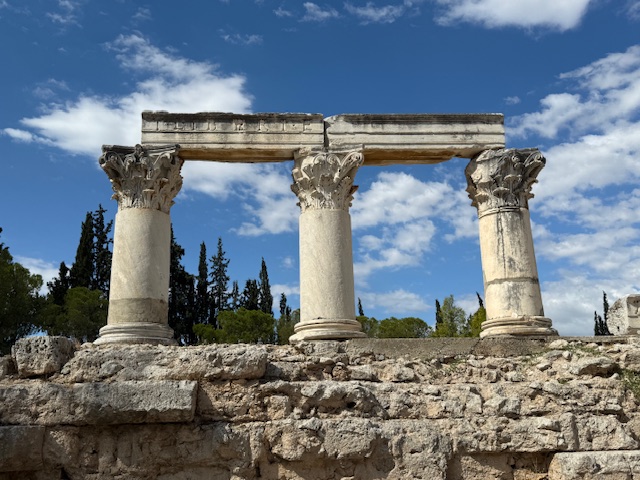
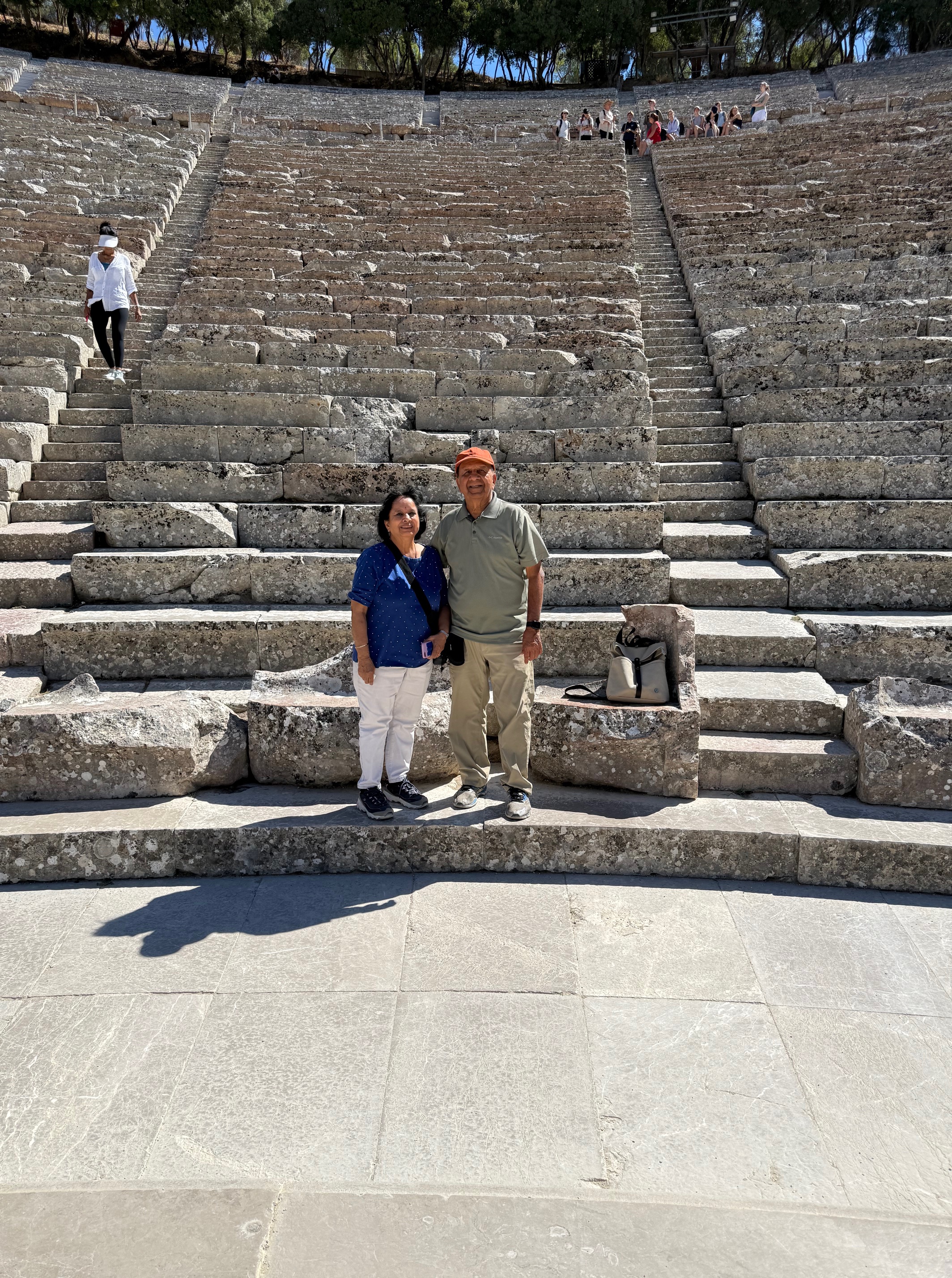
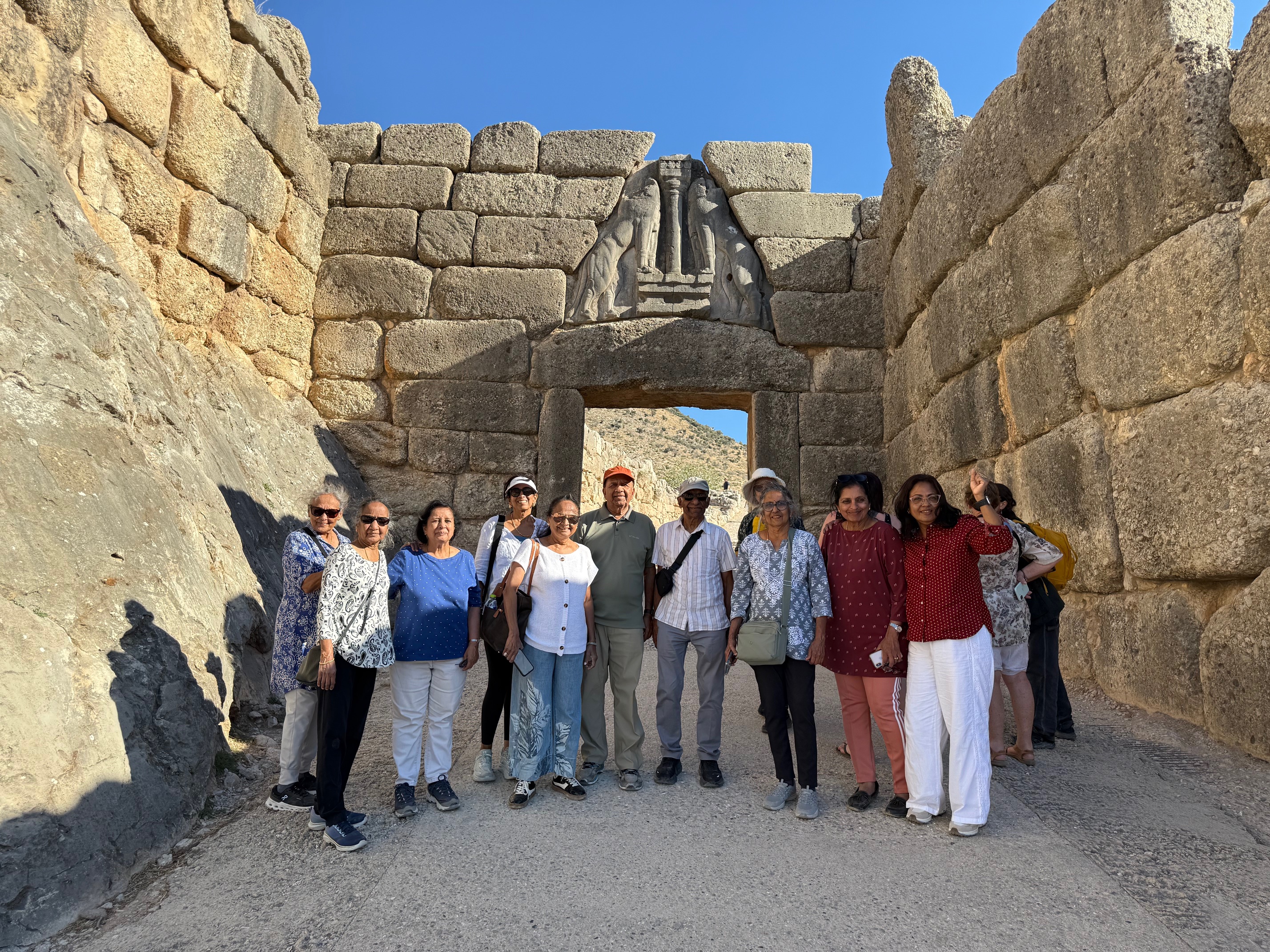
    Our itinerary included Mycenae and Epidaurus on the same day.  Again more impressive ruins some more preserved than others.  If you thought that Epidaurus had a medical ring to it, you were absolutely right.  The ancient doctors here treated their patients in a unique way. In bygone days,  people even made stone casts of their limbs and sent it the doctor ahead to diagnose the problem!   The arena in Mycenae was put to good use to expose people to music, laughter and entertainment to heal them.  Apparently people came from far and wide to avail of these treatments.  The Lion Gate was pointed out as was a viewing from a small hilltop.  Mycenae and Corinth had extensive ruins and even prayer halls and arches were shown to us. The scene from a viewing platform gave a complete picture of how the living quarters were.  In addition Corinth is reported to be rebuilt by the Romans after they destroyed the original Greek one.  The presence of many pillared structures still partially standing gave us amazing ideas of the ancient town.  Only our pictures can bring back these precious memories.

Ruins at Corinth

Stadium at Epidaurus …… Part of our group at Lions Gate and a close up of lions at Mycenae

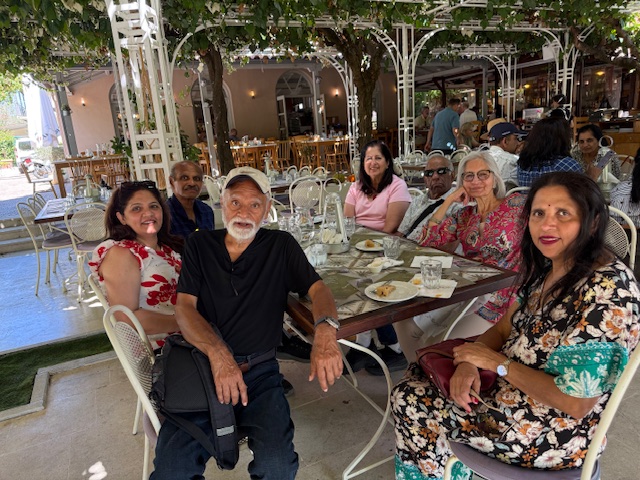
Loved the local lunch on the way, though it was nearly 3 pm! We were served deliciously cooked eggplant, zucchini patties and tomatoes stuffed with rice etc. with brownie and ice cream for desert.

Enjoying the delicious local lunch

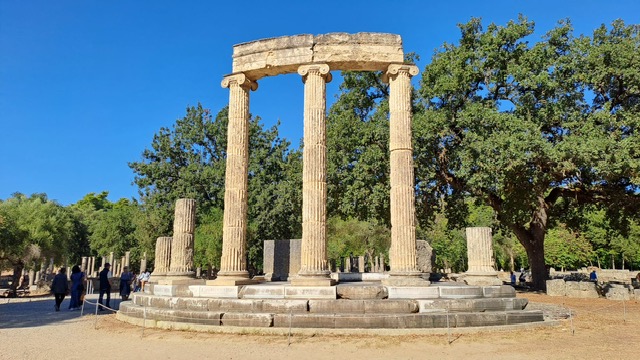
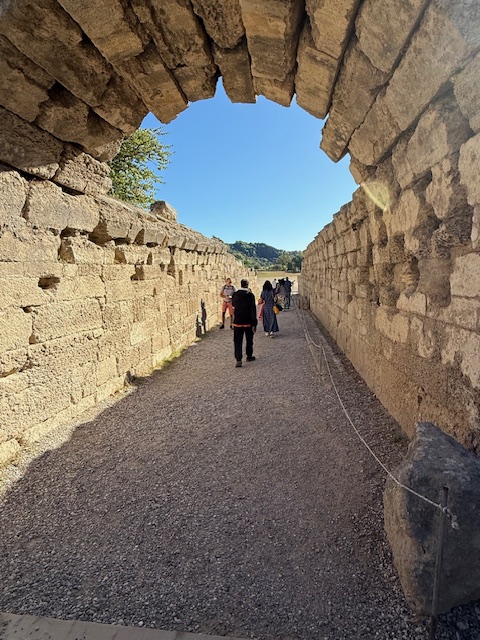
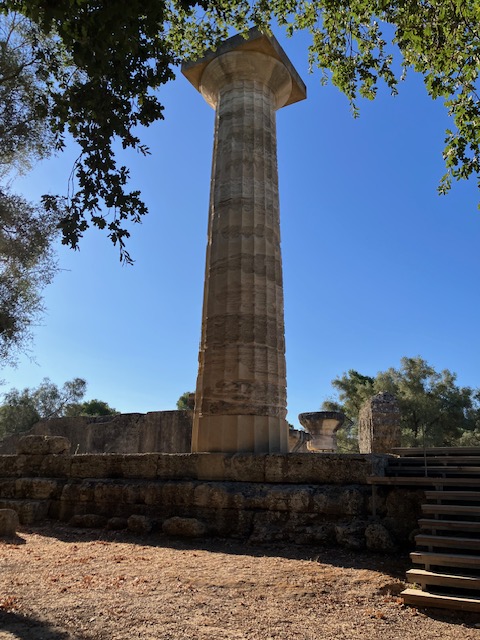
That night it got quite dark before we reached our hotel.  We found the Amalia Olympia to be extremely spacious in its lobby areas, the rooms comfortable and their buffet dinner to be tasty and substantial. We made an early start for our tour of Olympia.  This was perhaps the most exciting part of our foray out of Athens.  Not because the ruins were impressive or the architecture amazing, but the sheer knowledge that the world famous Olympic Games originated here and were held regularly originating in 776 BC till they were disallowed by the Romans around 391 AD.  The excitement was palpable as the guide explained everything to us and every added fact that we were unaware of made the level of anticipation go up even more.  For example, did anyone know that in ancient times, participants ran naked in the races with the purpose of having full equality and no one had an economic advantage?  There were no gold medals, but the winners had statues erected for them and received a crown of olive leaves. Of course winners were celebrated when they returned to their own villages and given many privileges.  There was a row of shame too for those who cheated!  Only men were allowed to be participants or the audience. The participants first visited on site the temple of Zeus (where the colossal statue of Zeus was installed but later moved and destroyed in an accidental fire). Then they had an area where they could train for their events.  Finally they walked through the famous archway to enter an arena, not circular, but a long field.  The audience sat on the grassy slopes to watch. Yes, our group too entered, we stepped on the famed arena of bygone victories, some ran a stretch and made memories with videos.  We certainly enjoyed the thrill.  After listening with rapt attention to the guide and doing a tour of the attached museum, we left the village.  Viewing the current Olympics will never be the same for us as it will be colored with the memories of the original ones and our unforgettable visit.

At Olympia stadium and fields…. Zeus temple pedestal …the museum featuring Hermes …The archway leading to the Olympic field, our runners ready for the final dash!!

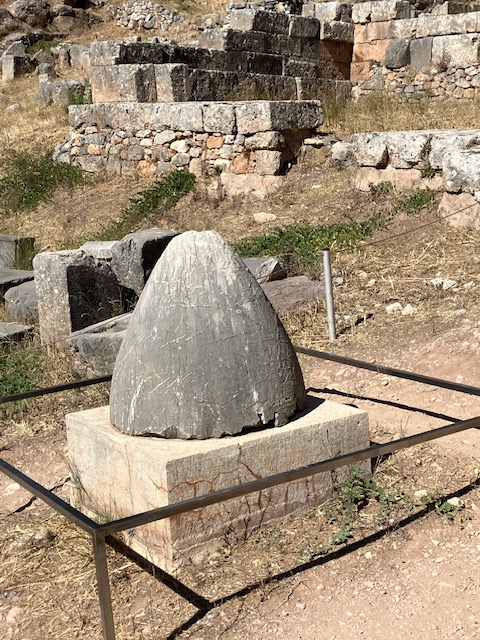
  Looking back it is almost impossible to recapture every site and what it was famous for!  Everywhere we went into archeological sites and beautifully arranged museums that displayed the excavated artifacts.  However, the temple of Apollo in Delphi will be remembered by our group if not for anything else, the “lookout” for a “lingam” that was rumored to be there!  Whether we found it is questionable, but the search was interesting!  
The climb up the hill was a bit challenging but the huge architectural remains of the temple atop was very impressive against the mountain background.  In fact Shankar and Shalini even climbed up further to view a stadium.  We all waited for them to return by the specified time ….. and they did!!  No gelato 😦   In fact we were so busy there was no time for gelato till we reached one of the Greek islands.

            For a welcome change we were taken to a honey farm.  Here we learnt that honey was a superfood.  Every part of the hive, including the wax was useful and had extraordinary properties. Worker bees were females, males were drones and good for reproduction mostly! (I could see women agreeing!!) The Queen bee has the option to fertilize male or female eggs. It was a family run small operation and we really liked the young lady who owned it and made the presentation.  We made her happy (after the honey tasting) by buying her products including cosmetics made with the wax. Later we visited an olive oil factory but as it was not harvest season we could not see the process. However everyone bought tins and bottles of EVOO to take back as gifts!

Honey Farm and an inviting pool at our hotel

The Amalia hotel in Delphi was really scenic and amazing. With the picture perfect weather, it was a great photo-op for all of us as we strolled their manicured property. Our drive back to Athens was uneventful but we did have a treat in store.  For dinner that night, we headed for Acropole restaurant where along with dinner we were promised a cultural show.  This comprised of lively music (they honored our request for Zorba the Greek and also played Never on a Sunday!) and even more lively dancers, two pretty girls and a guy who danced extremely well. They changed costumes couple of times.  Later they invited the diners to join them on the floor to try some Greek moves! The food was average but we compensated with ordering our own baklava which was generous and accompanied by blobs of ice cream.  It was a lovely way to end the mainland visit.  We had so much more to see and enjoy and even relax in the islands.  We were catching the ferry the next morning.

Greek entertainment and food! Baklava and ice cream

****** STAY TUNED FOR PART 2 ON GREECE, OUR INTERESTING FERRY RIDE, THE LOVELY HOTELS IN MYCANOS AND SANTORINI AND OUR SIGHT SEEING ADVENTURES *******

The Greek Krishna we found in one of the museums

Muscat, if you need a quiet getaway

Write up dedicated to my sister, Malathi, who lives in Muscat and loves it as much as her original city of residence, Mumbai

Shankar and I along with my sister Malathi and neice Shubha pose at the beautifully intricate sanctum of the Sultan Qaboos Grand Mosque in Muscat.

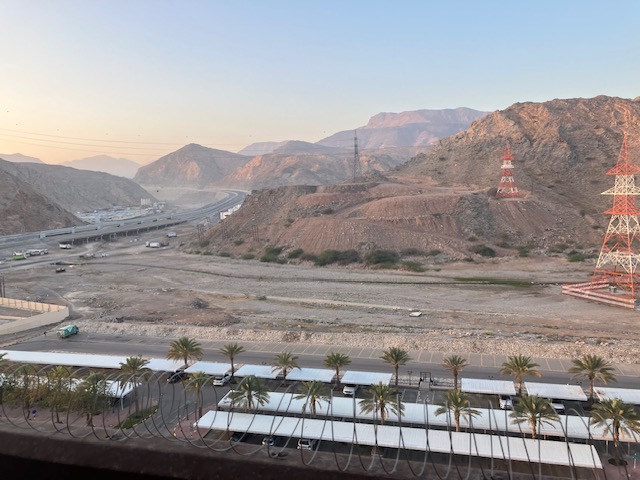
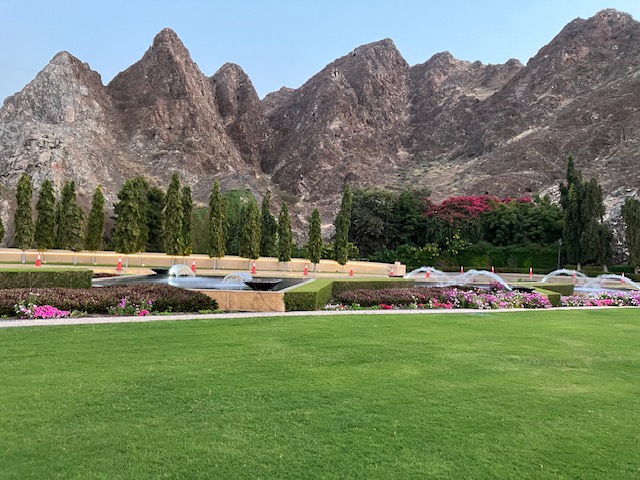
            Two things about Muscat really stand out – one that you cannot find a scrap of paper or any junk on the streets and two it is surrounded by mountains that are stark and bare and have no foliage.  But even a short visit is enough to convince the tourist that this is a really nice place to live!
            Among other things I liked Muscat for the availability of Indian food and the price of almost everything being quite reasonable compared to other towns we have been to.  More on the food later, it’s a topic by itself!   The mosques and places of interest we saw were also unique and pristine.

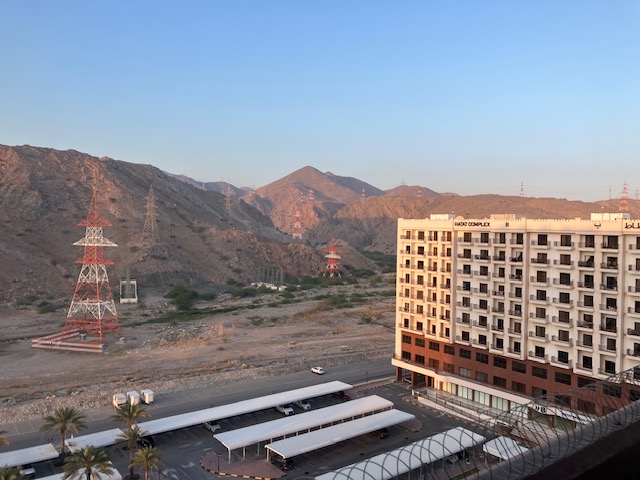
View of the stark surroundings One of the residential complex buildings           

Muscat is quite socially advanced with women getting excellent treatment.  The headscarf or any extra covering is optional though many do it to uphold their culture.  Female drivers are quite commonly seen on all roads.  We did not visit Muscat with a view to doing a tour.  We were visiting relatives, my sister, niece and her husband.  They are working in Muscat and have had an earlier stay there also.  In between they were in India for some years.

            My niece planned an excellent tour for us.  Firstly the apartment and the complex they had chosen to reside in was lovely.  The apartment was very large by standards of other cities, especially Mumbai!  There were many balconies, passage areas and the rooms were in general, very large.  The two building wings were multi-storied.  The complex also provided swimming pools, walking areas, meeting room, a library  and a children’s park.  The population staying there, many of Indian origin, were also young and vibrant, celebrating festivals and organizing fun events for neutral days like Valentine’s Day with eye catching red décor and lights.

            We were pleasantly surprised to find there were two full-fledged Hindu temples within short driving distances.  On day one we visited the Shiva temple which was small  but beautiful in an older section of the city.  It was well maintained, only the parking being a bit difficult to find spots on weekends.  Outside vendors were selling fresh vegetables like drumsticks and plenty of fragrant karipatta.   For lunch or should I say appetizers, because my sister had already made a delicious lunch, we went to a place specializing in pani puris and it was delectable.    The standard as good as India.

A lovely carved and decorated bull  outside the Shiva temple        

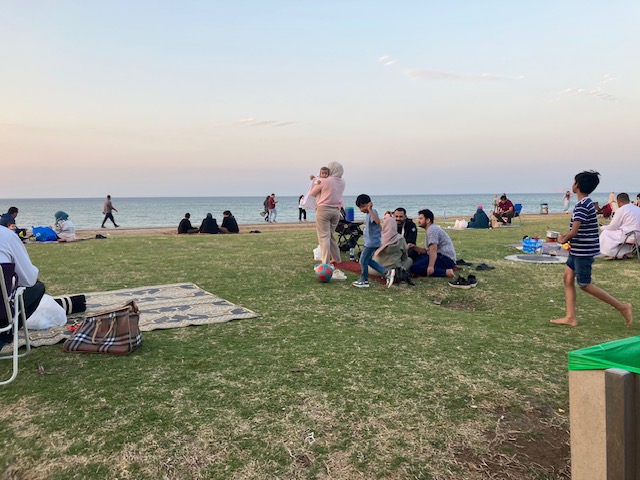
Our second day morning was reserved for a small shopping spree in a famous LuLu store nearby.  Wow!  We were impressed with the large selection of items and vegetables.  In Muscat one need not go to an Indian store to get their daals, attas and other typical groceries.  All the LuLu stores carried them.  In fact some items like atta was even manufactured in Oman.  Besides Indian items there was everything from A to Z from many parts of the world including imported chocolates in profusion from UK and Europe.  There were always promotions and the prices seemed very reasonable.  After lunch and some rest, we made our way to Qurum Beach which was a very clean and scenic area.  Families came there in the evening to spread their sheets on the large grassy area a short distance from the water and the children could play and picnic happily.   The sunset was gorgeous and we could view it as we walked on the built up pathway closer to the water with an uninterrupted view.  The next day we set out in the morning for a tour of my neice’s hospital which is actually government owned.  It did come with some perks like generous amount of vacation days and a schedule that was not overwhelming.  We drove around in many areas of the petroleum development corporation (PDO) and saw the numerous villas owned by them and given on rental to the employees.  Since the homes were built on the hillsides with occasional view of the ocean, it proved to be a scenic drive.

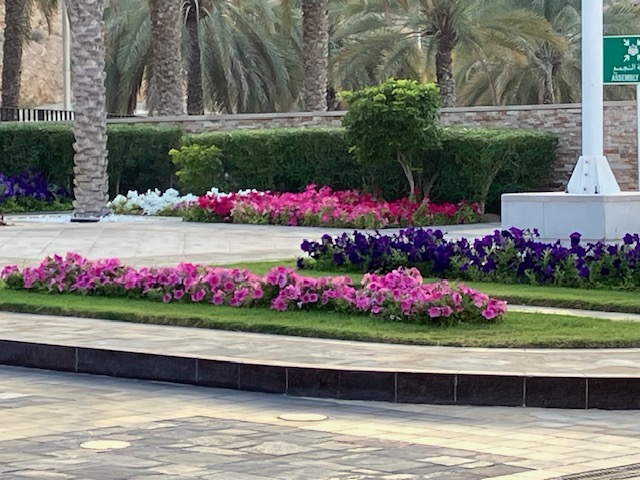
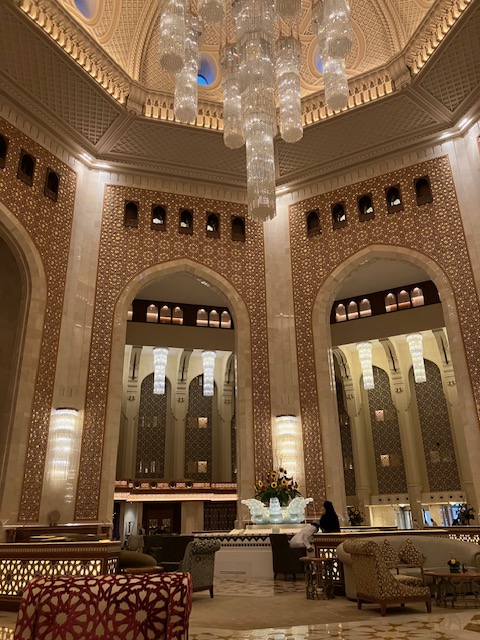
            That evening we went to the Jumeirah Muscat Bay hotel and enjoyed viewing their outdoor landscaping and the beautiful lobby.  This was followed by gorgeous views from the Al Bustan palace hotel which also had a lovely lobby area.  That evening it was our plan to try out a idly-dosa place named Gokul and I still cannot stop singing praises of their quality and reasonable pricing. 

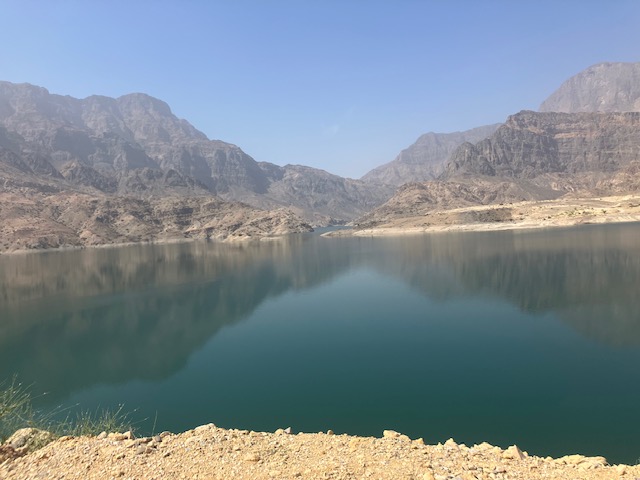
            Wadis are famous in the middle east.  Basically it is a stream in a valley that flows when there is the rare rainfall and flash flooding happens sometimes.  This day we visited Wadi Dayqah dam which was about an hour and a half drive away from Muscat city.  The drive was pretty mountainous through the Hajer mountains.  As expected there was a small garden with plenty of picnic tables close to the reservoir.  The dam was nearby and we could walk the short distance to it.  Given the pleasant sunny weather we enjoyed the outdoors and had our samosa snack there.  And upon return home we saw the famous sign Wadi Adai in the turning near our complex and as always, had a little laugh because Adai is an Indian snack!

At the Wadi Dayquah which was a lovely out- of -town half a day outing           

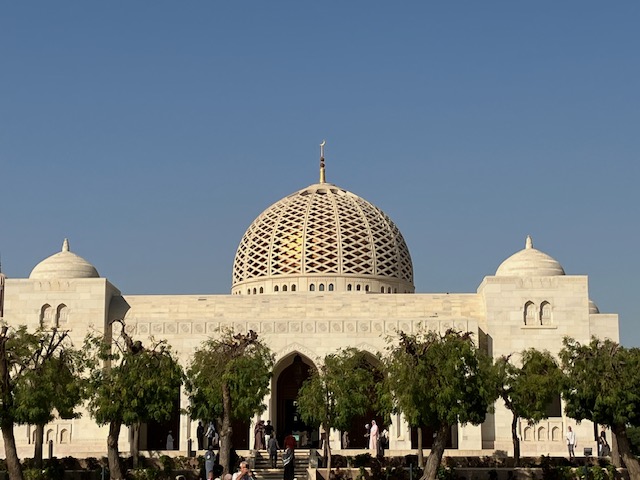
The Sultan Qaboos Grand mosque was on our itinerary the next day.  It is a place of wonder not to be missed.   Not because it was an ancient monument, but due to it being a modern architectural wonder with its beautiful golden dome, tall minarets and pleasing landscaping.  Built over six years starting in 1995, it can accommodate 20,000 worshippers including its inner and outer areas.  It is actively used.  How such a big edifice could be accommodated in the heart of the city of Muscat is a wonder. It was the most generous gift to the city from the Sultan Qaboos bin Said Al Said. He  enjoyed the popularity of the people during his half a century reign.  We also heard that the Sultan had studied in India and had admiration for the people of India and their principles.  The mosque reflects  a combination of Islamic, Middle Eastern and Omani architectural styles.  It is stated that 30,000 tonnes of pink sandstone purported to be imported from India were used as well as local granite and white marble.  Five minarets at an imposing height of 90 meters add to its grandeur and symmetry.

The golden dome of the Grand Mosque

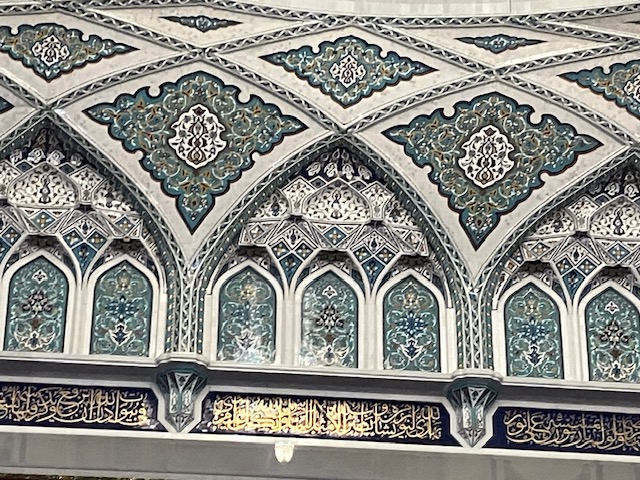
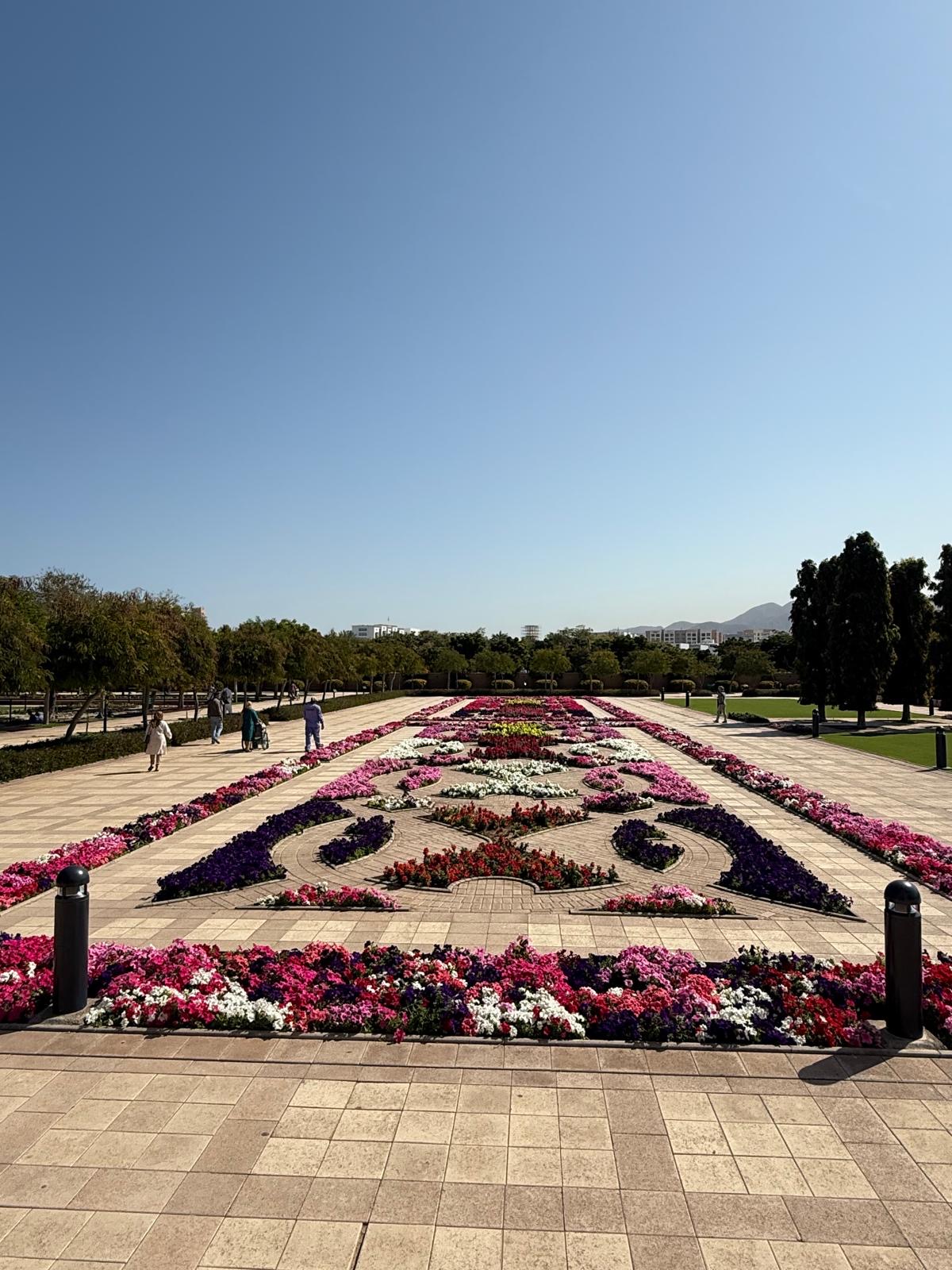
            Some of the unique features that attracted me personally were the intricacies in every inch of architecture, the huge open verandahs and the beautiful and endless courtyards beautifully decorated with flowering plants.  A hall, especially dedicated for women to pray and the main hall certainly deserves mention.  A 24 carat gold plated chandelier decorated with 600 Swarovski crystal is at the center of the main prayer hall.  Smaller versions could be found in other parts of the mosque.  But what wins the main mention is a huge hand-made carpet that was, believe it or not,  a gorgeous piece that took 600 Iranian women four years to complete.  Amazing intricate designs, color and uniformity are its hallmark.  Visitors are allowed at specific days and times to visit this must-see modern edifice that quietly competes with other beautiful monuments seen in India and other parts of the world.  The visitor activity is conducted with utmost order and precision. The only requirements are modest clothing and head covering for women. Footware is to be removed and stored. Inside the main prayer hall, all was quiet as people took in its beauty and one could feel a divine connection contained within its beautiful walls and ceiling.  When one leaves, it is with great reluctance.


The Grand Mosque building and grounds and the famed carpet          

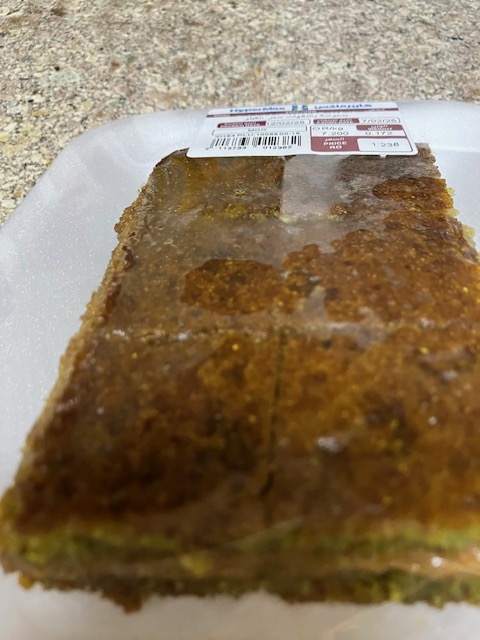
This was another day to eat out.  We had lunch at Kailash Parbat in the mall.  It was not a full-fledged restaurant, just a take-out place where we could carry the food to the tables set up nearby inside the mall.  The food was delicious, including pani puri and warm jilebees.   In the evening we visited the second Hindu temple in Muscat.  It was the Krishna temple, serene and beautiful as expected. Muscat was quite a food fest!  Not only did we try many eateries big and small but brought home delicacies chief among them being the delicious baklavaBusbusa was another delicacy more cake- like and slightly sticky and very tasty.  The pistachio version was the best and sold fresh at LuLu’s “bakes and cakes” promoting Omani delicacies. Of course we splurged on the various mini bars of chocolate that were very attractive by way of two bags for the price of one!  At home too we were bent on making “godumai halwa” a south Indian speciality and had to jump through the hoops to get Indian wheat which always has a higher gluten content, very essential for this halwa.  While every other item was from India at LuLu the wheat being promoted was exclusively of Omani origin.  Anyway we succeeded and the result was delicious and more cholesterol of course, being made with fresh ghee! And anyone feeling the overload of sweets could turn to the cilantro chutney also made at home with locally sourced ingredients. We celebrated my sister’s birthday which was later in the same month with a delicious ” Aapam meal at a special restaurant, Woodlands, and cake at home.

Some yummy edibles: Crispy dosa at a local restaurant, the famous pistachio Busbusa, a cousin of the Baklava and homemade wheat halwa 

The LuLu stores are quite a legend in Muscat city.  The word is supposed to mean “a rare pearl”. They were first started by Yusuff Ali Musaliam Veettil Abdul Kader, born in Thrissur, Kerala, India.  It is the largest employer of Indians in the region.  He started his import business in Abu Dhabi and the first LuLu store in 1990.  There are LuLu stores in India as well.  By the end of our stay we were referring to the one nearby as “namma LuLu” in Tamil which means “our own Lu Lu”. I found it very amusing that they were all called Hypermarkets instead of Supermarkets!  Indeed there was hyper activity in each store between the aisles of groceries, fresh fruits and vegetables and even clothing and home use articles, appliances and furniture!  Per the internet the 78th store was recently opened in 2001 in the area surrounding Muscat.  No wonder it won the award as the “Retail company of the year” award and features in the top hundred super brands in the Gulf.

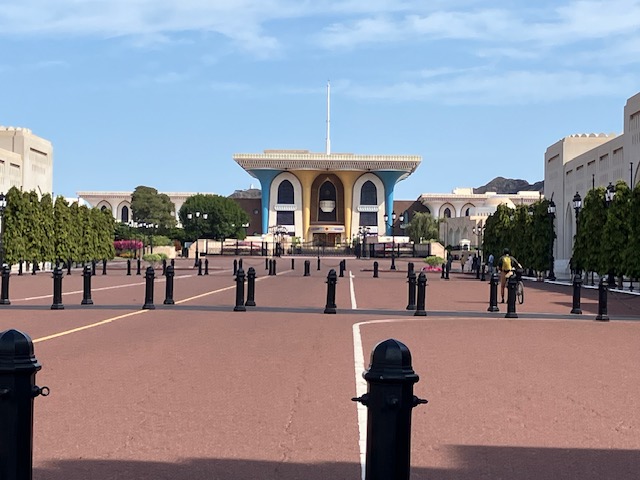
            In our jam packed itinerary and food tasting spree, we were yet to visit some notable spots and we covered these the day before we left.  The Al Alam palace and the National museum we drove by or stopped briefly without going in, although the outside was quite impressive. 

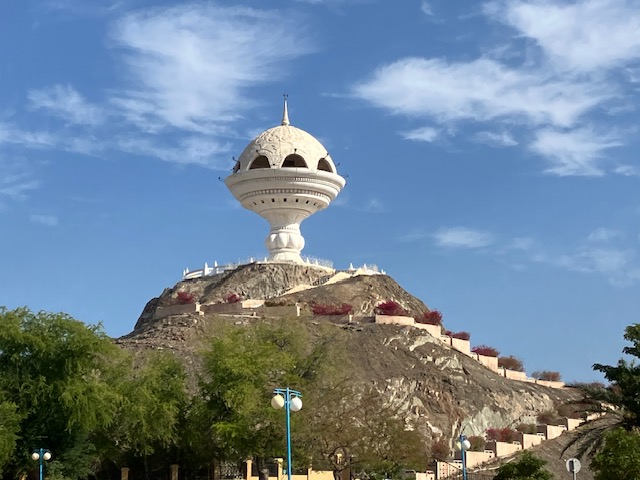
Al Riyam Park and the Palace courtyard          

  Al Riyam park was made unique by a huge incense burner look-alike cement structure.  Since our time was limited we could not get closer to it to verify if one could actually climb up within it.  The park itself was beautifully landscaped with many green picnic areas and benches and play-yards for children at two levels.   From certain higher locations the sea is visible too.  Muscat residents are constantly encouraged to go out into the open to get fresh air and exercise and this is done with beautifully maintained parks and sea face walking areas.  Even on a drive around Muscat there are many roundabouts that featured quaint colorful teapot structures symmetrically placed or some other piece of art!

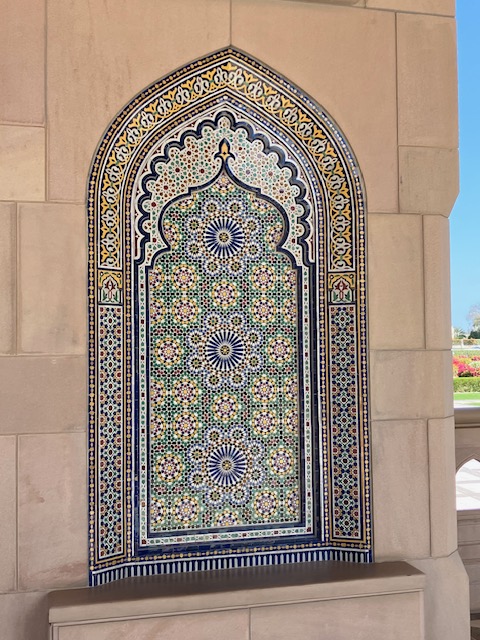
Beautiful mosaic artwork as the Grand Mosque           

All in all it was great to visit Muscat!  If one needs a quiet, clean and reasonably priced get-away this is the place. With a small recommendation from me, my neice will give you guidance! She is a great doctor as well as a foodie whose enthusiasm and tireless energy are simply amazing!

Egypt Part 2

Egypt – Larger than Life Part 2    Visit in Feb 2025

Post under construction — pics being added!

     Amidst the  excitement of viewing the ancient magnificent sights of Egypt, we also managed to have a calm and interesting cruise on the Ms/Miriam.  Part of the credit goes to the ship crew and organizers and part to our enthusiastic co-travelers on Gita Travels.  Admittedly some of us were retired and practically covering the few remaining countries on our bucket list, but many were still much younger and full of enthusiasm.

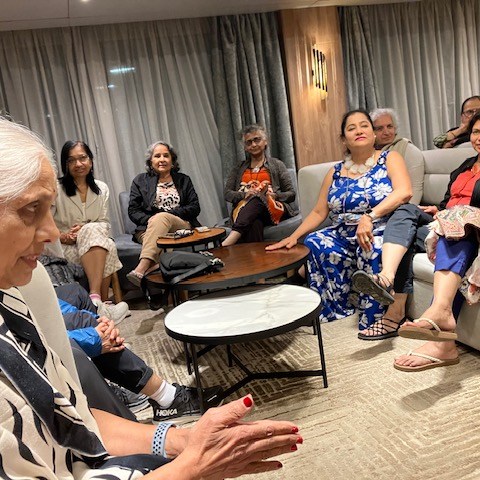
Among the activities we had, first an Antakshari program organized by the very enthusiastic Vaishali and her group.  As there were 70 plus people on this tour, it was hard to get to know everyone well (given how busy we were kept) but some stood out by their enthusiasm.   Everyone was roped in for the Antakshari and divided into two teams, very fairly the left and right side of the lounge.  The crew of the ship helped us put together seating facing each other.  It was a tension free session, everyone breaking into songs, old and new and enjoying it thoroughly.  Hindi and Tamil songs were the most popular. 

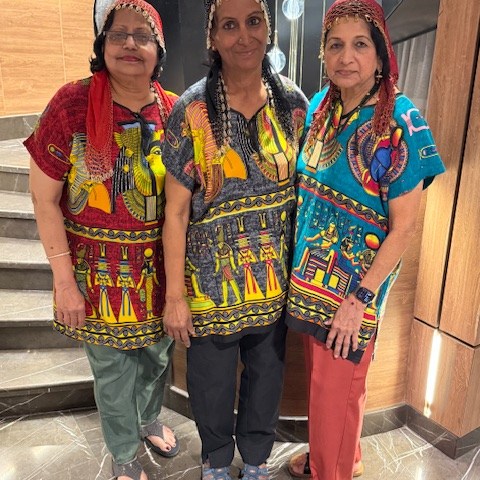
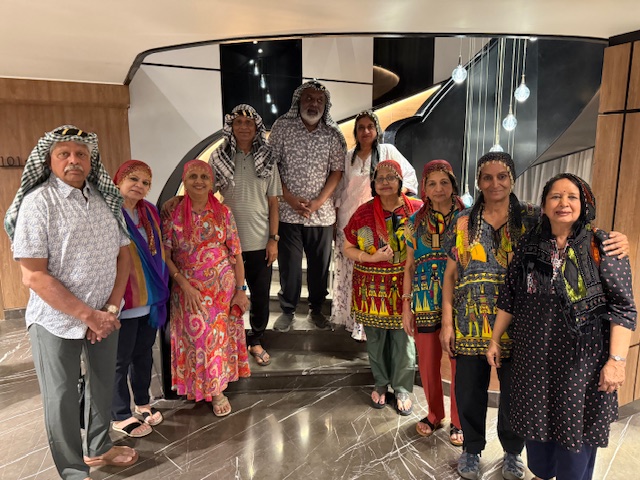
Antakshari excitement Three of our lovely ladies clad in local garb

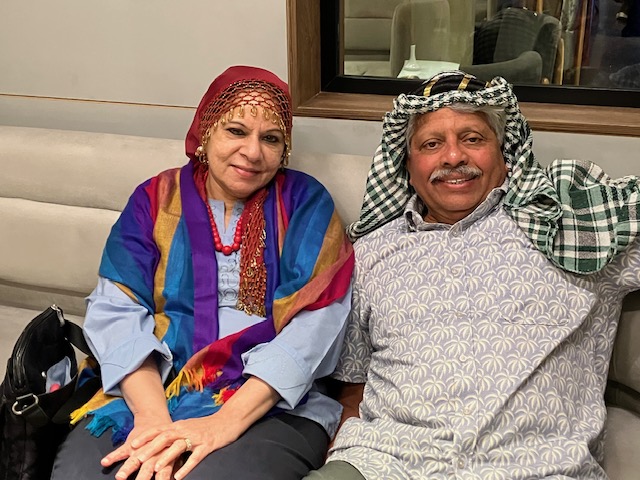
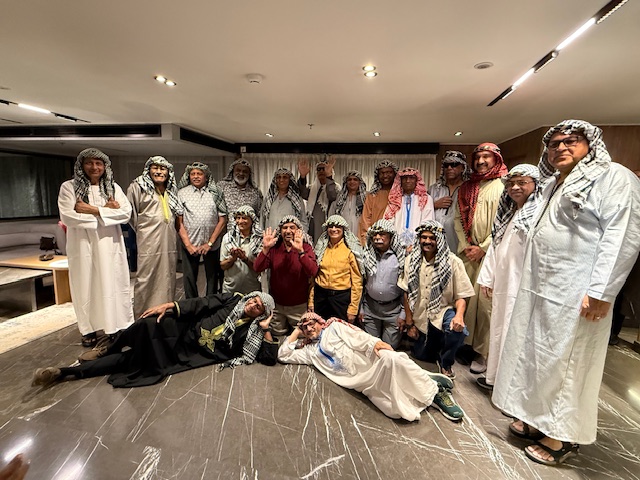
Another fun activity, this time organized by the ship’s crew was an Egyptian evening.  We had been told earlier to dress up in their local clothes, a “Galabeya” or a long loose-fitting dress with a specific headgear for men and women.  Most of the ladies went for it with a colorful, almost gypsy like headdress, with shiny tinsels.  The men for a large part stayed in their regular clothes and sported a typical checkered head scarf available in various colors, held in place with a ring.  Think Sadat!  Starting with a yummy dinner featuring local vegetarian fare and deserts, we moved on to the lounge deck where the crew members did a fabulous drum session and dance.  Then the floor was open for the rest of us to join in and dance the steps they demonstrated.  Everyone including the spectators, had a very enjoyable time.

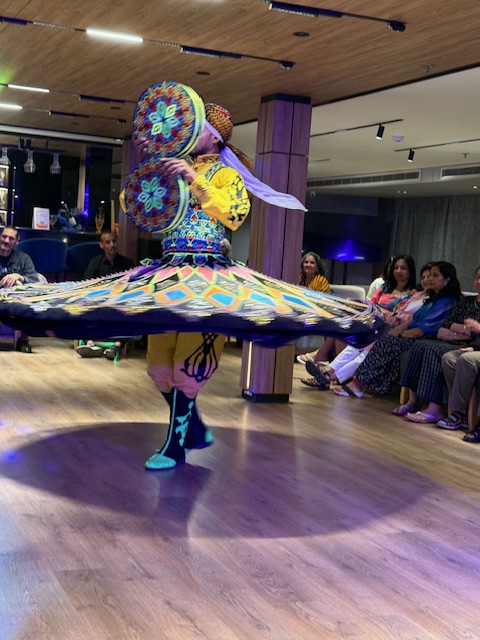
Whirling Dervish, friends posing in local costume 

The highlight was taking photos in the finery to show our families!  Another entertaining evening was dancing by a belly dancer and a whirling dervish.  The former of course made the men happy and collected quite a few dollar bills.  The Dervish, accompanied by a lively band, performed well and also had on a very colorful costume  that lighted up from time to time.  On the whole an interesting evening.

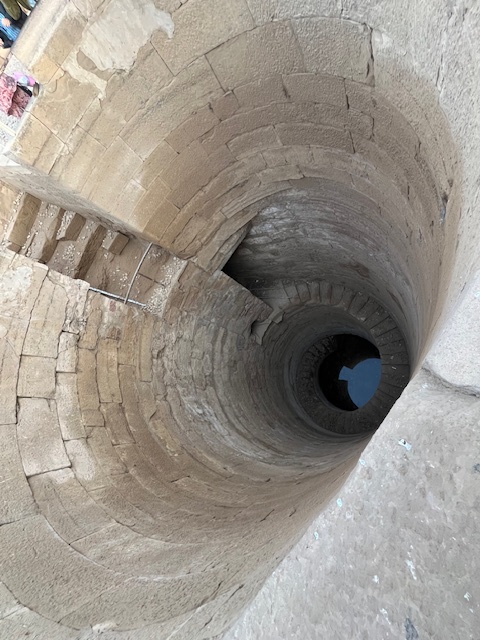
The ship next made a stop for us to visit the Kom Ombo temple. Built in the second century, BC close to the river, it emphasized the use of animal references in the Egyptian hieroglyphics.  Specific to this temple was the crocodile and the falcon in some ways depicting good and evil that exists in the world.  Two notable features of this temple were the well in the compound that measured the level of the Nile river and an attached museum that featured around 300 crocodile mummies.  Apparently, crocodiles are very much part of the Nile river although we did not see any live ones!

Kom Ombo temple, Picture of the well, courtesy of Seema

The next day was the longest and a very interesting day of the Egypt visit.  It was actually moved from the afternoon to the morning, that too very early departure.  The reason we were told was that crowds increase at the popular sites.  It was an optional visit to Abu Simbel, the temple of Ramses 2 and his beloved Nubian consort, Nefertari.  We were told that those who did not want to make the trip could stay behind and relax on the boat but to my knowledge no one did!  The drive itself was unique as we could see the countryside.  There was desert like sand for miles.  Many fields and properties were walled, with fences stretching for miles together.  Alfalfa was the crop we could view here and there, making a green patch in the sandy stretches.

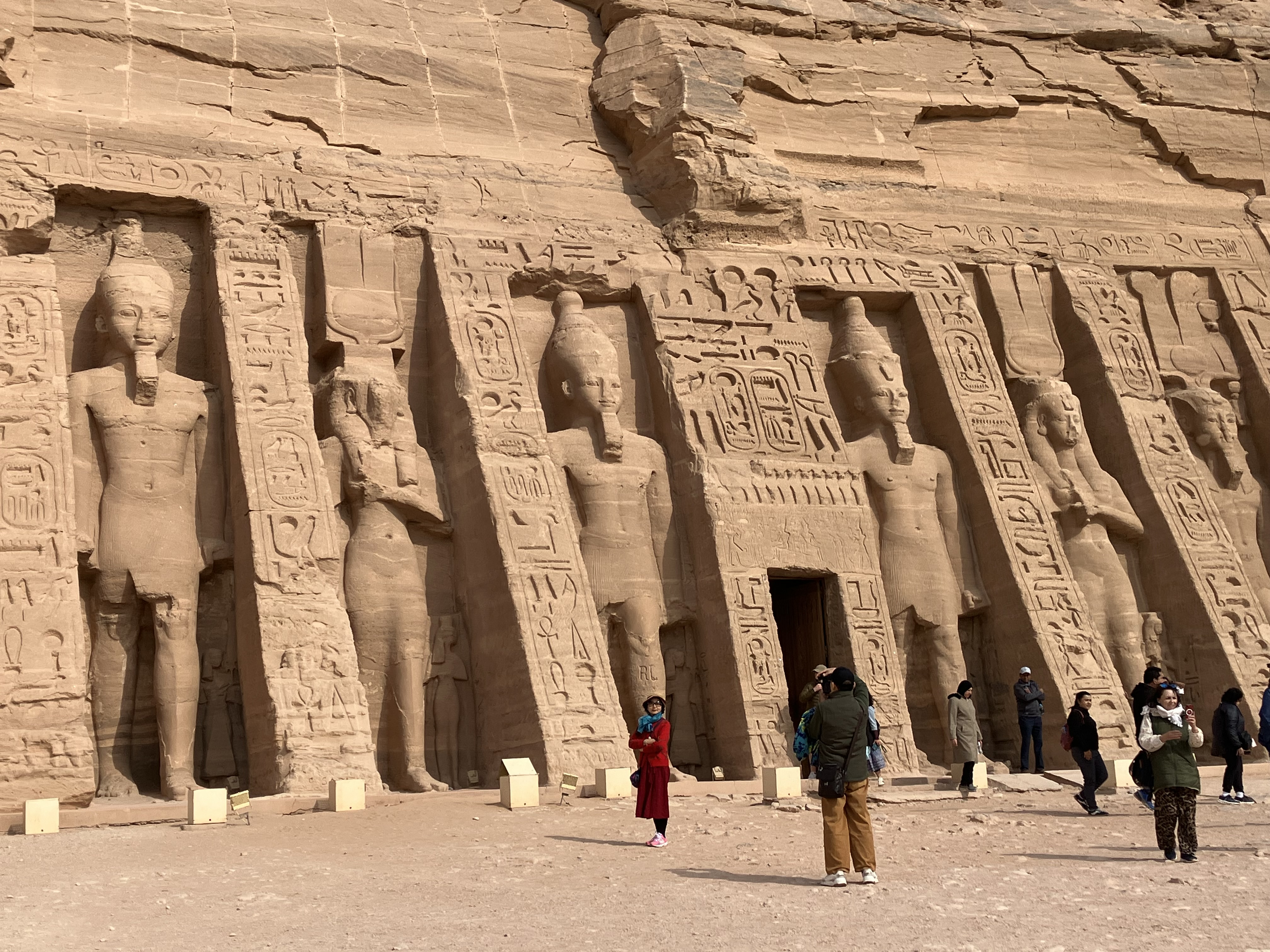
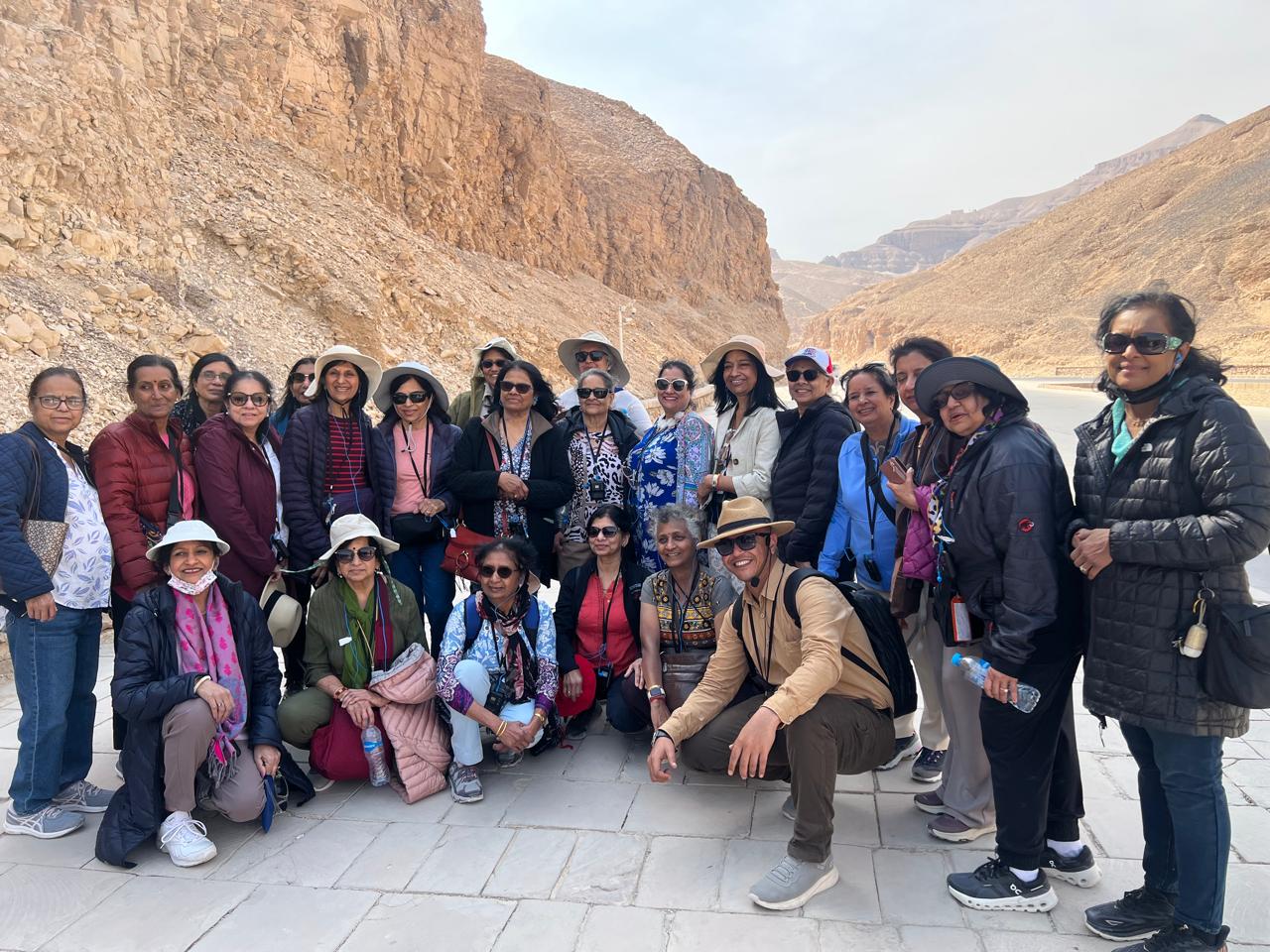
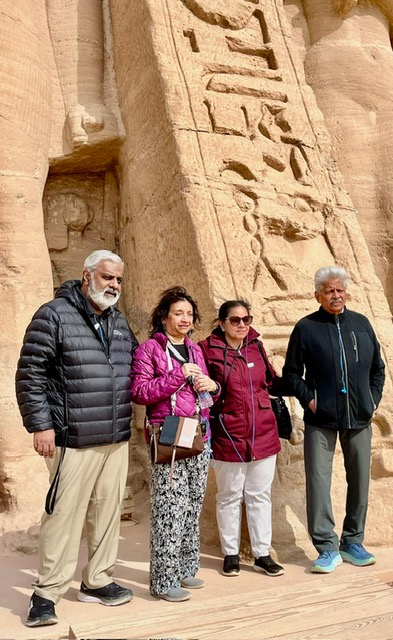
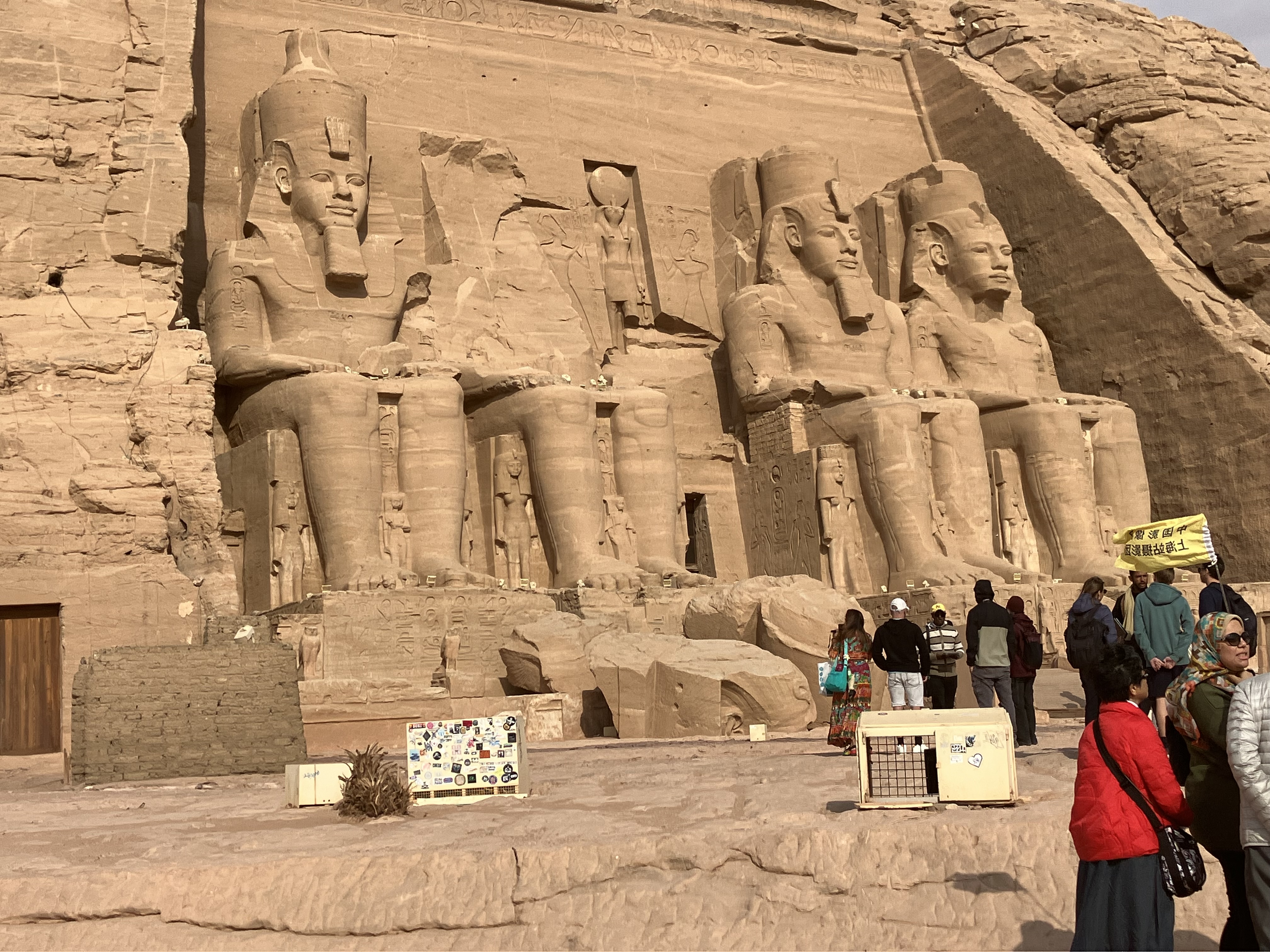
Views of the Ramses 2 temple outside and in, the temple of Nefertari; Our ladies group with tour leader and guide, Mohammad

Ramses 2 himself was a very colorful character per our guide.  He was the son of Seti 1 and ruled uninterrupted from 1279 to 1213 BC.  His father encouraged him to become a warrior and at a very young age he took to the challenge.  He was tall, healthy, virile and lived life to the fullest, never afraid of leading many successful forays to conquer territory for Egypt.  In fact, nine kings were said to have carried the name Ramses forward.  It is said he met his favorite queen, Nefertari when he was just a crown prince,  during his foray in the southern regions of Nubia. She is depicted with darker skin tones and famed for her beauty.  In fact at the temples of Abu Simbel, a separate one is dedicated to her.  Sadly, she died before she could see the edifice ordered to be built by Ramses 2. Brought back memories of Boldt palace in Canada’s Thousand Islands where a huge Rhine castle was never completed for Louise, which her businessman husband, George C. Boldt, owner of the Waldorf Astoria, was building.  Like the Taj Mahal, also keeping alive the memory of a special woman, it is now enjoyed by tourists.

Massive statue of Ramses 2

Abu Simbel itself is certainly worth a visit.   At a scenic location, with the waters of the Nile dam, Nasser reservoir, nearby, the temple of Ramses 2 has four colossal statues at its entrance, each estimated to be about 66 feet tall, though shown seated. Often, for reasons unknown, many Egyptian temples had more than one statue of the same king.  In the 1960s, Unesco had to assist in the moving of these temples to higher grounds due to the reservoir of the Aswan dam being built.  These and many other temples that were moved have certainly preserved that antiquity and natural look and this move is no less a miracle than the original one being built and carved out of the hillsides.  An artificial hill was created for these temples!  We were given ample time to walk around and explore the cave-like interiors of the temples.

Having done a morning trip, we were back by lunchtime and really luxuriated in the free afternoon time on the ship.  Time to rest, to get up to the upper deck, watch the passing scenery and enjoy the tea and coffee service.  It was not to be missed, those precious moments because the next morning we were checking out.  Though we had to pack our bags pretty early, we could still have breakfast and get ready for a jam-packed day of visits. Our ship had reached its destination, Aswan.  The Aswan High Dam was actually the second dam built on the Nile.  The first dam had been completed in 1902.  It was useful only for a time.  So 7 km upstream the new dam was built, also creating Lake Nasser reservoir.  Construction took place in the 1960s and at that time it was the tallest earthern dam in the world.  It served the purpose of controlling flooding, improving irrigation and generating electricity. The downside, we were told, was the lessening of the fertile soil it brought to the region.  We got the opportunity to walk on the road on top of the dam and take pictures but each group had a very short time allotted for this activity due to the busy tourist season.

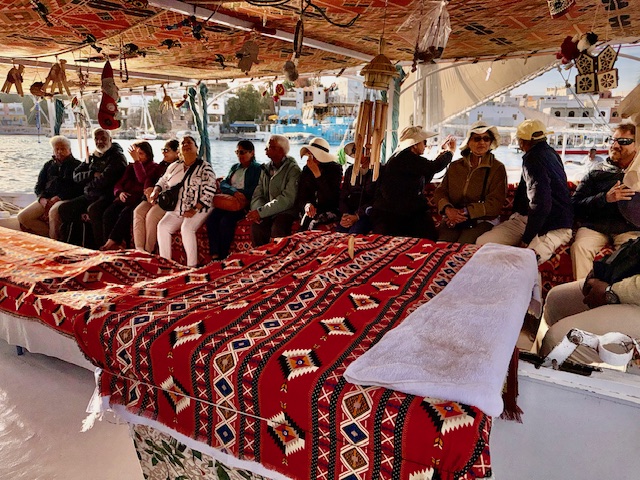
Felucca boats, on the boat ride, temple of Philae

Next attraction was the short boat ride to the Temple of Philae.  This was located on an island and had also been moved to a different location and done efficiently.  We went the short distance by boat. The edifice was large and very impressive.  Similar to the Karnak and Luxor temples with a double walled entrance and beautiful etched carvings on its walls.   The cruise ship had been kind enough to allow us back on board to have lunch and use the top deck for relaxing.  The rooms were being readied for the few passengers who boarded for a return trip back to Luxor.  Our flight was later that night so one more fun trip was squeezed in.  This was the felucca boat ride on the Nile.  We were taken to a wider part of the river in a boat that operated just with sails and wind power.  The boatmen had to be very skilled as there were many boats around.  Then we were shown some souvenirs for purchase on board during our return ride.  Small knick-knacs including maps and tour books that would serve as reminders of our visit.  It is to be mentioned and admired that everything seemed to be manufactured in Egypt itself and the roadside hawkers were willing to bargain.   Later in the night we caught our flight back to Cairo to our old hotel. Kudos to the organizers for having our room allocation all done in a very short time. Having picked up our stored luggage and catching some shut eye, the next morning we were ready once again to see the most exciting part of our tour – the pyramids of Giza!

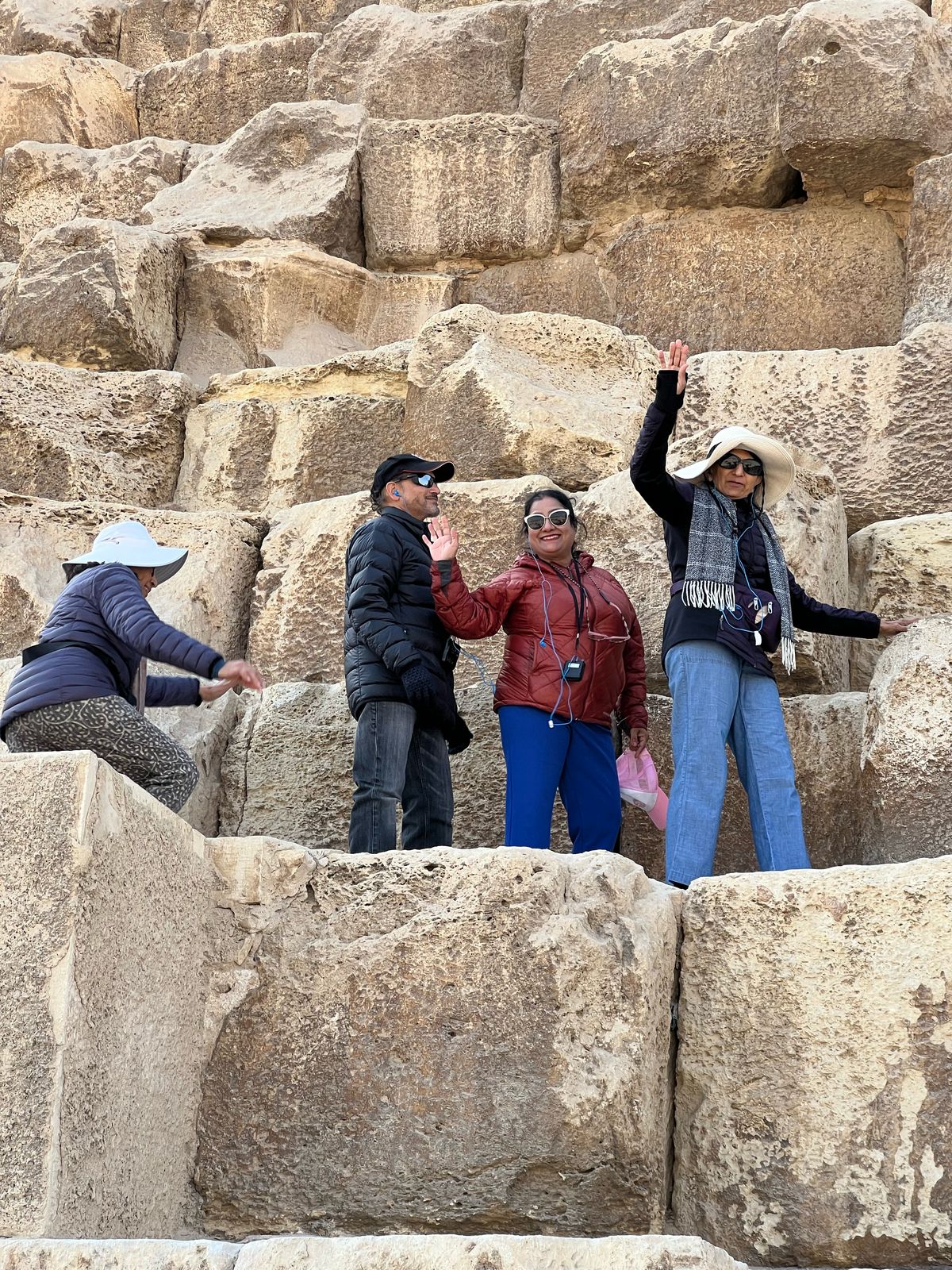
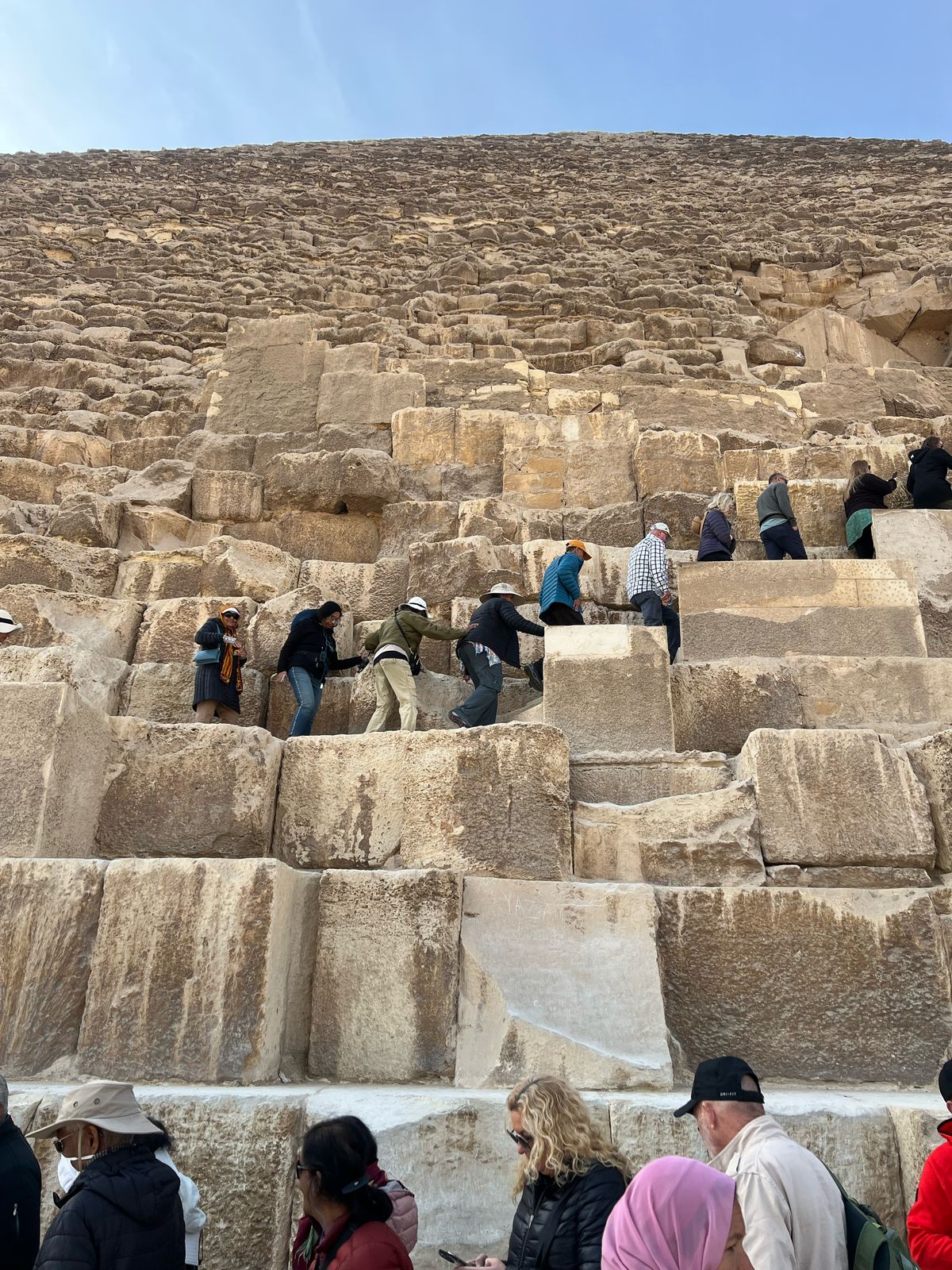
The perfect symmetry Entrance is visible Up close and climbing on the blocks!

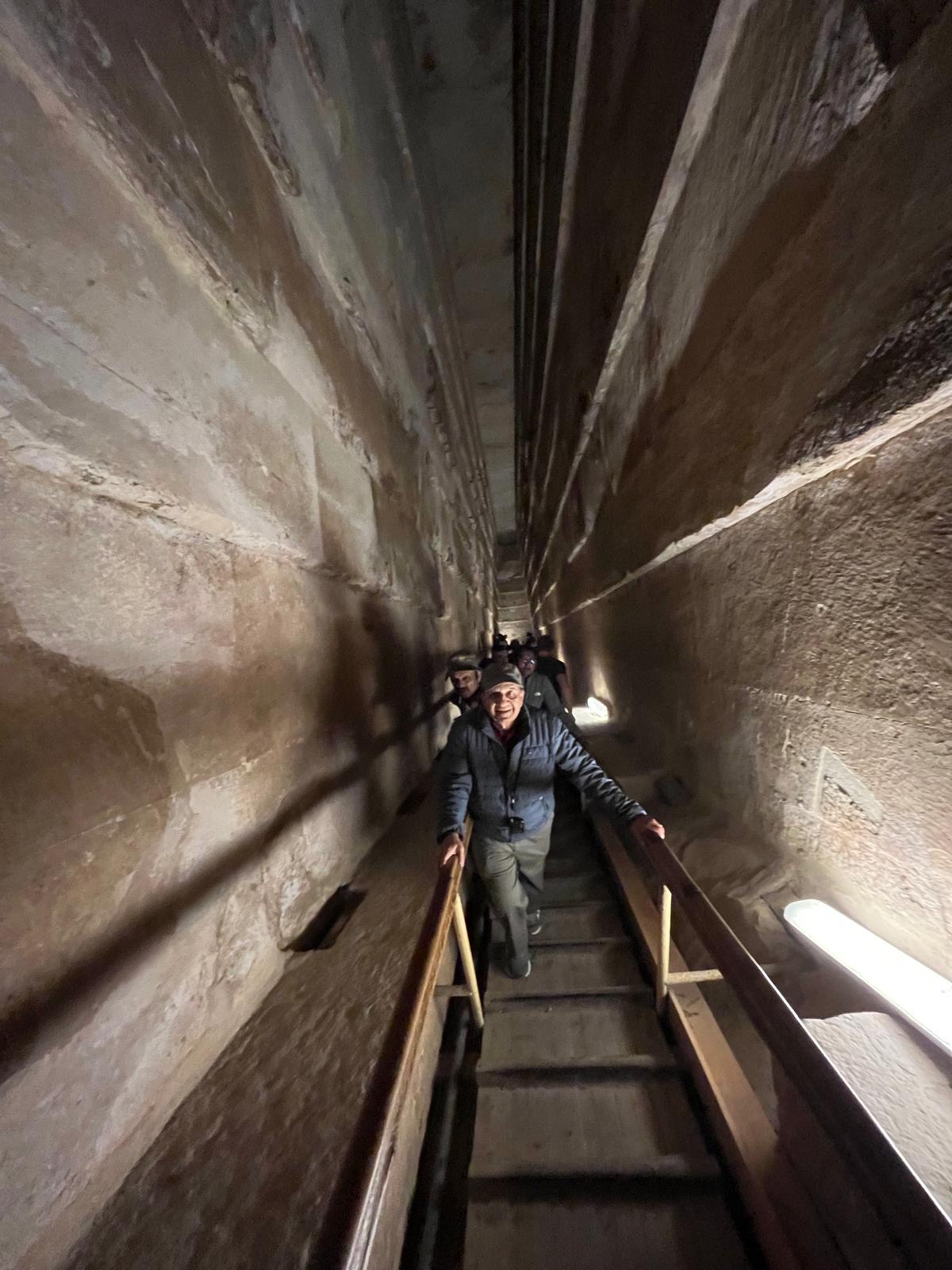
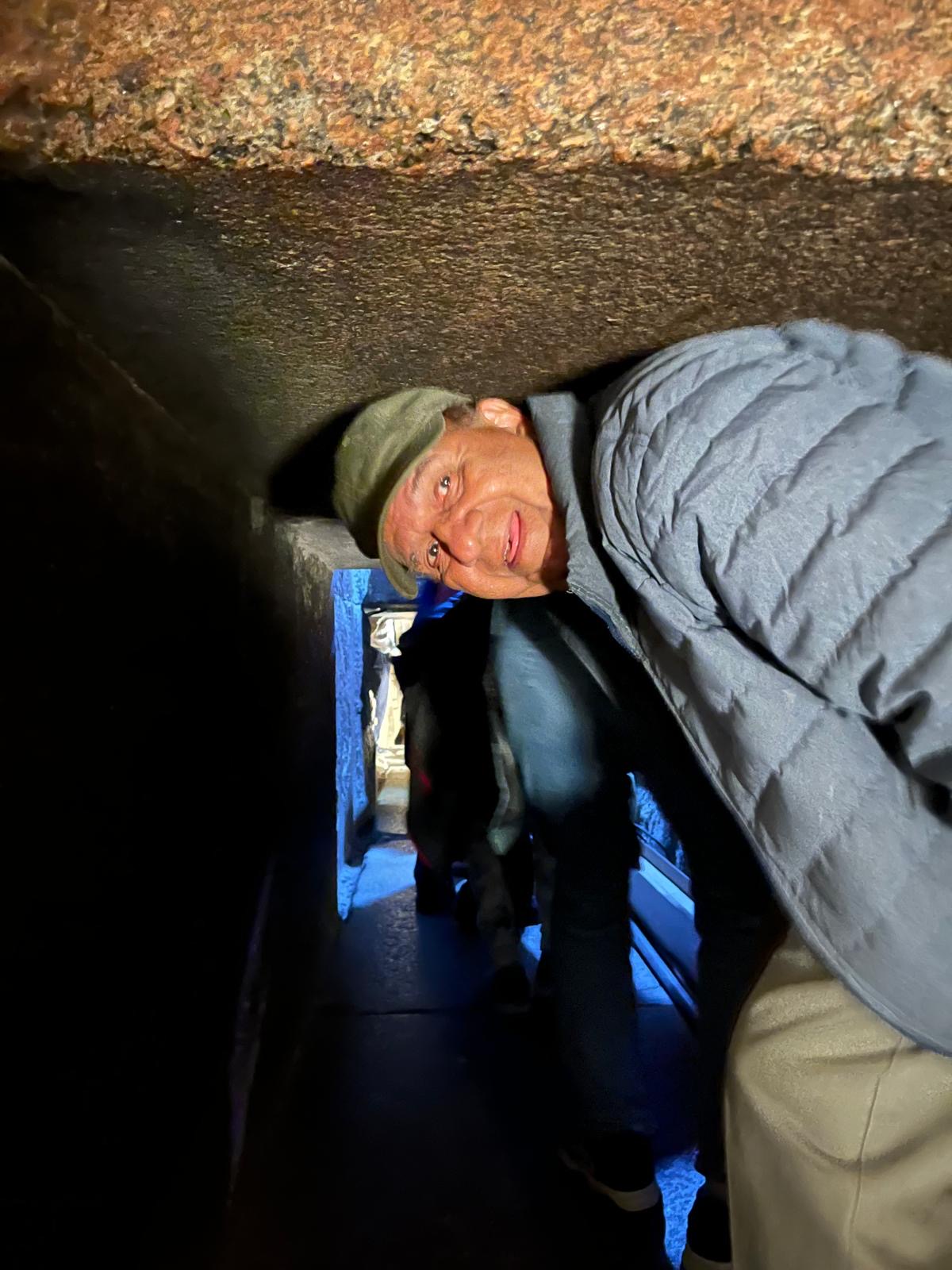
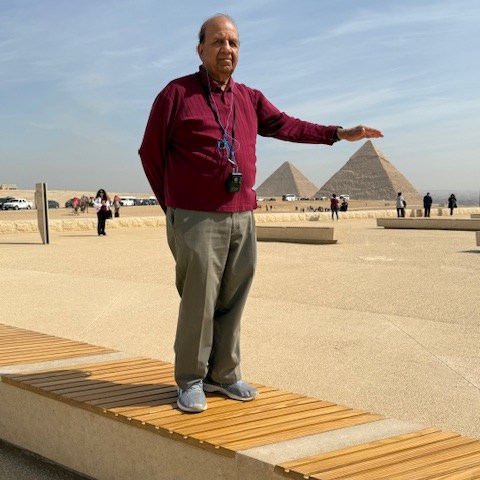
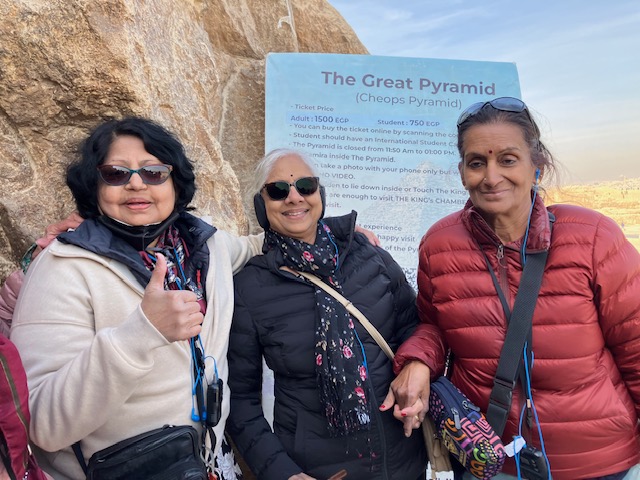
One reason this had been kept for the end of our tour was the fact that initially everyone arrived at different times and could be jet lagged.  Now we were fit and fine, in tune with the brisk sight-seeing.  An early start was a must. After the mind-boggling variety of breakfast items offered, we boarded our buses for the short ride to the Great pyramid for it was very close to Cairo.  It could be seen in glimpses along our bus ride but up close it was just amazing in its size and symmetry.  It’s not called Great for nothing.  It is one of the Seven Wonders of the old world. Our pictures will speak more than our words.  The exciting part was that we could climb up the great blocks of stone and go up to the entrance.  Only the brave few ventured inside as we had been warned that the ceilings were very low and in many sections one had to literally be on hands and knees.  Compared to the Valley of the Kings, there was very little art work to be seen inside. This pyramid is the largest one in Egypt and was the tomb of the pharoah Khufu and is estimated to be built  in 2600 BC over a period of about 26 years.  Today it is largely intact with only a few blocks that have fallen off in the lowest tier. The height itself was originally 481 feet with blocks of stone weighing 6 million tonnes.  Most pyramids had a smooth casing which has been weathered away.  No point in quoting other dimensions, we want to dwell more on the emotions it evoked.  Initially there was a scramble to climb up before the crowds made it impossible.  Though the entrance was only a few feet high, it was a bit of a difficult climb as one had to be careful.  But once we had made sure our victory had been captured on camera, we came down and walked around.  The cobblestones around are to be carefully walked on too in order to avoid ankles being twisted.  Our small group of friends walked up to a corner to view the angle and also took some pictures with a few camels.

Standing there in front of this wonder was totally awe inspiring in the deepest sense of the term.  That humans had put in so much effort to build something for posterity and it still stood there a witness to all the changes the world is seeing, was too deep to fathom.  But it was a rock-solid feeling that some things will not change so easily and gave our coming days something to think back upon, to ruminate the meaning of life itself.  A visit well worth the time we spent.

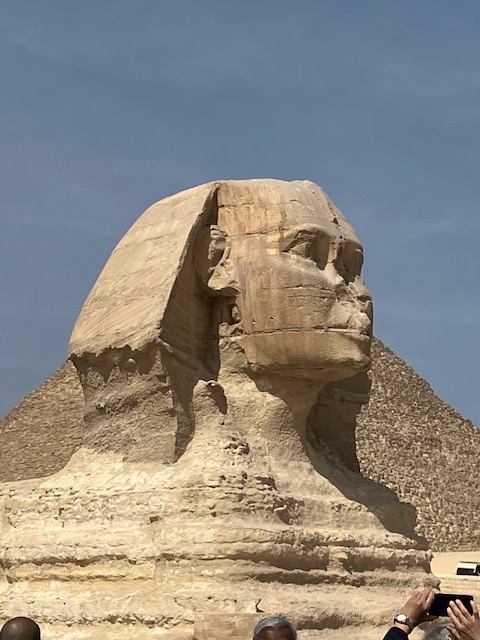
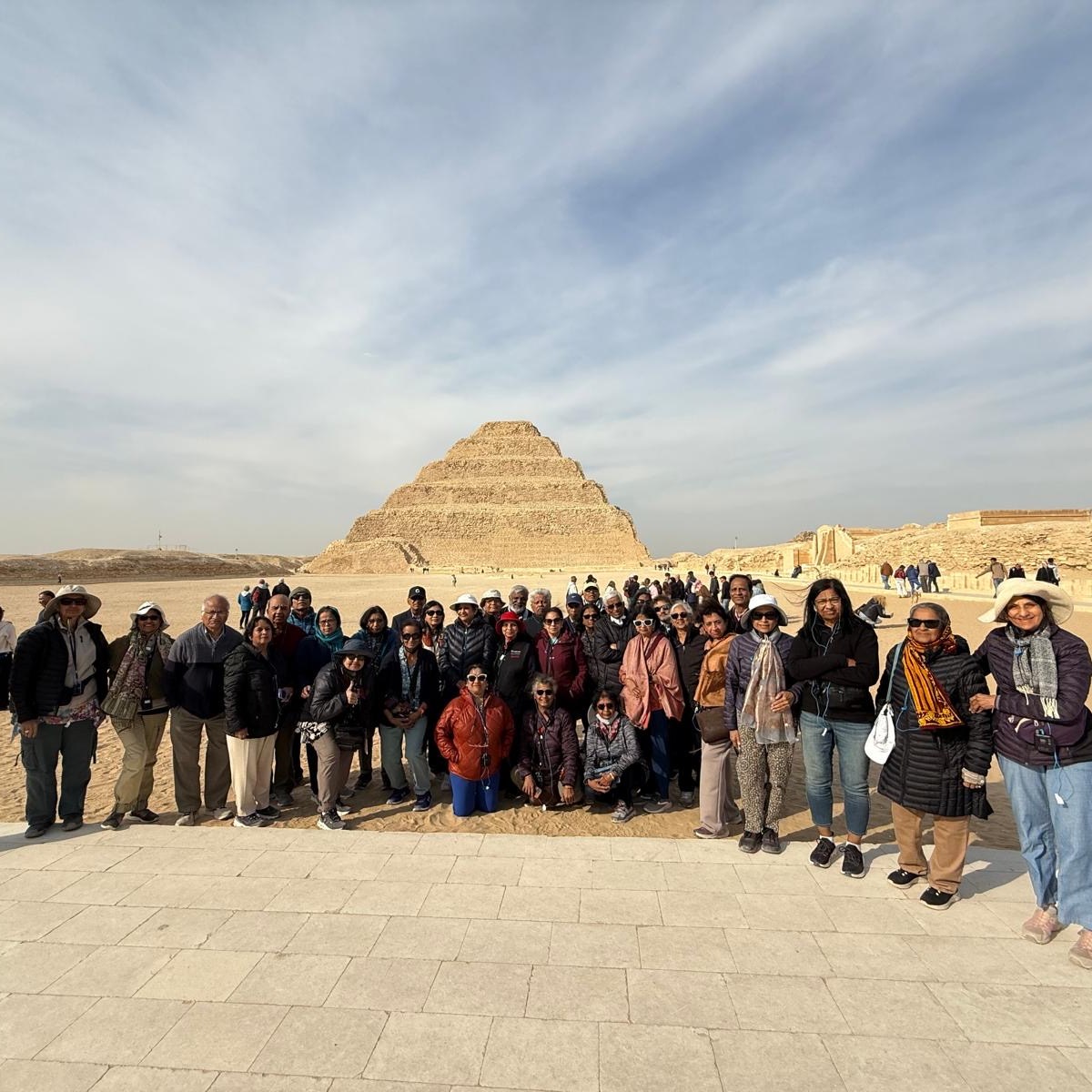
We were then taken to see some other lesser but still very impressive pyramids that were in the distance. These had accommodated mummies of family members of the pharoh.  We saw the step pyramid at Saqqara and finally the grand Sphinx which did not disappoint in spite of its face being disfigured over time.  It was huge with a much larger pyramid behind it.  A ramp to view made picture taking easy.  We had seen it all and it was all so very impressive.

The step pyramid at Saqqara Sphinx and a pyramid “Look how small it is!”

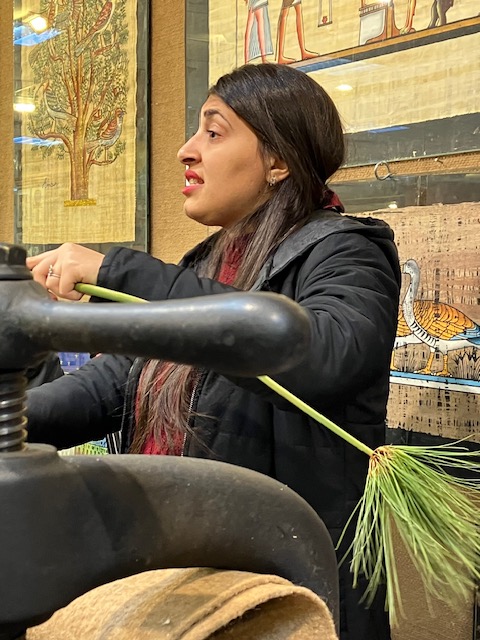
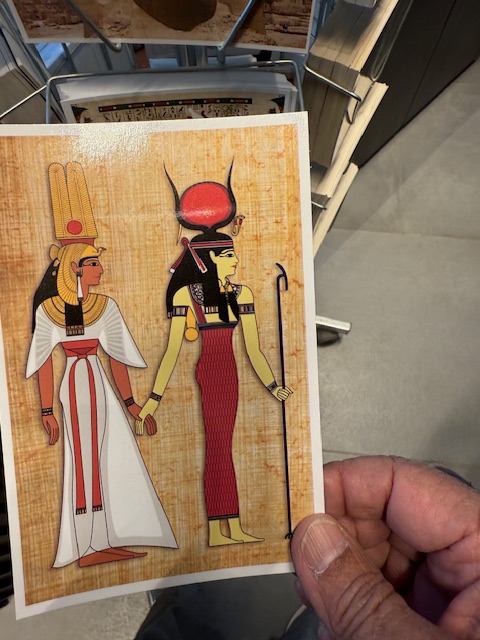
Here I have to mention that we were taken to a showroom with original papyrus paintings and a demonstration of how papyrus leaves are processed and preserved.  Other visits to alabaster showrooms and essential oils processing plants and sales had been sort of lukewarm so far as the shopping was concerned.  But at the papyrus place, everyone went gung-ho!  Firstly this art is unique to Egypt and details on the artwork was pretty amazing.  Secondly, it was easily transportable being packed well in cardboard cylinders.  Finally, it was a trophy that could be displayed on our living room walls, something that was sure to prompt a conversation that started with “you visited Egypt?!”   Almost everyone bought something (the prices were reasonable too, depending on the size and intricacy).  Those into painting also bought some blank papyrus to try their own skills back home.  A marvelous demonstration of how the papyrus stalks are converted to a sheet was also given, taking us through the process of stripping, soaking, rolling, drying in a press and finally  a ready sheet that had undergone some days in the press was shown.  Yes, we were given extra time to complete our shopping!  Quite close by was Cotton world, a T-shirt paradise made with high quality Egyptian cotton, was also of great attraction for our group, shopping for kids and grandkids!  Items were bought by the dozens!  Finally we were given the opportunity to go to a bazaar and complete shopping for items left out or last minute gifts.  This was the Khan el Khaleli bazaar and literally had everything from A to Z.  During the day we were also taken to the familiar restaurants on the Nile that provided us with simple vegetarian fare with pitas.  The only shortcoming of the tour was no Indian food!

Some random interesting facts: In the tombs, pharaohs were buried with countless amulets, artifacts of gold and precious stones, even mummified pets. The priests decided what would work for that individual soul. The roof of the tomb above the sarcophagus was painted with stars and there were passages where the soul could wander in before its departure! Not all pyramids were perfect, there is one known as the crooked pyramid!

So to conclude Egypt is a “must see” destination with grand sights, a relaxing river cruise and friendly people.

(Pictures courtesy of R. Shankar, S. Shankar and friends on the tour — please click on each pic to expand and view details)

We did it!

Egypt, Larger than Life!

(Friends, this is just a light hearted account of our group’s experiences while touring Egypt. Please excuse any mis-facts or mistakes and feel free to send your special pictures for posting to my email. (This blog is a work in progress, more pictures being uploaded)

Since the advent of the recent pandemic and the postponement of our trip to Egypt and Jordan we had been hoping to revive our cherished trip. Earlier this year an unexpected opportunity came our way when one of our friends cancelled their trip and another friend facilitated us receiving their spots. We were able to see Egypt thoroughly through a well- arranged tour and learn its secrets from a knowledgeable Egyptologist, travel with friends and relax on the Nile cruise. Very satisfying!

We chose to combine it with a visit to India and Muscat prior to the tour and though challenging to pack varieties of clothes and essential items, we were able to pull it off . In fact we arrived in Egypt with minimal time difference and jet lag. We also decided to leave behind a suitcase of unneeded clothes and other items as we were coming back to the same hotel after our Nile cruise.  The pick-up by Gita Travels from the airport was smooth. A bus had been arranged  as many from our group arrived at around the same time.  We hit the evening commuter traffic and it took us about 45 minutes to arrive at Hilton Ramses, downtown.  We were met by Gita and Kris in the lobby. This lovely couple has been running this travel company for a long while now, based in Troy, Michigan. The couple had made a trip to Cairo just to get us started on our tour and accompanied us to Luxor and settled us in the cruise boat.  This was the largest group we had travelled in , two full busloads of about 35 people each.  We travelled everywhere together but stayed with our group.  In fact on the  Nile river cruise ship, we had the entire place to ourselves which made it super exclusive.  It was smooth operations all the way, no glitches kudos to the organizers, Gita and Kris! Everyone was very satisfied with all the arrangements.

Raji, Rajini and myself at the Citadel and mosoleum

The next morning, our first day of sight seeing, we visited a museum and a mosoleum.  Our group had a dynamic, friendly and very knowledgeable Egyptologist as our guide.  He was with us throughout the trip.  In fact Mohammad Taha, as everyone on the bus agreed, was a rare gem and we were so lucky to have him.  He shared so many details with us, practically the inside info on ancient Egypt.  At the same time he was easy to approach, friendly and forgiving if we were a bit late.  He was open to answering all questions, including the social life of the locals.  Right from the first moment, he won our hearts by calling each of us “Habibi”, a term of endearment!  His “Meshe Meshe” with which he ended every other sentence is still ringing in our ears!  Similar to “do you get it?” or “okie dokie”.  We knew we were in good hands!

The Tahir Egyptian Museum showed us things which we would not be able to see at the actual sites.  For example, down the road (or the Nile river!) we visited the Valley of the Kings containing the tombs and sarcophaguses of past Egyptian kings. But these were all empty for most part.  They only exception being the tomb of “King Tut han kha mun.” In the museum we saw an actual mummy as well as many of the treasures recovered from the sites.  In fact there are daily digs happening in Egypt and treasures discovered. The museum was super educational with amazing artifacts.  There were stone tablets that the Egyptologists could talk about for hours, interpreting the hieroglyphics.  The throne of King Tutankhamun, wood coated with gold, the usual articles found buried in tombs and a section dedicated to the famous King Tutankhamun.  This room where photography was prohibited, displayed his golden face mask and several sarcophaguses with gold coating that went one inside the other.  The mummy itself was left behind in the original tomb in the Valley of the Kings which we visited later.  The upper level also featured long showcases of gemstones and other valuable items recovered from various sites.

The gilded chair and some beautiful artifacts at the Tahir Museum

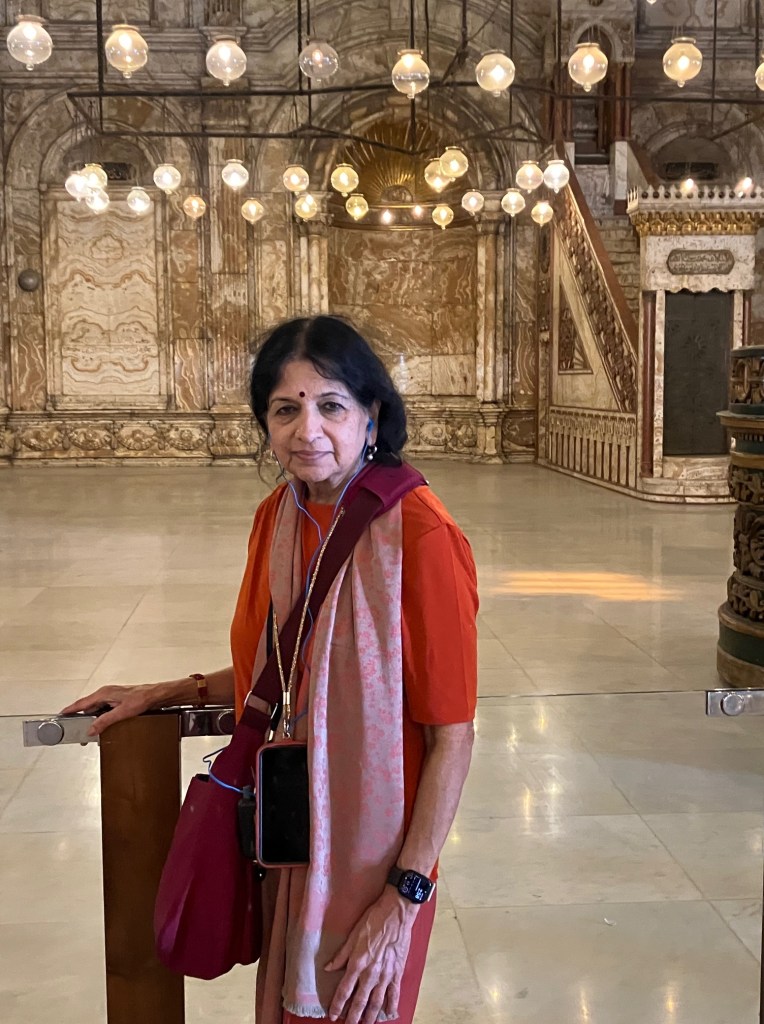
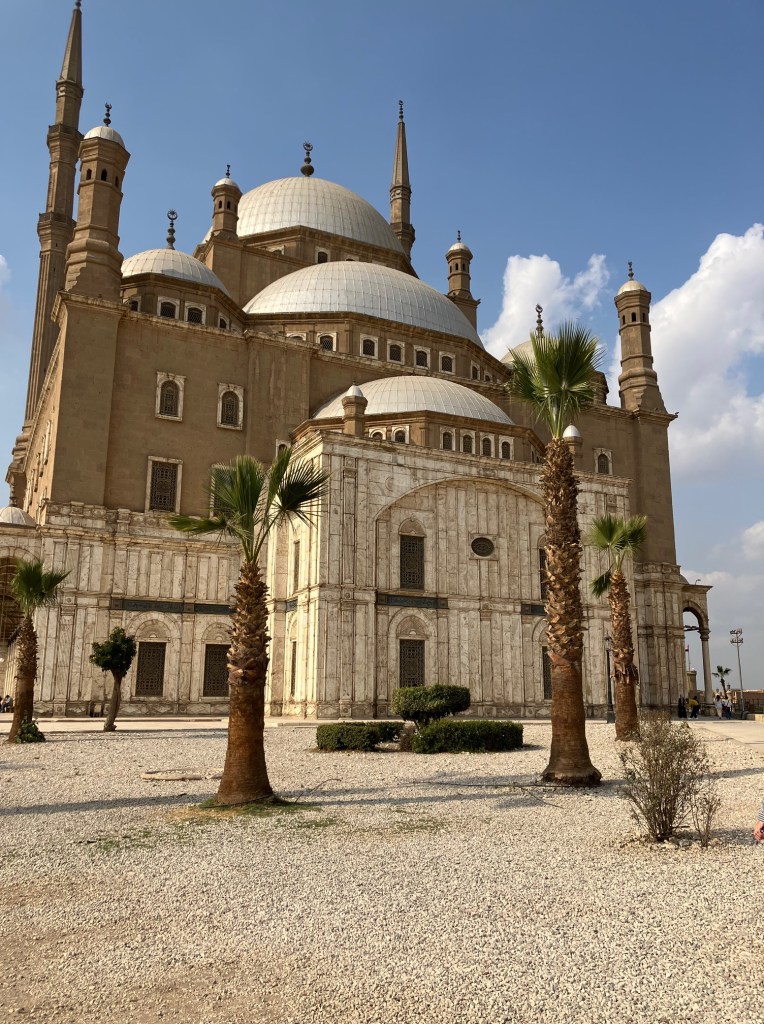
After a local buffet lunch at a riverside restaurant our next stop was the Salah El-Din Citadel.  This was a mosque as well as a mosoleum combined since it contained the remains of the emperor, Muhammad Ali Pasha.  It also has a wall fortification to defend the city.  We were given foot covering to put over our shoes. Inside, the main attraction for us was the beautiful high ceiling and the unique artwork on the walls.  We also took pictures in front of the area that was used for prayer, facing Mecca.  For dinner we proceeded to another  restaurant on the Nile which had beautiful night views of the famous river.  We could also view this from some rooms at our hotel.  Cairo by night was a vibrant and colorful city. Hilton Ramses was a top notch hotel to stay in.

The beautiful Nile river by night at Cairo

The next morning we had an early flight to Luxor.  Not only were there many luxury river cruise ships leaving from there but it saved us time going by road.  The idea of spending four nights on a ship was ingenious because we did not have to move from day to day, packing and unpacking.  The lovely ship, the M/s Miriam, moved us serenely along the placid river (though we went against the current flow) to our next destination to see sights.  We had a warm welcome on the ship with coffee and baked delicacies and were given an orientation speech.  The rooms were lovely and the bathroom modern.  A picture window afforded a view of the river at all times, even from our bed.  There were three levels with the spacious dining hall on the lowest.  There were no elevators.  More about the ship later, but to describe it in one word – Fantastic!  We loved the space, the food the service and the people working on it.  They made us feel like it was our home.  Just a mention about the unique way they “ parked” or docked.  There were three to four ships parallel to each other and to reach ours, we had to step into the lobby of each of those and walk to our own! Just docks were in a state of disrepair in many ports and one had to watch one’s step.

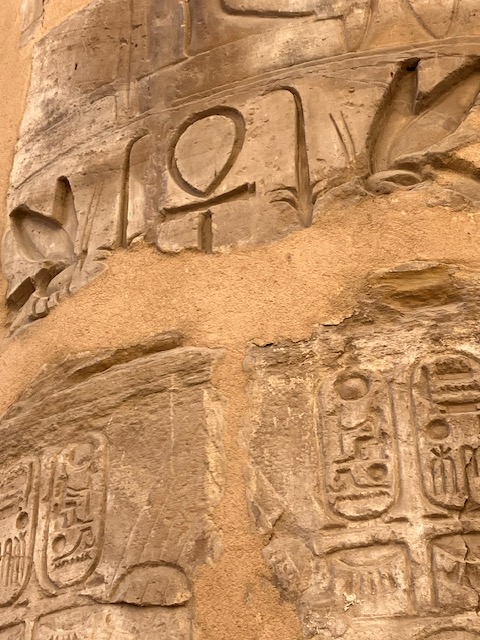
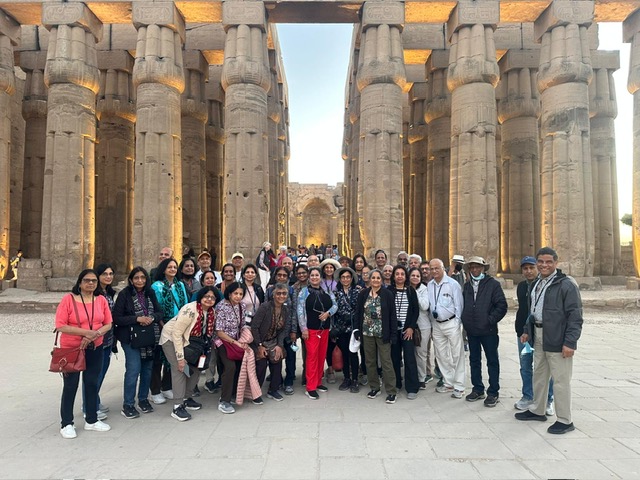
Before we set sail, at Luxor we saw two wonderful “temples” as the ruins were called.  As it was our first exposure to outdoor Egyptian architecture, we were bowled over.  The statues were very large as were the pillars.  But the colorful inscriptions carved on every inch of stone was what was quintessentially Egyptian.  For those who could decipher, many stories were silently told.  Our guide Mohammad did not miss an opportunity to delve into each and every one of them.  Sometimes we were so much into the intricacies that we almost missed the big picture.  But I am sure many of us understood a lot more than just visiting on our own.  We got familiar with the “Ankh” symbol which was a mirror-like holy object on top of a cross (no relationship to the Christian cross) and also signified sound and philosophy of life, the oval “Cartouche” which contains the name of the king or queen in hieroglyphs.  We saw much of this at every location we visited.  Some were even damaged or erased by subsequent pharaohs who did not want to give credit to the original leader.

We viewed the Avenue of the Sphinx (some damaged or destroyed) which was a long open air passage leading to the Karnak temple.  At the temple end, we could wander into the passage to see them up close. Here before the entrance was a very large paved area where apparently the commoners gathered in ancient times.  Only priests and royalty were allowed inside the actual temples.  Mohammad entertained us with many legends and stories including a quaint one of men going off to war and the only male being left behind was a small lad named Sim.  He eventually grew to manhood and the women all had children so the clan could survive.  This did not please the men who eventually returned from war.  They first cut off an arm and a leg but later killed him and cut him into 14 pieces.  These are represented by 14 pillars at the temple.His true love  resurrected him  and she had a child by immaculate conception as his manhood could never be found.  This story of was continued at other sites too.. Snakes had significance also.  Some pharaohs wore a snake on their headgear representing one of the wives who could keep track of all the wicked plots brewing in the harem!

Other group members enjoying the sights; Luxor temple on the right

The second temple was simply called Luxor temple.  Most temples we visited had a two wall  structure with an entrance in the middle, getting narrower as we walked into the innermost sanctum which was nothing special,  just a space, sometimes with a large stone block in the middle. Obelisks or needles were common as their purpose was the connection between man and God. Luxor temple was unique because it also had a mosque on one side of it, the Abu El Hagag mosque, separated by only a wall and visible.  Apparently the temple was underwater for a long time till it was restored. Imposing huge statues were located outside. Floors had originally been made of alabaster which represented water, being translucent and smooth.  Often organs of kings, before being mummified were stored in alabaster jars Mohammad told us.  These organs were removed from the body before the mummification process to prevent decay of the body and being of attraction to animals when tombs were made in the mountainsides.  Mostly only royalty received mummification and burial in decorated tombs especially in specific areas like the Valley of the Kings.

Luxor was a bustling, friendly small town,  here you could see modern cars, there a cart being pulled by a donkey.  Cats that looked well fed wandered around in the city and ruins.  People everywhere in Egypt were friendly.  We were strictly told to stay away from hawkers who followed tourists everywhere, except inside the monument area.  Of course the enterprising Indian shoppers from our group managed to strike bargains in the few moments it took to walk to the bus!  Real talent!!

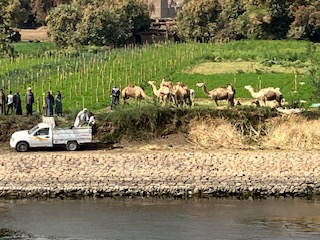
After our lunch the next day, our ship set sail and it felt wonderful.  The Nile cruise part was as beautiful as the Egypt monuments.  In the daytime we could see the ever- changing scenery, both sides of the shore being visible though the river felt quite wide.  On the first day we passed through some locks that adjusted the ship to the level of the water as sometimes the river level rose or was lowered.  It was an unusual experience with both sides of the lock very close to the ship.  Soon we were out on the river and there was much greenery, other sailing boats and sometimes animals like camels along the shore.  We could view all this from the top level of the ship which also had ample reclining chairs and space to walk and get some exercise and fresh air.  We loved the tea/coffee service on the top deck on most days in the afternoon too.  These were the cherished moments of relaxation that will stay with us forever.

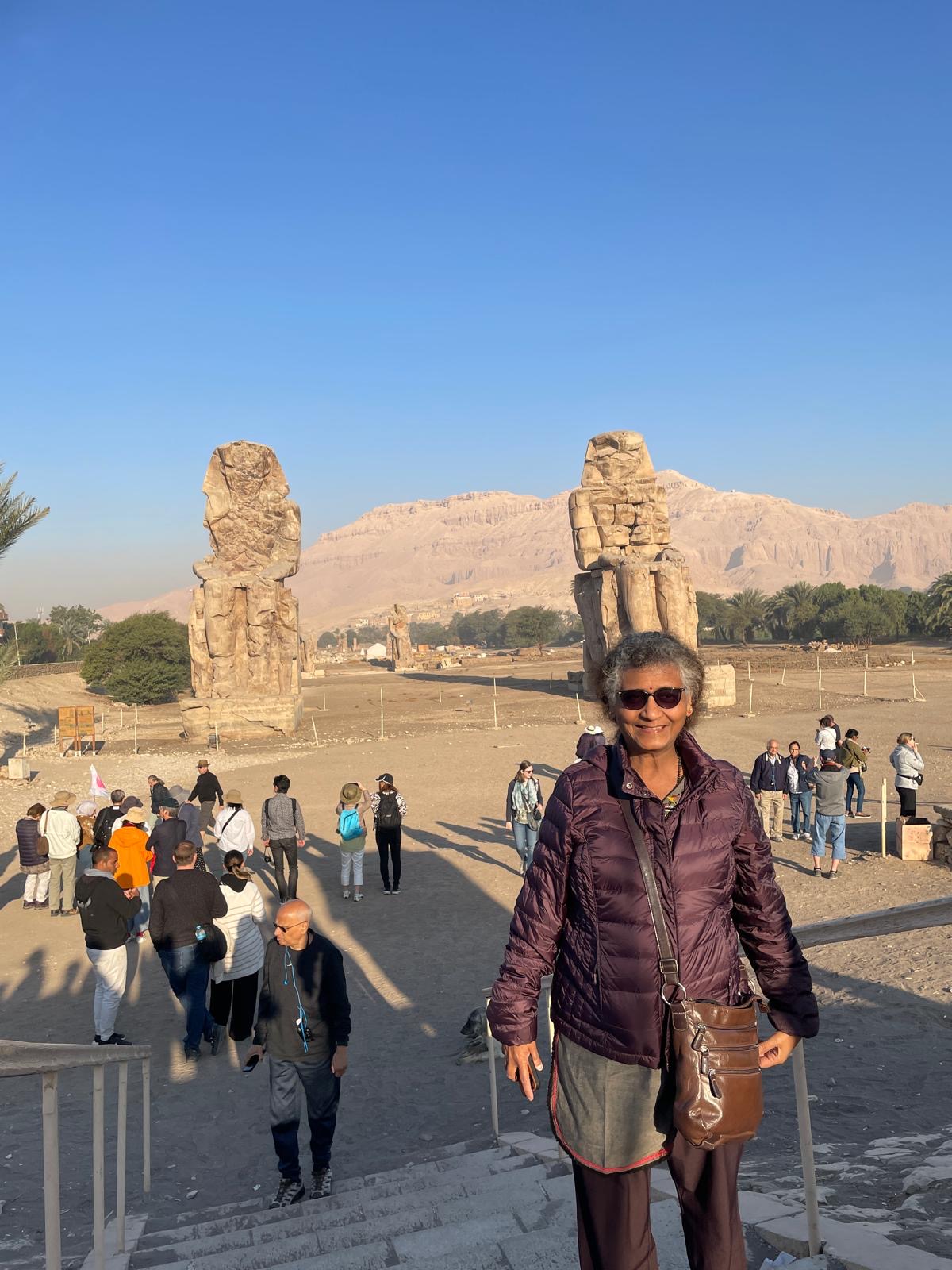
The trip arranged by Gita Travels really fit in so much.  One of the highlights after breakfast the next day was the visit to the Valley of the Kings, including the tomb of King Tut.  Some of the more adventurous ones had decided to take a hot air balloon ride and we picked them up at a spot which also had some collosal statues.  This was a 45 minute ride.

The high mountain of the Valley of Kings, inside a tomb and outside the tomb of King Tut

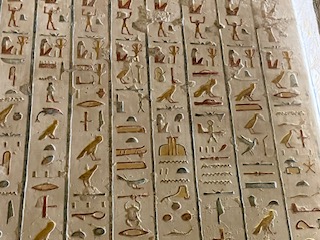
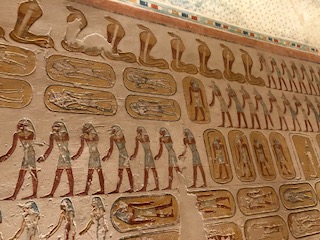
At some point in time, instead of building pyramids for kings, they decided to bury them in tombs on the mountainside. One exclusive area was this valley where the soft mud was conducive to digging.  We went into two caves as recommended by our guide, including that of Ramses 4 and 9. The walls of the cave were well built with amazing carvings and colored hieroglyphics on the wall.  The tombs themselves had been raided many times, the riches stolen in spite of guards posted. But they were still worth a visit. Mummies had been removed to other locations. Apparently, King Tutankhamun’s tomb was discovered untouched by British explorer Howard Carter in 1922.  It was not seen earlier as it was right under another King’s tomb and discovered accidentally.  When the young King’s golden mask was pried loose, his mummy suffered damage as did the rest of his body.  So it was treated and left back in the tomb, bereft of the priceless fineries, thought to be over 5,000 in number. The 18 year old king, worshipper of the Sun god, Amun,  who was estimated to have died in 1327 BC had been found in a triple sargophagus, one inside the other, all gold painted.  Many fascinating facts about King Tut as he is popularly known now, can be found on the internet.  There was a separate charge for entry to his tomb. Some of us opted not to go.  However, those that went not only “saw” his mummy (his face could not be discerned by the pictures) but found the artwork in the cave to be fabulous.  Fortunately they brought back some pictures for us to see:

Beautiful wall paintings in King Tut’s tomb. The sarcophagus and his mummified body. Note that he was identified by the cartouche(s) on the walls. Photos by kind courtesy of Jayanthi Raghunath

We had to reluctantly leave the the Valley of the Kings because there was another location awaiting us, the temple of Queen Hatshepsut.  As it was a long walk to the actual tombs, we were transported in an open buggy that saved time and effort.

The Temple of Queen Hatshepsut, her statues outside depicted with a beard

This was undergoing mega renovations and re building thanks to a Polish group we were told.  The outside façade was very impressive and it had several levels.  The beautiful Queen born in 1508 BC and was depicted in several statues.  She ruled with her own power after marrying a stepbrother who inherited the throne. After his demise her stepson who was a toddler ascended the throne.  Hatshepsut was appointed regeant.  She became a self appointed Pharoah. She ruled for over two decades, wearing a false beard and manly attire as was required.  Though married, she is said to have an affair with her architect who is reported to be buried on the land occupied by her temple.  Her story is certainly impressive among the queens of Egypt.

So much more was yet to be seen as we sailed along the Nile.  Meanwhile we had some entertainment too from hawkers who pulled along the ship in small boats and tossed their fabric wares three stories high with perfect dexterity and their customers examined them and paid them or tossed them back.  It was fun and the hawkers made their money with a little help from some of the friendly customers who facilitated their sales, like our friend Rekha.  She proved her dexterity by understanding their system and throwing them money wrapped in their goods with perfect precision!  In the end the fair minded hawkers gave her a hefty discount!

You can see Jayanthi, Shamla, Chandra, Rekha and Raji

In the interest of not cramming too much into Part 1, I will conclude here.  Please enjoy the pictures that tell half the story.  The best is yet to come — our visit to the pyramids which was saved for the end. If you wish, you may leave a comment on this blog. Thanks for reading.

A Visit to Amsterdam to see Tulips!

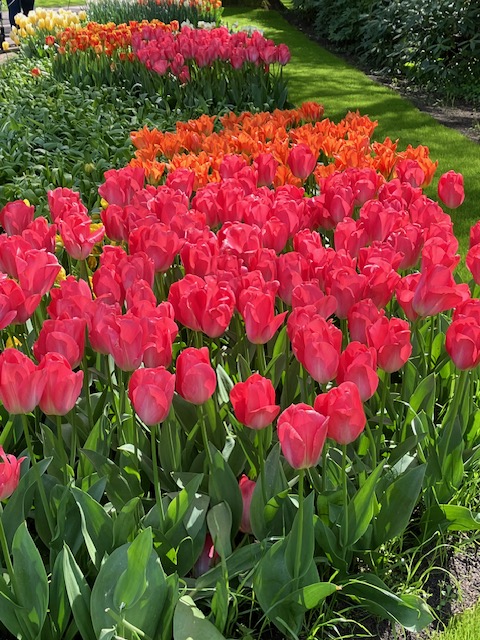
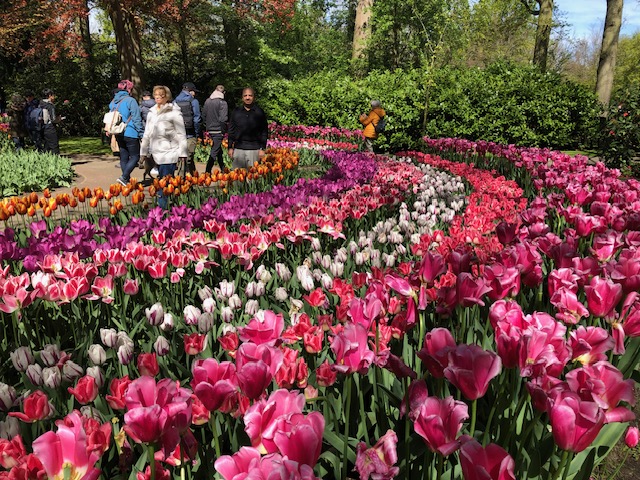
     Does anyone go abroad just to see a garden?  Well, we did.  We flew from New York to Amsterdam for four days mainly to see the world famous Keukenhof Gardens in the outskirts of the city.  It is well known worldwide for the cultivation of tulips and Shankar had actually seen it during his work-related trips to Europe decades ago.  Knowing my love for scenic places, he decided to take me there.  It is known as the Garden of Europe and one of the world’s largest gardens.   It was a sweet treat and a retreat!

     This was our first trip where we did not use the services of a travel agent and winged it on our own.  It did need a lot of pre-planning.  Firstly, the flowers are in peak bloom only a few weeks in the spring and we wanted to go when the weather would be half-way decent too.  In general spring and rains go together so we tried to go in the third week of April and kept our fingers crossed.  Lucky for us, only one day out of three was rainy and we had picked museum visits for that day so it worked out fine.

     We also had to do all the bookings ahead of time for the little trips to the countryside and boat rides as things get filled up in the peak season.  But it was nice that the city is very tourist friendly and allowed cancellations 24 hours ahead.  We actually booked for the garden viewing on two different days in case it was very rainy but closer to the trip we could see some sunny forecasts for our original day planned and cancelled the second one.  Weather too changes frequently and rains are brief.

     Taking an overnight plane from New York we arrived at the  Amsterdam Schiphol airport pretty early.  We took a cab to the hotel we had booked ahead, the Novatel.   Most hotels in downtown Amsterdam were historical (read old) and no matter how much they renovate trying to retain the old-world charm, we tend to be partial to clean and modern.  On the plus side, the city transport system was so good and convenient.  We had made sure the subway was close to the hotel and got a pass for the four days.   In fact we used a cab only twice to go from and to the airport, using the trains and even a tram once.  But a word of advice to the novice.  If the QR code is printed on a piece of paper it does not always work.  We finally tried using the one on our phones.  One has to scan when entering and exiting the subway.  Only once we got assistance as all stations are unmanned!  After putting our luggage in the storage room, we had a bite to eat and were ready for our first day of sight seeing.

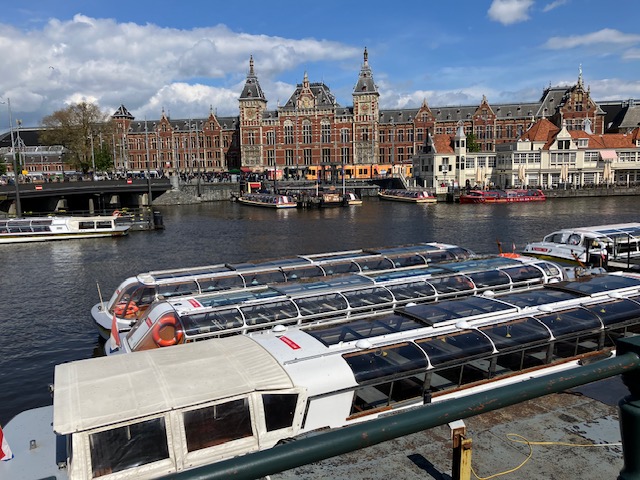
     We reached the Central Station in Amsterdam well in time for our 2 p.m. tour.  Located very close to the banks of the River Amstel, it was a beautiful scenic spot where many roads intersected and people could stroll along the canal and on a sunny day enjoy the sight of small boats.  Incidentally Amsterdam is a city of canals and interestingly the Dutch East Indian company contributed to providing funds for the improvement of the city, more on that later!  We just walked around and had hot chocolate and croissants at a sidewalk café.  Our tour was supposed to be a small group and we were told to look for the orange umbrella outside a named hotel, but there was none to be seen!  Just five minutes before the given time, lo and behold a lady walks out of a van with a large orange umbrella, something I suspected would happen!  Four other tourists were our travel mates for the afternoon.  Two did not show up.  They were all from the US.  Two older sisters who always went on vacations together and another Indian couple.  We all got along well and chit chatted on our way to see the sights.

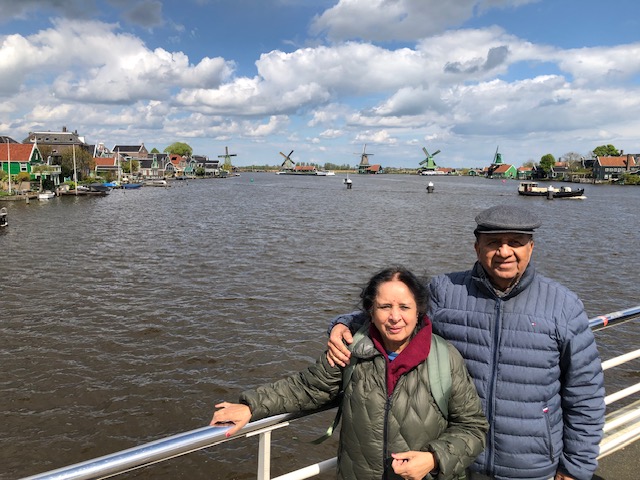
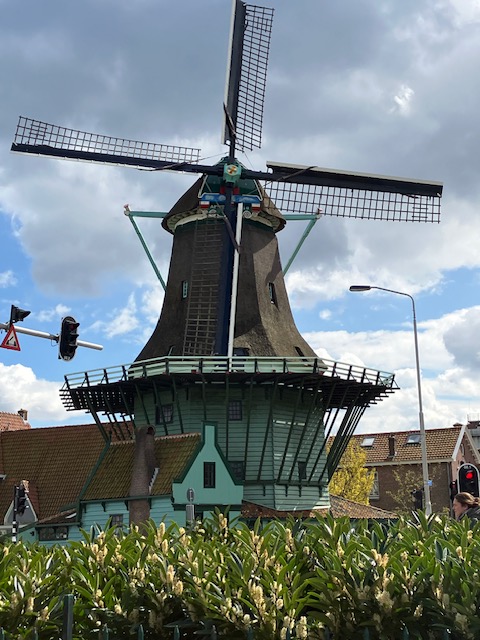
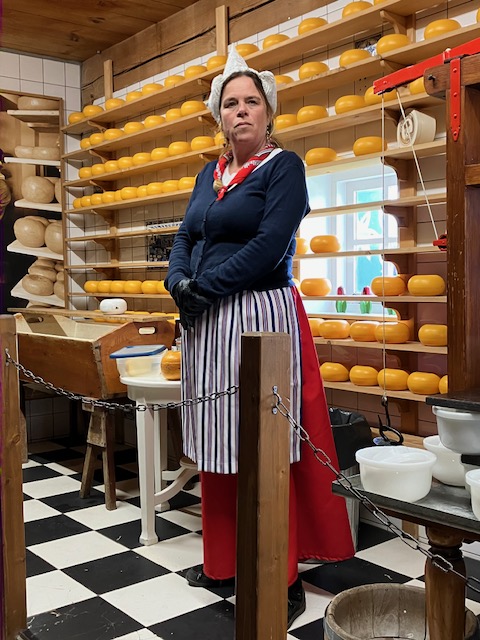
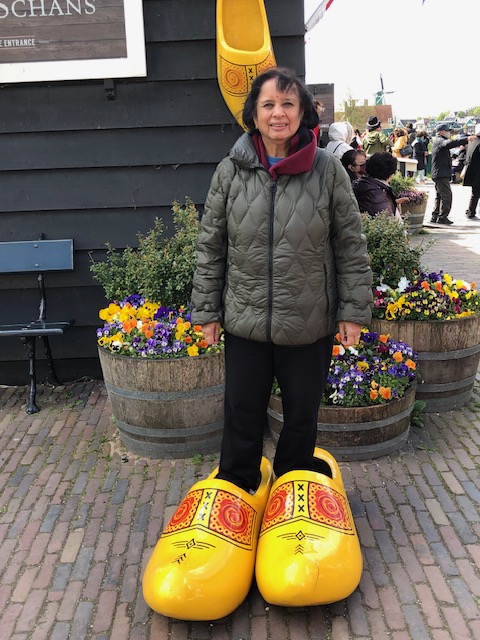
     Though the sights were all around some original old windmills and other demos were  bunched together for convenience at a scenic place known as Zaanse Schans, we got a lot of information and enjoyed the demos.  It was about a 45 minutes drive north of the city and very scenic being located near a lake or reservoir.We could enter an old windmill to see how it worked, saw a demo of how clogs (wooden shoes) were made and got details on cheesemaking.  The windmill we saw had actually been used previously for breaking up stones and was still in use.  One could climb up to a balcony close to the blades, but the climb was too steep and the area very windy.  Wooden clogs were made of a very soft wood and the craftsman demonstrated this with his lathe.  These days it was partly done by machine and partly by hand.  A lot of water was also used in the process.  Surprisingly, we were told that clogs are still used as footwear in rural areas and farms and are pretty durable.  The painted ones were lovely with bright colors and we viewed some special ones used by the bride and groom at weddings.  Last but not the least, a partial glimpse into how gallons of milk are curdled and churned in a big vat to make cheese.  The main attraction here was the sampling and purchase of Gouda and other cheeses, some flavored with spices like cumin and red chilli flakes.  They made a good gift for family back home.

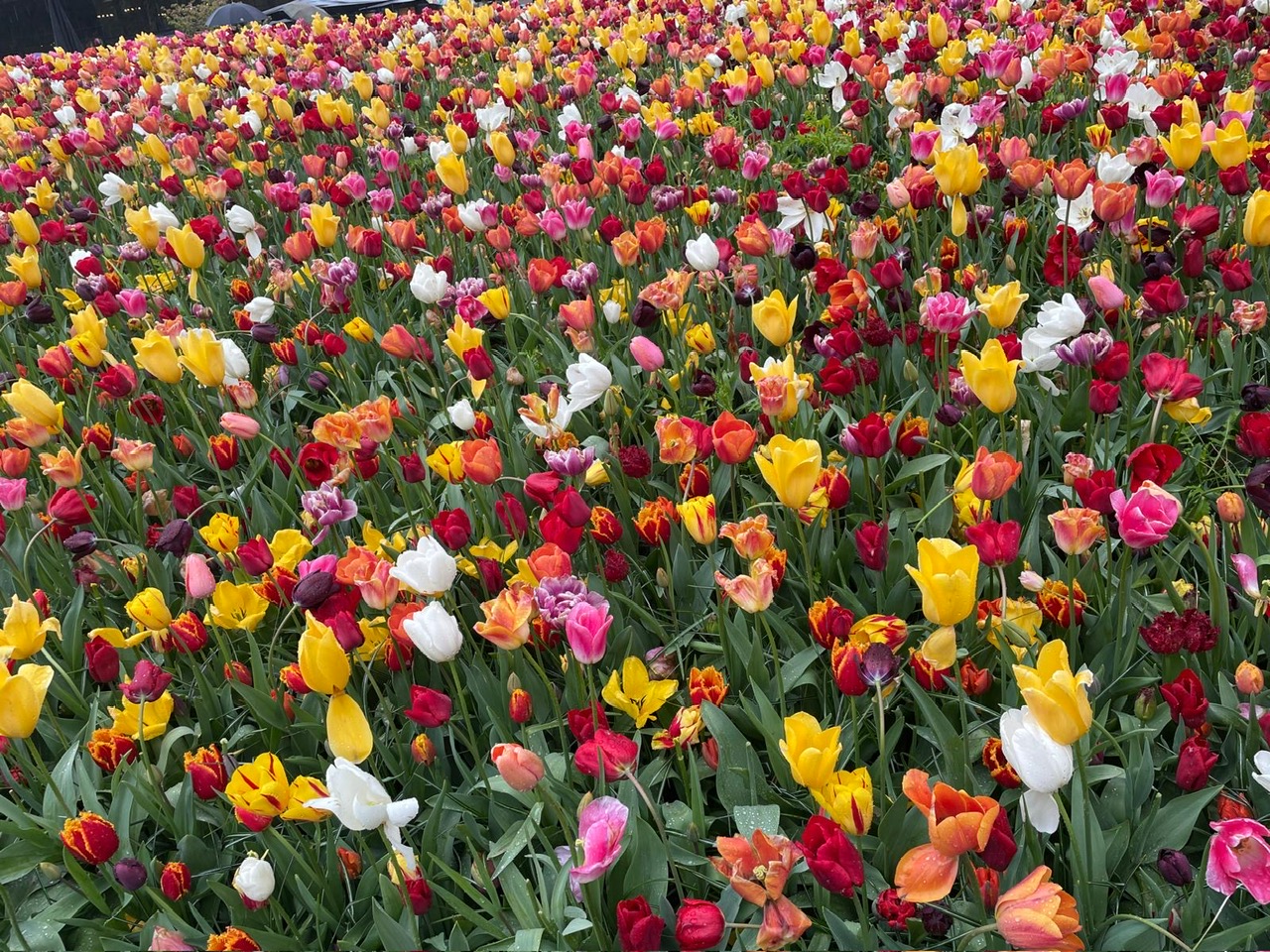
     After we were brought back to Central Station, we decided to eat dinner back at the hotel.   We headed back by train and decided to eat some freshly made pizza at the dining room.  It had been a long but satisfying day in Amsterdam.  We had signed up and paid extra for the breakfast each morning and it was totally worth it.  There was ample choice of items both hot and cold and the croissants we squirrelled away in our backpacks sufficed for a quick snack lunch followed by coffee or ice cream.  The next day was our big day at Keukenhof garden and we made an early start, once again catching the train to the departure locality.  We also had to take a short ferry ride to reach the location from where our bus was leaving.  On arrival, we found many orderly lines but the organizers were quite strict about the bus bookings as it was peak season.  The ride was almost an hour, but the countryside scenic.  Closer to the gardens, we saw fields of tulips in rows of single colors that made a lovely tapestry on mother earth.  We were glad we had booked a canal boat ride later to see these fields up close.

     Lets get some facts about Keukenhof gardens for it is highly impressive!  The actual meaning is “kitchen garden” as it was originally used by a countess residing in a castle.  Later another countess had it landscaped to grow flowers.  As of 1949, a consortium of bulb growers and flower exporters have been using it to showcase their products and support the export industry. Each autumn, over 40 gardeners plant 7 million bulbs, donated to the park by over 100 growers.  The flower beds are arranged in such a way that there are blooms throughout the 8 week period when visitors come. A staggering 1.5 million visitors come from around the world when statistics were recorded for 2019.  A word about the tulip fields, they can be viewed from the height of the bus on the way to Keukenhof.  We had done our homework, so we got a closer look when we went for a boat ride along the canals bordering these fields.  Apparently, they are grown for flower export but the just to see thousands of blooms of a similar color like red, yellow or pink is such a privilege.  We were so glad to have booked that 45 minute boat ride.  Another interesting visit we were told was the flower trading market in Amsterdam.  Large scale flower sales happen, bouquets can be bought as also bulbs for replanting.  These have to be certified and approved by the country they are being taken to.

     About the garden itself, what can be said?  It far outpaces our expectations.  The exotic colors pleasingly put together to form the most eye pleasing combinations, the burst of rare and unusual shades, the sea of healthy blooms bordered by smaller flowers.  Words definitely cannot describe this amazing sight.  Maybe photos may do some justice.  It was not a tiny area either, they are estimated to be on about 80 acres, taking easily 2-4 hours to have a good viewing.  Suffice to say, there was no shortage of blooms.  It is said that in each spot, three bulbs are planted at different heights in the soil.  When the topmost plant is done blooming, the second one is ready to bloom!  What precision to keep the viewers happy!  We walked around without realizing how many hours had gone by.  The entire garden was very pleasingly landscaped with small lakes, trees with overhanging branches, large patches of velvety green grass.  One could go up close to the flowers and enjoy them and take pictures.  There were no major restrictions or barriers.  Of course everyone was mindful.  There was a long walkway with flower patches on either side, vying to catch our eye.  By the canal where the boat rides were happening, there was a windmill too adding to the quintessential Holland look. The boat ride itself brought us close to the fields.  It was the experience of floating amidst the tulip beds or literally fields of the same color.   The canal went all around the beds and brought us back to the garden.

 Though the garden raises funds through tickets and by leasing out of food stalls, we were struck by the lack of eating places cluttering up the area every few feet as is often seen in parks in other countries.  In fact there were only one or two such areas and the ice cream we had was delicious.  One other item of note was a different but equally exotic flower variety filling up a greenhouse.  The orchid!  Every single plant had lovely strands of flowers of different colors and there were numerous pots.  For a plant that is very hard to grow, the effortless ease at which this was being done was nothing short of remarkable!

Taking our hour long bus ride back, we reached the city and set out in search of Gandhi restaurant and found it on a main road a short walk away,  but through some unsavory entry ways!  Given the heavy non veg menu, we really wondered why it was named after an ahimsa saint!  But we were satisfied with the Indian vegetarian fare served, the naan being quite fresh and authentic.  Our main purpose of seeing the beautiful tulip gardens had been successfully completed.  We had one more packed day left to complete our sight-seeing.

Our last full day had been dedicated earlier to museum visiting.  Fortunately we had bought all our tickets online.  As we stood on lines, we often noticed the “sold out” sign being put out as they did not want overcrowding.  In fact it was funny to watch a young man trying to get in.  After trying to convince the pleasant young lady in charge at the entrance, he requested to go into the coffee shop.  Seeing through his crafty plan of sneaking in via the cafeteria, the lady politely directed him to a  coffee shop opposite to the museum!  Amsterdam is full of various museums so we had to pick and choose.  The most popular were the Rijksmuseum and the Van Gogh museum.  Our tickets went with ear phones that described the numbered paintings on the wall.  Rijks (pronounced Rikes) had a  variety of paintings and a few sculptures on display, some very large. 

There were many floors to be covered.  Those who are in the art circles know that Dutch painters like Vermeer, Van Gogh and Rembrandt were superbly talented and world famous.  For some the fame came after they passed away.  Painters were encouraged and recognized even in their day.  Van Gogh museum featured not only his famous paintings but also his life story and many self portraits over a period of time. His full name was Vincent Willem van Gogh (March 30 1853 to July 29 1890). His works were prolific, he created over 2,000 works of art.  He is said to have contributed to “expressionism in modern art”. He also observed peasants and laborers and tried to depict their life in paintings.  He did several self portraits, Shankar can be seen posing below with one. He was not always mentally stable and even had to be hospitalized and ultimately ended his own life.  His brother Theo, with whom he was very close, promoted and sold his works during and after his life. After the intense visits to the two museums, we were secretly happy that we had not decided to do the Anne Frank museum as well!  As many know, Anne wrote a famous diary about her family’s imprisonment during Nazi times.  The house happens to be in Amsterdam and was converted to a museum. 

Though it was raining a bit off and on, we managed to reach the dock with the canal boat ride departure.  Luckily it had a covered roof and we could view in comfort without getting wet. The Dutch canals known as “gratchen” are said to run for about 100 kilometers with 1,500 bridges traversing them. It is estimated that there are 165 canals. They are said to form concentric circles or belts around the city.  The original ones were built in the 16th and 17th centuries.  Originally they were dug for water management and defense.  They also greatly helped in the draining of the swampland and are monitored by engineers even today.  Later they came in use for transportation of goods.   Today the tourists mainly use them to get a view of the city.  In fact a humorous side to the canals is that the lifestyle of the people over the decades was pieced together from the junk that was found at the bottom of these canals.  To us Indians, a smile came to our lips when we heard the commentary that Amsterdam was a poor city till they started the trade with India after they formed the East India Company. This wealth facilitated the building of more canals.   But the smooth and pleasant boat ride did make a great way of sightseeing the city.  Initially we had planned a night ride, but decided we could see more in the day.  It was true.  We passed by many pretty painted homes and buildings, some termed “monumental”, right at the water’s edge.  We passed under many bridges too. 

The icing on the cake was our dosa dinner at Saravanabhava which was a bit of a walk.  But after a nice meal we were unable to connect with Uber.  Our signals did not seem to go through.  A friendly young Indian couple who had finished dining and  who lived locally helped us to find a nearby tram stop and using our pass we were able to get back to our hotel very soon.  So those were the four packed days we spent in Amsterdam.  Really worth it!  A word of advice, try to go in tulip season and book it all ahead!

.

Cambodia and Bali Noteworthy Temples

Visit to Vietnam, Laos, Cambodia and Bali

November 2013

The Moat around the Ankor Wot complex

If so far our travels had been adventurous, Cambodia brought us to the doorstep of awe inspiring.   One hears a lot about ancient wonders and even sees pictures, but being there is very different.   It always turns out to be eye popping, grand, larger than life  and imprints on the memory like nothing else.   So it was with Cambodia, it was not just Angkor Wat, there were so many unique and amazing temples within short distances.

To me the strange aspect was the lineage of the rulers; did they came from India, quite far geographically or were they just influenced by the Chola kings?  No one knows as the meagre information was gathered from inscriptions or travelers who wrote notes.   We can be justly proud of these rulers who managed to perpetuate dynasties for centuries and more remarkable, left distinctly Hindu architectural marks that the world can continue to appreciate for centuries to come.  As with many migrations, trade via the Malay peninsula could have been the catalyst that motivated the dynasty to be so much under Indian influence.

To go back in history for a moment, the building activity was at work from the 9th to the 14th centuries.   It hit the peak in the  12th century during the reign of Suryavarman II.  His ancestors, notably Jayavarman II and earlier emperors, ruling from the 6th century had consolidated several areas of the Mekong and moved the capital to the present area of Angkor. However, by the 15th C, the thriving Angkor had become a Forgotten City, cleaned up and  revived  by benefactors, notably the French and now surprisingly, India which is participating in a restoration  project for one of the temples.  Angkor Wat had been used as a Buddhist monastery in the later years, but now it is basically a tourist attraction only.

IMG_0267

Amazing Angkor Wot

To list a few unique qualities of Angkor Wat (the second word means temple), it is considered one of the largest standing Hindu monuments of the world.  The complex occupies 250 acres, fully surrounded by a moat still filled with water.   It has several entrances, each designated to permit passage according to the seniority or rank of the people.  Built at three levels with interconnecting stairs outdoors, it aspired to imitate Mt. Meru, the abode of the Gods.  Its levels, angles and construction is perceived to be perfect in respect to the sun, planets etc. as is often the case with edifices built in India.   It is considered  based on Dravidian architecture.  But this was built at a time when manual labor, metal tools and simple mechanical devices was all that was available to the builders.   Everyone in the country was put to work, it appears, as stones were hauled from distances.   Without cement, the guide pointed out to us, the blocks were placed so close together and so aligned that even rain water could barely get through.  There has been conjecture as to why it faced West and one explanation or guess has been that the emperor’s remains were buried within, East being the auspicious direction.

We did not see the famous Angkor till the morning after we arrived and had a relaxing night of sleep in the luxurious Grand Soluxe Angkor hotel at Siem Reap. The hotel was beautiful with a huge lobby, a lovely girl playing a soothing instrument to set the mood.  The grounds with the lotus lake were charming for a morning walk. The day of arrival from Thailand was used to take us around to a handicraft center, a wax museum depicting various scenes and people like the Emperor and his consort sitting on their thrones.   Next was the inevitable viewing of the atrocities of the civil wars and the skulls and bones were stored in a glass case at an exhibit garden known as Wat Thmey or the Killing Field.   On the way out we saw some young monks enjoying activities in the noonday sun.  Our next stop was some beautifully maintained gardens inclusive of miniatures of the city.   We were duly impressed with the huge wall fresco of Buddha in a reclining pose.   The same garden provided us with our evening entertainment.   By the time we slowly sauntered over, the good seats were all gone and some of us had to plop down on the hard floor.   But the slow dancing and the play acting spread over two huts with pretty damsels in ethnic clothing climbing up and down, chased by local youth, was quite entertaining.   We ended the day returning to the hotel after a nice dinner.   The distances in Siem Reap were much less compared to Bangkok and afforded us some relaxing time.   However, though we passed by dozens of foot massage parlors, it was almost the last day before we had time to actually try one!  We did enjoy some meals at the Currywalla restaurant, items that were almost homemade in taste and topped off with rich and creamy yogurt.   The other Indian restaurants were mediocre.


The next day was dedicated to Angkor Wat and other temples.   We spent the whole morning at Angkor and continued to be surprised by its size and grandeur and amazed by its carvings.  As we walked over the Rainbow bridge, we admired the super long naga  (snake) balustrades and the lion guardians of stone.  Inside, a small man made  pond reflected the ancient structures and enticed the photographers to pay an early morning sunrise visit the next day.  Inside we found a bare statue here or there of a large sized Vishnu draped with decorative cloth.   Other statues had been pilfered over the centuries, but not necessarily destroyed.   In any case only us diehard Hindus from India want to cram every available inch with our variety of gods.   The building itself inspired wonder, not necessarily reverence.  It felt more like one of our Indian forts. The smooth and detailed bas relief carvings on two extra long walls evoked amazement for their detail and beauty, still very well preserved.   One was dedicated to the Mahabharata and other to the Ramayana with Vishnu incarnation stories woven in.   Notable among all this was the churning of the seas with the snake with Shiva and Vishnu in attendance.   Devas, asuras, the Kurma avatara, the battle scenes, chariot with Krishna and Arjuna and also the pleasures of heaven and travails of hell, the valors of Hanuman, all this and much more could all be found.  One would need several days just to examine and admire these carvings, especially by us Hindus who are familiar with the epics.   At several points in the complex, the view from the elevation was serene and beautiful.   Commercialization had been kept out completely inside the complex and the restoration was tastefully done.  We explored several galleries, both inside and outside in the courtyard.

Angkor Thom, Bayon and the Tribhuvana

Reluctantly we said goodbye to this world heritage sight as there was much more to see around Siem Reap. As Shankar aptly commented, the Brihadeeswarar temple in south India was built a bit earlier in the 11th  century or so,  but because it continued to serve the local people as an active temple, it never went to ruin. We visited next a temple with huge faces in four directions, the Angkor Thom, built with blocks of stone  with an impressive avenue of asuras and a yali (lion) guarding the outside.  At Bayon, similar with large stone heads,  the expression on the faces was amazing and we could climb to the upper levels to see at close quarters.  The temple  indoors had a linga from bye gone days, now just an architectural memento.  This temple was more in disrepair with huge piles of fallen stones outside.   On the outer walls were more beautiful frescos detailing daily life events, including a mother giving birth, , armies on elephants.  Then there was the Bante Srey built by King Rajendravarman in the 10th century, before Angkor.  It was the only one with pink sandstone with good detail to the carvings.   Here the “tribhuvana” or three gods, Brahma, Vishnu and Shiva were celebrated in olden days.  Beautiful archways with intricate carvings,  a three headed elephant and even Shiva riding a Nandi,  was depicted.

In order not to let the temples befuddle our brains, our guide next took us to a landmine museum. It was a one man project founded by Aki Ra.   Besides the pictures telling stories of unfortunate victims there were remnants of the landmine pieces displayed.  Volunteers are still removing these dangerous hidden missiles that maim rather than kill and innocent children playing around are often victims.   Our group was quite fascinated by the details and chipped in donations toward the work.   We also visited the Bantey Samrai temple where lovely carvings of Vishnu and Gajalakshmi on the door and many “prakarams”  impressed us.

On the return trip, as dusk was fast approaching, we were led into Bapuon complex which we totally mistook from the outside to be something small.   It was actually humongous, a huge fortress, layer upon layer of stones.   Now the jungle is fast taking over.   We did not even attempt to climb the upper levels  in the fading light, but wandered around the periphery.   An adventurous few attempted to climb a steep and open stairway (to the heavens?) while the rest of us stood down and prayed for their safe return!

Ta Prohm, Amazing nature and Architecture

Last but not the least, the following day, we visited the temple of Ta Prohm where nature and man have unwittingly co-operated to produce a fantastic effect.  Here literally the huge and curvy trunks of trees have squeezed themselves into the stones without knocking them over,  leaving the tourist to gape in wonder.   The trees were also huge, the trunk of one like a cave carved out, a good photo opportunity to stand within. We could see many Indian sign boards announcing in Hindi and English, the co-operation by the two countries to restore parts of the temple that were more in ruins.   We enjoyed wandering around, spotting heads of Buddha or Hindu deities within the roots of trees.

IMG_0392
The trees as impressive as the temple!

One project that had enticed many of us was the visit to Kbal Spean where carvings were to be seen in the river bed and waterfalls and this was supposedly a difficult but adventurous trek through some jungles.   For better or worse, we will never know, our tour operator decided to take us to a different place on the same mountain eliminating the trek,  which many in our group could not have taken.  The viewing here, though different, was nevertheless very exciting.  With the weather being warm and sunny, it turned out to be a very pleasant excursion. We took the long drive to the Phnom Kulen mountain.  The area is known as Srah Damrei at the peak, the bus went all the way to the top.  We were told that the kings often visited the spot and had coronations and important ceremonies there due to the lingas in the river sanctifying the place. Water from the river is used in worship and it is also said to produce good crops as it flows over the sacred carvings.

Lingas in the river at Srah Damrei

We were quite surprised by the amount of the very small lingas enclosed by stone squares that had been carved in the river bed at various spots, literally thousands.   Depending on the light, the visibility varied.   A  girl helped us by drawing a picture on the sand of the reclining Vishnu and Lakshmi carving on the river bed.   It is more visible in the drier seasons when water flow is low, we were told.  At a different spot that we could reach by bus, we were able to actually step into the water and walk around a rope cordoned area in the river bed to clearly view another reclining Vishnu with a lotus stalk coming off his navel,  Brahma seated on top of the lotus and Lakshmi at his foot.   It was exciting to walk around in the flowing current, ankle deep in water.   Some of our group also found a waterfall and viewed that as well.  Kbal Spean was located on another tributary of the river, we were told,  with its origins from the same mountain.


The trip had gone so well, but one incident that made us very sad was the fact that our dear friend and tour organizer, Lakshmi, fell at the hotel in Siem Reap and broke her ankle. Others had taken falls too, but with no broken bones.  She had to leave the next day for India, missing the entire Bali trip.   We were just happy that she was well cared for by the docs and others in our group and received good treatment in Mumbai as well.  We missed you in Bali, Lakshmi.   On the last night, in Cambodia we made a second visit to the night market in Siem Reap, nearby and also got our foot massages which were wonderful and dirt cheap,  so soothing after all the walking we had done.   We were all quite satisfied with the shopping as well; all the men got white shirts with button necks and the women got printed pants and white gauzy shirts, a typical reminder of all the countries of the Far East.   Our trip concluded with a long boat ride on a fresh water lake 140 km long, the Tonle Sap, which connected to the Mekong river.   The sunset cruise was relaxing and scenic.

Reaching Bali

That leaves just Bali!   Well getting there was not a fun experience.   We left Cambodia in the morning and after many hours of delay reached Bali only at 9 pm thanks to the disorganized airline, Air Asia.   Then to find out that our luggage was only arriving on the next flight!   Fortunately the organizers made sure that the staff at the Indian restaurant waited  till 11 pm to serve us dinner.  Throughout the Bali trip, we got very good food from a chain restaurant Queens Taste of India, and the south Indian chef gave us personal attention and lovely treats like masala dosa, pani puri and the all time favorite, yogurt rice with pickles!

The resort in Bali was located at the south end of the island and reached by a 12 km bridge each time we went in or out. This did prove to be very time consuming and we missed out by not being closer to the main areas.   However, the Nusa Dua resort and beach was gorgeous.  Every morning we could walk on the pristine beach.


We were served free cappuccino made right there!   We just wished we had more time to enjoy the resort, but it was the same story every day, get up early, eat and out for the whole day!   The foggy and rainy weather also prevented us from viewing the volcano and lake; though we made a two hour drive each way, we could not see a thing in the Kintamani area.   We did end up at a coffee “plantation” where we learnt about something really strange.   The Lawasa peabury coffee bean is used to feed a mongoose (Civet per internet) comes out undigested, is cleaned and roasted, ground and made into a delicious (???) cup of coffee, we were told!   Who came up with this unbelievable process was not revealed! Was it even true??  We tasted other flavored coffees.

Kecek musicians and dancers

Memorable among the visits in Bali was the one to the Uluwatu temple on the mountain where the Kecak dancers and about 50 musicians entertained us with depiction of parts of the Ramayana and their sole instrument was their mouth, they made a constant chak chak sound with it with both hands raised.


Some of us opted out of the long drive to view another temple on the beach at Tanah Lot and instead enjoyed the beach and resort and local shopping.   In Bali our disappointment was that the drives were long distances through heavy traffic and for one reason or another we missed the good views.   The town seems to be over commercialized as well and we drove by rows of stores making batiks, wood furniture and carvings all for export.   The temples themselves had no idols, the people were just very well informed about the Hindu gods and incarnations.  We saw several beautiful temples which drew in the local people to a silent retreat in serene and lovely gardens with high, empty pedestals.  They seem to shun idol worship, although we saw many gardens in private properties decorated with Ganeshas and other Indian gods.

Our shopping was a disappointment too, we made a time consuming outing for silver jewelry to come back almost empty handed.   Seems like we missed the main ethnic shopping in the Ubud village.  Other curio items available seemed to be of a much inferior quality compared to workmanship of Laos or Cambodia or even Thailand.


Soon the long and adventurous trip of almost three weeks came to an end with everyone catching different flights to different destinations, but the memories will stay with us.